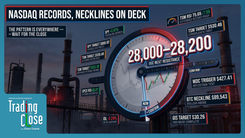

My Trading Game Plan Revealed - 04/22/2026: S&P 500 at Multi-Year Resistance, Oil May Spike Above $100, Semiconductor Melt-Up

The financial markets are currently presenting one of the most fascinating psychological and technical disconnects in recent history. Despite escalating geopolitical tensions and significant supply chain disruptions, equities continue to show remarkable resilience. In this morning's My Trading Game Plan show, Gareth Soloway, Chief Market Strategist at VerifiedInvesting.com, provided a masterclass in separating emotional narratives from pure chart logic, revealing critical setups across equities, commodities, and cryptocurrencies.
Today's analysis dives deep into the technical structures driving the S&P 500, the ominous setup brewing in the oil markets, and the psychological discipline required to navigate an earnings season fraught with parabolic moves and hidden traps.
The Geopolitical Disconnect: Why the Market is Ignoring the Headlines
The macro environment is currently dominated by headlines that, in a different era, might have sent equities into a tailspin. Yesterday, following the closing bell, the President unilaterally extended the ceasefire, citing that Iran lacks cohesion. This "Taco Tuesday" announcement initially caused oil to pull back, while stock market futures ripped higher.
Even more remarkably, overnight news that Iran fired on three ships failed to dent the bullish momentum. Stock market futures remained elevated, signaling a profound belief among market participants that the administration will avoid any actions that could exacerbate inflation or disrupt the U.S. economy.
This psychological phenomenon isn't without precedent. As Gareth pointed out, investors are drawing direct parallels to April 2025. During that period, the President threatened massive tariffs, only to walk them back significantly. The stock market bottomed on that fear and proceeded to rip higher for the remainder of the year. Investors, suffering from the FOMO (Fear Of Missing Out) of that previous rally, are now clamoring to buy every dip.
Furthermore, the market is actively ignoring severe supply chain warnings. The Strait of Hormuz blockade is directly impacting the transport of critical components to Taiwan—the global hub for semiconductor and AI chip manufacturing. Yet, the markets continue to push to new all-time highs. Why? Because U.S. corporate earnings remain robust, and a specific segment of the economy continues to drive massive consumption.
"…the top tier, the ones that are spending, the ones that are flying first class, the ones that are buying the luxury items, they are still loving an all-time high stock market and spending like drunken sailors," Gareth explained. Until this earnings strength degrades or the top-tier consumer pulls back, the broader market is perfectly content to ignore Middle Eastern conflicts.
The S&P 500's Historic Parallel Channel
To understand the current market structure, we must look at the long-term technical architecture of the S&P 500. The index is currently respecting a massive, six-year upper parallel trend line. This channel has defined the market's boundaries through multiple cycles, capturing the COVID low, the bear market low, and the recent liberation sell-off low.
Recently, the S&P 500 hit the midpoint of this parallel channel—a level Gareth identified as a "buy with both hands" zone. The resulting bounce was monstrous, blowing past expectations and launching the index to all-time highs. However, this parabolic move has now brought the S&P 500 directly into the high pivot of the upper parallel, mirroring the exact technical resistance seen in 2021.
This creates a critical juncture for investors. While the momentum feels unstoppable, the technical reality is that the index is sitting at a multi-year resistance ceiling. As Gareth frequently reminds his viewers: "The level is the level until proven otherwise."
If the S&P 500 stays at or below this trend line, traders must respect it as a potential major top. If the index breaks through and confirms the breakout, the bullish thesis expands. But until that confirmation occurs, pure chart logic dictates caution at these elevated heights.
Oil's Technical Setup: A Return to $100?
While equities bask in all-time highs, the energy sector is flashing warning signs that could eventually derail the stock market's rally. U.S. oil is currently up fractionally, but the underlying chart pattern suggests a much larger move is brewing.
Gareth introduced a compelling new technical analysis on the oil chart, projecting a potential move back above $100 a barrel in the next week or two. The setup is a classic technical formation. Oil had established a firm support trend line, hammering against it repeatedly. In technical analysis, the more a support level is tested, the weaker it becomes. Eventually, oil broke below this line.
However, markets rarely move in straight lines. When a major support level breaks, there is a high probability of a specific phenomenon occurring: a "retrace to the scene of the crime." This means price will likely rally back up to test the underside of that broken trend line, which now acts as resistance.
A backtest of this trend line puts oil squarely above the $100 mark. While Gareth noted he does not expect oil to surge back to $118 or $120, a near-term push above $100 is highly probable—especially if the Strait remains blockaded and shipping disruptions continue.
This creates a fascinating intermarket dynamic. If oil surges back above $100, the resulting inflationary pressure could be the exact catalyst that causes the S&P 500 to reject off its multi-year parallel resistance and head lower.
The Semiconductor Melt-Up and Earnings Volatility
Earnings season is the ultimate test of a trader's discipline, and the current landscape is providing a masterclass in volatility and technical extremes. Nowhere is this more evident than in the semiconductor space.
The SOX (iShares Semiconductor Index) has staged an unprecedented 39% rally in just 16 trading days. To put this in perspective, Gareth noted that a similar 40% move last year took 25 trading days to materialize. The index is now slamming into a massive resistance trend line that connects previous highs and lows, having rallied from a base of $148.
Despite being historically overbought, the momentum has refused to break. This perfectly illustrates why professional traders scale into positions rather than committing all their capital at once. By inching into a trade, you can weather the storm of irrational exuberance until the mathematical probability of a pullback finally plays out. With major players like LAM Research and Texas Instruments reporting after the bell, alongside IBM and Tesla, this semiconductor resistance level will face its ultimate test.
Individual earnings reports are also providing distinct technical lessons:
Boeing (BA): The stock closed around $219 and rallied to $228 on earnings, a roughly $9 move. However, for a $200-plus stock that was trading at 230 just days ago, this lacks the necessary volatility. Day traders require extreme emotion—fear or greed—to create an exploitable edge. Without it, the risk-to-reward ratio simply isn't there.
GEV: Following a bullish consolidation pattern (an up-move followed by sideways chop), the stock rallied roughly 6% on earnings. Gareth noted a fascinating technical zone to watch, stating he would be eyeing the $1,075 to $1,100 area for a potential day trade short, given the stock's push to all-time highs.
VRT: This stock provided a textbook lesson in candlestick analysis. Trading down from a close of $3.12 to about $3.05, the drop wasn't massive, but the preceding setup was clear. The day before earnings, VRT printed a "topping tail" at all-time highs—a classic bearish reversal signal. The chart warned of downside before the earnings were even released.
AT&T (T): Falling slightly from $25.88 to $25.32 (a drop of 50 to 55 cents), AT&T presents a compelling downside target. Gareth identified a massive gap-fill and pivot-low support zone at $24.06. If the stock flushes down another $1.25 to hit that level, it becomes a high-probability buy zone.
Yields, The Dollar, and Precious Metals
The broader macro picture is further clarified by the movements in currency and bond markets. The US Dollar (DXY) recently pulled back into a perfect support zone. A level that previously acted as hard resistance—rejecting price multiple times—was broken, and upon the retest, it functioned exactly as support should, providing the dollar with a bounce.
The 10-year yield is showing a similar respect for technical boundaries. After inching up over the last day, it hit a precise trend line connecting previous highs. It pierced the line briefly before printing a topping tail and reversing back down to its own support zone. When yields and the dollar respect their technical levels this cleanly, it provides traders with a much more reliable roadmap for equities.
In the precious metals sector, the charts are painting a more cautious picture. Gold rolled over yesterday and remains in a generally bearish pattern, suggesting lower levels are likely before a true bottom is found. Silver experienced a small bounce, respecting the critical $82 per ounce level. If silver can push through $82, it opens the door for a retest of the $92 to $93 zone. However, the overarching pattern remains bearish, requiring patience from long-term bulls. Natural gas, conversely, continues to move up, validating the breakout and rewarding those holding long positions.
Bitcoin's Ascent and the Psychology of Probabilities
Bitcoin continues its relentless march upward, retesting the highs from last Friday and nearing $79,000. For those who have followed the technical roadmap since the $60,000 low, the targets of $80k to $85k remain firmly in play. Gareth noted that once Bitcoin hits $80,000, his stance will shift from bullish to neutral-bullish. If it reaches $85,000, the probabilities strongly favor a significant pullback.
This approach to Bitcoin perfectly encapsulates the core philosophy of Verified Investing: trading is a game of probabilities, not certainties.
As Gareth explained, a top-tier trader aims for a 70% to 75% win rate. This means that out of every 10 trades, you will lose 3 times. Accepting this 25% to 30% failure rate is what separates professionals from amateurs. If you demand a 100% win rate, you will freeze, over-leverage, and ultimately blow up your account. But if you trust the math, you will take a 70% probability setup every single time, knowing the edge plays out over volume.
This requires immense psychological discipline, particularly when managing active positions. It is human nature to put "blinders" on when you are invested in a certain direction. If you are long, you want to ignore bearish topping tails; if you are short, you want to ignore bullish consolidation patterns.
To survive and thrive in these markets, you must wake up every morning and look at the charts as if you have no positions at all. You must let the logic of the parallel channels, the gap fills, and the trend lines dictate your bias, rather than letting your portfolio dictate your logic.
As we navigate this complex environment of geopolitical tension, semiconductor melt-ups, and shifting energy prices, the charts remain the only source of truth. By stripping away the emotional narratives and focusing purely on the mathematical probabilities, investors can navigate this historic market with clarity and confidence.
Trading involves substantial risk. All content is for educational purposes only and should not be considered financial advice or recommendations to buy or sell any asset. Read full terms of service.