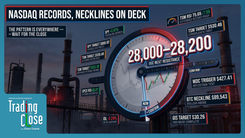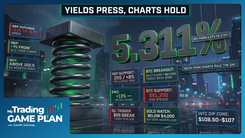

Trading The Close Market Recap - 06/30/2026: Light-Volume Window Dressing Masks Hawkish JOLTS — SMH Leads, Bitcoin Cycle & Commodity Setups

End-of-Quarter Buying Lifted the Market, But Volume Told the Real Story
The headline into today’s close was simple: stocks pushed higher. Drew Dosek’s read was more important than that.
This was not a clean risk-on session built on heavy institutional conviction. It was an end-of-quarter tape, helped by light volume, window dressing, and momentum chasing in the same high-flying areas that have led the market. That does not make the move meaningless, but it does change how traders should interpret it.
When markets rise on thin participation into the end of a quarter and the first half of the year, the first question is not whether price is green. The first question is whether the move has the structure to survive once normal volume returns.
That was the core of today’s Trading the Close Market Review. The indexes remain technically resilient, semiconductors are still the engine of the market, but the backdrop is not as clean as the price action makes it look.
The Green Tape Was Not the Whole Signal
Drew pointed directly to the character of the buying. Markets were bid, but participation was extremely light. SPY had only traded roughly 52 million shares by the late afternoon, which is not the type of volume that usually confirms broad institutional accumulation.
That matters because the calendar is part of the setup. End-of-quarter and end-of-half positioning can create temporary demand for the same stocks that already worked. Portfolio managers want to show exposure to the winners. Momentum names catch a bid. The market looks stronger on the surface than it may be underneath.
That is why this move needs to be judged by levels, not emotion. A light-volume rally can keep drifting higher longer than skeptics expect, but it can also reverse sharply once the calendar effect fades and liquidity normalizes.
The macro side added another layer of tension. Today’s hotter JOLTS data did not support the idea of an easy Fed backdrop. Drew’s point was not that the data immediately overrules the tape. It was that the market is choosing to push higher while policy risk remains alive.
That is the kind of disconnect traders need to respect. Price is still the final signal, but the stronger the market gets on light volume while macro pressure builds in the background, the more important confirmation becomes.
SPY and QQQ Still Have Technical Momentum
The S&P 500 ETF remains technically firm in the near term. The important clue came from yesterday’s narrow-body candle holding directly on the inclining trendline. A candle like that can show indecision, but context matters. In this case, the market tested support near the June 10 pivot area and buyers were there.
That gave today’s move a cleaner technical base.
The next key level Drew is watching on SPY is $750.31. That area lines up with declining trendline resistance and the June 22 pivot high. A clean push through that zone would keep the bullish structure intact, while rejection there would fit the idea that the market is running into resistance after a light-volume end-of-quarter lift.
The Nasdaq 100 ETF is showing the same resilience. QQQ rallied roughly 1.7% and is moving toward a key gap-fill area. If price reaches that zone and powers through, the next test becomes the double-top all-time high area. That level also connects with the lower boundary of a prior inclining parallel channel, which makes it more important than a simple round-number resistance test.
The bigger takeaway is that tech is still carrying the tape. Even after a meaningful pullback, QQQ is already pressing back toward all-time highs. That is not bearish price action. But it still requires follow-through.
SMH Remains the Market’s Risk Engine
The semiconductor ETF remains the clearest leadership tell.
SMH had recently confirmed a breakdown from an inclining trendline, but the last two sessions have almost completely repaired that damage. Today, price pushed into trendline resistance near $659.74 before pulling back slightly. That level matters because semiconductors have been the market’s main transmission mechanism for AI, data centers, and risk appetite.
Drew highlighted one specific scenario into tomorrow: a gap above resistance. If SMH opens above the trendline instead of fighting through it during regular trading hours, the resistance burden is reduced. That can free price to push toward the prior all-time high.
The level for that setup is $665.03. Above that, the all-time high near $671.83 comes into play.
What makes this more important is the failed bearish signal underneath the surface. In the last month, SMH printed both a weekly topping tail and an engulfing reversal candle. Those are not minor warnings at the top of a chart. Yet price is already pressing back toward highs.
That is the market’s message right now. Bearish signals are showing up, but leadership has not broken. Until SMH stops recovering from damage, it remains hard to call a durable risk-off turn in the broader market.
Commodities Are Sending a Different Message
The commodity side of the market is not confirming the same clean risk-on story.
Gold remains technically heavy. It is putting in a doji-type candle while making new lows, which shows hesitation but not yet strength. The daily structure still looks like bearish consolidation unless buyers reclaim resistance. Drew’s key upside level is $4,130. Until gold can break through that area, the more important downside level remains $3,886.
Silver is acting better than gold on a relative basis. It did not make new lows today, and RSI is improving even while price remains pressured. That relative strength is worth noting, but it is not the same as confirmation. The key near-term resistance sits near $61.45. On the downside, Drew is watching deeper support zones near $55.09 and closer to $50 as areas where longer-term interest could build.
Oil is also notable because of what it failed to do. With Middle East uncertainty still in the background, crude has not produced the kind of bounce traders might normally expect. It failed to reach the $75.56 area and remains pinned near trendline support with RSI deeply oversold.
That lack of response is information. If oil breaks down from here, $62.33 becomes the next major support zone, with the $66 area still worth watching because of prior consolidation.
Natural gas remains its own risk category. Drew called it the “widow maker” for a reason. It can reverse violently, especially as seasonal expectations start to matter more. For now, it is chopping after a confirmed breakdown. The downside level to watch is $3.03, while the trendline near $3.37 remains important if price starts to recover.
Bitcoin’s Clock Is as Important as Its Price
The most valuable part of Drew’s Bitcoin read was not just the level map. It was the time analysis.
Bitcoin traders often focus only on price, but Drew walked through the historical cycle structure. From the December 2017 pivot high to the November 2021 pivot high, Bitcoin moved 1,428 days peak to peak. After the 2021 top, it then took 371 days of downside pressure before the next major bottom formed.
Applying that timing framework to the current cycle gives traders a roadmap, not a guarantee. If Bitcoin follows a similar time rhythm, a full cycle low would project toward October 12, 2026.
In the near term, Bitcoin is still consolidating bearishly on top of the prior pivot near $59,362. A breakdown below that level opens the door to $53,800. Below there, the larger head and shoulders structure still points toward a measured move near $37,508.
The psychological level is just as important. Drew noted that a move below $50,000 would likely draw attention from both institutional and retail buyers. That does not mean $50,000 has to be the bottom. It means the character of the market may change once Bitcoin moves into that zone.
Single-Stock Reads: The Charts Are Still Foreshadowing
The individual equity charts reinforced the same lesson from the broader market: structure is still giving clues before the headlines catch up.
Google remains under pressure after the topping tail from May 18 foreshadowed the current weakness. Price is now testing a declining parallel channel. Bulls need a daily close above $357.03 with continuation to start flipping the trendline from resistance into support. If that happens, $369.41 and $395 become the next upside levels to watch.
Intel is building differently. After its sharp move from the March lows, the stock has been digesting through sideways consolidation. It closed above its trendline on June 22 but did not follow through. Drew wants to see a push above today’s high to confirm that the breakout has real continuation behind it. Without that, the chart remains a setup in progress rather than a confirmed move.
Onto Innovation gave one of the cleaner examples of bullish consolidation. Buyers repeatedly defended the 50% area of the inclining parallel channel, leaving wicks on pullbacks and showing demand underneath price. Today’s move through the top of the channel was constructive, but Drew’s caution was important. Breakouts from rising channels are harder to maintain because the support level rises every day. The breakout needs follow-through quickly.
Axon remains strong after building a large bull flag structure from the April 10 low. The stock broke out on May 28, retested that structure, then pushed through resistance at $547.58. A daily close above today’s candle would keep $612.01 in play, but the near-term overbought condition means traders should avoid assuming the move is risk-free.
Viewer Charts: WING and TXRH Need Confirmation
Wingstop was a good reminder of why technical context matters after a move has already worked. The earlier RSI divergence helped set up a major move, but now the chart is about structure. After being rejected at the 50-day simple moving average, the moving averages are starting to realign. The 20 SMA is moving back into position, while the 50 SMA is beginning to act as a possible structural floor.
The key level is $170.91. If Wingstop can hold that area after breaking through resistance and closing above the June 15 pivot high, $185.75 becomes the next upside level to watch.
Texas Roadhouse is a slower setup. On the weekly chart, it is pressing into the apex of a large pennant pattern. On the daily, it is testing declining trendline resistance for the third time. The fundamental backdrop may be supportive, with consumers still favoring casual dining while grocery costs remain elevated, but the technicals need confirmation.
A confirmed breakout would put the all-time high area near $206 back in view. If it fails, $178.90 is the support level Drew is watching for a potential reaction.
Bottom Line
Today’s market looked strong, but the cleanest read was not simply that buyers were in control. The better read was that end-of-quarter positioning, light volume, and momentum leadership helped lift the tape while macro risk stayed in the background.
That makes tomorrow’s levels more important than today’s green close.
For the broader market, the focus is SPY near $750.31, QQQ near its gap-fill and all-time high zone, and SMH near $665.03. If semiconductors clear resistance and hold, the market can keep pressing higher. If leadership stalls once quarter-end flow fades, the light-volume nature of this rally becomes more important.
The lesson from Drew’s recap was simple: do not trade the mood of the tape. Trade the structure. In this market, the levels will tell traders whether today’s strength was real continuation or just another end-of-quarter bid that looked better than it was.
Trading involves substantial risk. All content is for educational purposes only and should not be considered financial advice or recommendations to buy or sell any asset. Read full terms of service.