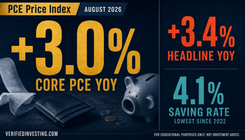

PCE March 2026: Headline Inflation Spikes 0.7% as Saving Rate Hits Lowest Since 2008

Published by Verified Investing | U.S. Economic Metrics Released: April 30, 2026 | Data Period: March 2026 | Source: U.S. Bureau of Economic Analysis
Key Takeaways
- Headline PCE rose 0.7% month-over-month — matching November 2021 as the hottest monthly print in more than four years and accelerating sharply from February’s 0.4%.
- Core PCE (ex-food and energy) cooled to 0.3% MoM from 0.4%, the headline of the report bond traders will lead with — but Core YoY ticked up to 3.2%, the highest reading since January 2024.
- Headline PCE YoY jumped to 3.5%, equal to December 2007 and the highest since May 2023’s 4.0%.
- Personal saving rate fell to 3.6% — last seen in July 2008 — as consumers funded a 0.9% nominal spending surge by drawing down their savings buffer.
- Goods spending outpaced services more than 2-to-1 ($132.6 billion vs. $62.9 billion), consistent with consumers front-running the April 2 tariff implementation.
- Real disposable income fell 0.1% in March after a 0.4% February decline — two consecutive months of shrinking real purchasing power.
- This is the last PCE reading entirely captured before tariffs took effect. The April release on May 28 will be the first to carry tariff pass-through.
Why This Matters Right Now
Today’s PCE release is the most consequential inflation print of 2026 so far — and not for the reason most coverage will lead with.
PCE is the Federal Reserve’s preferred inflation gauge. The Fed’s 2% target is expressed in PCE terms, not CPI. And March’s release is a rare combination: a hot print that predates the April 2 tariff implementation entirely, captured at exactly the moment the consumer was at maximum exposure to whatever came next.
The lazy read is that this report is “messy” — a hot headline (+0.7% MoM, the steepest in years) offset by a cooling core (+0.3% MoM, down from 0.4%). The sharper read is that every internal of this release points the same direction. Core YoY accelerated. Real disposable income fell again. Consumers paid for the spending surge by depleting savings to a level not seen since the eve of the Global Financial Crisis. The next PCE release will carry tariff pass-through. The buffer that would absorb it just got smaller.
What Everyone Will Focus On vs. What Matters More
Markets will lead with Core PCE MoM cooling to 0.3% from 0.4%. It’s the number bond traders watch first, and on its face it gives the Fed a small piece of good news inside an otherwise hot release.
What matters more — three things in order of importance:
1. Core PCE YoY accelerated to 3.2%, up from 3.0% in February. That’s the highest reading since January 2024. The MoM deceleration only looks like progress in isolation; the trailing trend is moving the wrong way. The Fed reads the YoY trajectory, not single MoM prints.
2. The personal saving rate collapsed to 3.6%. That’s the lowest reading since July 2008. The saving rate has now declined for three consecutive months: 4.5% in January, 3.9% in February (revised down from 4.0%), and 3.6% in March. Consumers are drawing down savings to maintain spending — before tariffs hit prices.
3. Goods spending dwarfed services growth — $132.6 billion vs. $62.9 billion. That ratio is unusual; in a normal expansion, services lead. Goods leading by more than two-to-one, in the month before tariffs take effect, has the fingerprint of pull-forward demand. Consumers buying durables ahead of expected price increases.
The +0.7% headline is the eye-catcher. The story is what’s underneath it.
The Data
| Metric | February 2026 | March 2026 |
|---|---|---|
| PCE Price Index, MoM | +0.4% | +0.7% |
| Core PCE (ex-Food & Energy), MoM | +0.4% | +0.3% |
| PCE Price Index, YoY | +2.8% | +3.5% |
| Core PCE, YoY | +3.0% | +3.2% |
| Personal Income, MoM | 0.0% | +0.6% |
| Disposable Personal Income, MoM | 0.0% | +0.6% |
| Real DPI, MoM | -0.4% | -0.1% |
| Nominal PCE (spending), MoM | +0.6% | +0.9% |
| Real PCE (spending), MoM | +0.3% | +0.2% |
| Personal Saving Rate | 3.9% (revised) | 3.6% |

The 40-basis-point gap between headline (+0.7%) and core (+0.3%) is the widest in over a year and tells the same story as the parallel PPI release earlier in April: energy carried the goods print. Gasoline and other energy goods drove the headline reacceleration. Stripping that out, underlying price momentum at the producer level is more contained than the headline suggests.
But the YoY trajectory tells the story that doesn’t get cooled by removing energy. Core PCE YoY has now risen for two of the last three months on the trailing-twelve basis, from 3.0% in February to 3.2% in March. Twelve months ago, Core PCE YoY was at 2.7%. This is not a metric returning to 2%. It’s a metric drifting away from it.

The Consumer Engine Is Running on Fumes
The income side of this report deserves more attention than it will get.
Personal income rose 0.6% in March, but the headline is flattered by federal farm subsidy payments through the Farmer Bridge Assistance Program — a one-time policy boost — and partially offset by reductions in social benefit payments tied to lower Affordable Care Act enrollments. Strip out the policy-driven movements, and underlying compensation growth is the only durable story left in the income line.
Real disposable income fell 0.1% in March after falling 0.4% in February. Two consecutive monthly declines in real purchasing power. Yet nominal spending rose 0.9%. That gap was financed by the saving rate dropping from 3.9% to 3.6%.
To put 3.6% in context: the BEA’s historical comparison table identifies July 2008 as the last time the personal saving rate sat at this level. That was nine months into the Great Recession and three months before Lehman Brothers failed.
The mechanism today is different — front-running tariffs and resilient nominal demand, not recession panic — but the level is the level. The consumer enters the post-April-2 environment with a thinner cushion than at any point since 2008. None of the four conditions stacking against the next reading get easier in May: an inflation rate already drifting back toward 3.5% headline, a core measure not just elevated but accelerating, real incomes shrinking, and savings being burned to keep up.
What Traders Should Watch Next
The following is provided for educational purposes only and does not constitute investment advice.
-
April PCE on May 28 is the first read carrying any tariff pass-through. The April 2 tariff implementation post-dates this entire reference period. Watch the goods component first, particularly in categories with high import exposure: apparel, electronics, furniture, household durables.
-
Goods/services spending split. If goods spending stays elevated in April PCE despite tariffs raising prices, that’s continued pull-forward. If it collapses, the front-running has stopped and demand is responding to the new price regime. Neither outcome is clean for Q2 GDP composition.
-
Saving rate trajectory. A continued decline below 3.6% signals consumers can’t fund consumption from savings any longer; spending will slow. A reversal would suggest March was a tariff-driven anomaly. Either path matters.
-
Core PCE YoY direction. If core ticks above 3.3% in the April release, the Fed loses any cover to discuss cuts at the June meeting. If core comes back to 3.0%, March looks like a one-month base-effect spike rather than a turn.
-
Real disposable income. A third consecutive monthly decline in April would put real DPI in territory that historically precedes consumer spending slowdowns — a different recession signal than the saving rate, and a more reliable one.
Historical Context
The +0.7% headline MoM print is the highest since November 2021 — when the post-pandemic supply shock was still active and the Fed had yet to begin its hiking cycle. The only month with a higher PCE reading in the intervening 53 months was June 2022 at 1.0%, in the early aftermath of the Russian invasion of Ukraine. Outside that single spike, today’s reading is the hottest in over four years.
The 3.5% headline YoY is equal to December 2007 — three months before the Federal Reserve cut rates by 75 basis points to a then-shocking 3.0% in response to the unfolding housing crisis. The last time YoY headline PCE printed above 3.5% was May 2023 at 4.0%, when the Fed was still actively hiking and the federal funds rate was on its way to 5.25–5.50%.
The 3.6% saving rate hasn’t been seen since July 2008. The last time the rate was lower was October 2022, briefly, at 3.4%. Otherwise the current level is in the bottom decile of saving rate readings of the last twenty years.
These three reference points — November 2021, December 2007, July 2008 — were not similar macro environments. What they share with March 2026 is a consumer carrying a heavier-than-normal load into a regime change.
Bottom Line
March PCE is the cleanest pre-tariff inflation read we will get. It came in hotter than expected on the headline, less hot than feared on the core, but worse than either by every measure that determines what the next print looks like: YoY accelerating, real incomes shrinking, savings depleting, and goods spending suggesting consumers see the tariffs coming.
The Fed’s June meeting just got harder. The May 28 PCE release just got more important. And the consumer enters the new policy regime with a thinner cushion than at any point since 2008.
Watch the April release like it’s the first chapter of a different book.
Source: U.S. Bureau of Economic Analysis — Personal Income and Outlays, March 2026 (BEA 26–22, released April 30, 2026)
This article is published for educational and informational purposes only. Nothing contained herein constitutes investment advice or a recommendation to buy or sell any security. Please consult a qualified financial professional before making any investment decisions.
Trading involves substantial risk. All content is for educational purposes only and should not be considered financial advice or recommendations to buy or sell any asset. Read full terms of service.