
My Trading Game Plan Revealed - 01/20/2026: Tariffs Trigger Risk-Off, Tech Selloff, Yields Spike and Gold Breakout

Geopolitical tensions and macroeconomic shifts have returned to the forefront of market consciousness, driving volatility and forcing traders to reassess their risk exposure. In this morning’s episode of My Trading Game Plan, Gareth Soloway, Chief Market Strategist at VerifiedInvesting.com, dissected the sharp market reaction to the imposition of new tariffs and the ongoing saga regarding the U.S. purchase of Greenland.
While the headlines are dominated by political maneuvering, Soloway remains steadfast in his commitment to technical analysis, emphasizing that charts often predict these moves long before the news breaks. As the S&P 500 and Nasdaq face critical technical breakdowns, and yields surge globally, the "game plan" for traders must shift from blind optimism to calculated risk management.
The Geopolitical Catalyst: Tariffs and Market Reaction
The markets opened under significant pressure today following news of a 10% tariff imposition on eight European countries, effective February 1st. These tariffs, which could escalate to 25% by June 1st, are reportedly a negotiation tactic to strongarm backing for the U.S. acquisition of Greenland. While the political narrative is complex, the market’s reaction has been swift and binary: risk-off.
However, for students of technical analysis, this sell-off was not entirely unexpected. The charts have been signaling exhaustion and bearish divergence for weeks. The news simply acts as the catalyst to trigger the technical setup that was already in place.
S&P 500: The Risk-Reward Paradigm Shift
The S&P 500 futures have seen significant downside, trading as low as 6,850 in the overnight session. Soloway’s analysis of the broader timeframe reveals a classic rejection at the upper bounds of a parallel channel. For weeks, the index has struggled to re-attack the high end of this channel, and today’s move confirms a rejection.
The core of Soloway’s bearish thesis rests on a simple risk-reward calculation. From current levels, the upside potential is capped by heavy resistance, representing perhaps a 1% to 3% move. Conversely, the downside risk is substantial.
"If we fall, where's your first big support? I would argue that maybe right here would be your first big support. But your mega support is not until down around 6,100 on the S&P."
This asymmetry defines the current market environment. When the potential for loss vastly outweighs the potential for gain, the "smart money" begins to distribute, leaving retail investors who operate on "gut feelings" holding the bag. The breakdown below key technical lines on Friday was the warning shot; today’s action is the confirmation.
The Nasdaq and Tech Sector Breakdown
The technical damage is perhaps most visible in the Nasdaq 100 (QQQ), which closed below a critical trendline on Friday. Pre-market action has pushed the index further into bearish territory. The inability of the Nasdaq to make a new all-time high since October serves as a massive divergence from the S&P 500, signaling underlying weakness in the technology sector that has led the bull market for so long.
Soloway identified specific downside targets for the QQQ, noting that intraday support might provide a temporary bounce, but the structural damage points lower. The primary targets to watch are the gap fills:
- First Target: Gap fill at 600 on the QQQ.
- Secondary Target: Gap fill at 590 on the QQQ.
Microsoft and Meta: Bellwethers in Trouble
The weakness in the Nasdaq is driven by the deterioration of charts among the "Mag 7" stocks. Microsoft, a staple of institutional portfolios, has formed a "nasty" double top pattern. After breaking support, bouncing, and failing, it is now heading lower again.
While there is some support around $447, Soloway pointed out a large gap significantly lower on the chart. In technical analysis, the axiom "gaps are meant to be filled" suggests that Microsoft acts as a ticking clock for the broader index. Until that gap is resolved, the gravitational pull on the stock remains downward.
Similarly, Meta is trading well off its all-time highs and is threatening to break a long-term trendline dating back to 2022. If this trendline fails to hold on a closing basis, it marks a significant shift in the intermediate-term trend for one of the market's top performers.
The Bond Market Vigilantes: Yields Break Out
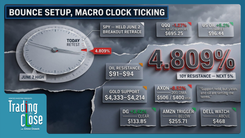
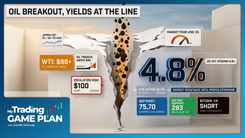
Perhaps the most critical chart discussed in today’s session was the U.S. 10-year Treasury yield. For three weeks, Soloway has warned of a "bull flag" pattern forming on the 10-year yield chart. Today, that pattern is resolving to the upside.
This move in yields is inextricably linked to the geopolitical tensions. As the U.S. adopts a more aggressive stance with international partners, the appetite for foreign nations to hold U.S. debt diminishes. If major buyers of U.S. Treasuries step back, yields must rise to attract capital.
"It doesn't matter if the Fed's cutting rates in May or June or July… That's the short end. What matters is the long end here. That's what sets the bigger time frame."
The technical target for the 10-year yield is an initial move to 4.35%, followed by a likely push to 4.5%. While a move of 30 basis points might seem trivial to the layperson, in an economy burdened by approximately $40 trillion in debt, the impact is catastrophic. Interest payments on U.S. debt have already surpassed $1 trillion annually; a move to 4.5% could push that figure toward $1.4 trillion, crowding out other government spending and acting as a massive tax on the economy.
The Japanese Connection
Adding fuel to the fire is the breakout in Japanese government bond yields. The Japanese 10-year yield has ripped higher, hitting 2.35% to 2.4%. As yields rise in Japan—a country with the highest debt-to-GDP ratio in the developed world—it puts upward pressure on yields globally. This synchronized rise in borrowing costs represents a "Bond Vigilante" moment, where the bond market forces fiscal discipline on governments by demanding higher returns for holding risky debt.
Precious Metals: The Safe Haven Divergence
In times of geopolitical stress, capital seeks safety. Today’s price action in gold confirms its status as the ultimate safe haven asset. Gold is ripping higher, breaking out above a key trendline.
Soloway’s analysis projects a continued move upward, with a technical target derived from a parallel channel measurement pointing toward a pierce of $5,000 per ounce. While the long-term target remains $10,000, the $5,000 level represents significant psychological and technical resistance.
Silver’s Lag
Interestingly, silver is not mirroring gold’s explosive move with the same intensity. While silver is hovering near the psychological $100 level, it faces resistance at an up-sloping parallel trendline. Soloway remains cautious on silver relative to gold, noting that while a touch of $100 is possible due to the "magnet effect" of round numbers, the technical structure is less bullish than gold’s breakout. This divergence suggests that the current move is driven purely by fear (benefiting gold) rather than inflation or industrial demand (which would benefit silver equally).
Energy Markets: The Discipline of Profit Taking
The energy sector provided a masterclass in trading psychology and discipline during today’s session. Natural Gas, which Soloway had previously flagged for a potential bounce, has exploded higher, rallying over 30% in just two days from Friday’s close.
For traders holding positions in UNG or BOIL, the temptation to hold for "more" is powerful. However, Soloway emphasized the importance of taking profits into strength.
"The old adage is don't look a gift horse in the mouth… When you get this type of move, at least for me, I took my profits. I said, 'Thank you very much.'"
This disciplined approach—selling into a 30% vertical move that hits technical resistance—is what separates professional traders from gamblers. While the long-term thesis for Natural Gas remains intact (driven by the massive energy needs of AI data centers that cannot rely on the traditional grid), the short-term technicals dictated an exit.
Oil, meanwhile, continues to grind higher, ignoring the broader market sell-off. Soloway views oil as a potential rotation trade. As money flees overextended tech stocks and potentially rotates out of silver if it stalls, oil remains relatively cheap on a historical basis and could see continued inflows.
Bitcoin: Risk Asset or Digital Gold?
The age-old debate regarding Bitcoin’s classification—risk asset or digital gold—is being tested in real-time. With gold soaring on safe-haven flows, Bitcoin has curled over, reacting negatively to the risk-off sentiment gripping equity markets.
"We just have to be honest with ourselves. As much as I do think it'll morph eventually… what it is right now is a risk asset, and it's coming in on deleveraging."
Technically, Bitcoin is forming a bearish flag pattern. After rejecting off the $98,000 level (just shy of the $100,000 psychological target), the cryptocurrency is testing support. Soloway warns that if the current bear flag breaks and confirms to the downside, the next major support levels are significantly lower:
- Primary Support: $80,000
- Secondary Support: Low $70,000s
This price action reinforces the correlation between Bitcoin and the Nasdaq (tech sector) rather than gold, at least in the current market cycle.
Conclusion: Logic Over Narratives
Today’s market action serves as a stark reminder of why technical analysis is essential for navigating volatility. The narratives—tariffs, Greenland, debt ceilings—are noisy and emotional. The charts, however, provide a roadmap based on logic and probability.
The S&P 500 and Nasdaq are confirming breakdowns that were signaled days ago. Yields are breaking out from clear technical patterns, warning of tighter financial conditions ahead. Gold is fulfilling its role as a safe haven, hitting technical targets with precision.
For traders, the game plan is clear: ignore the "blah, blah, blah" of the news cycle and focus on the levels. With the S&P facing a potential drop to 6,100 and yields pressing toward 4.5%, capital preservation and disciplined risk management are paramount. By waiting for the market to prove itself at key support and resistance levels, investors can tilt the probabilities in their favor, turning chaos into opportunity.
Trading involves substantial risk. All content is for educational purposes only and should not be considered financial advice or recommendations to buy or sell any asset. Read full terms of service.