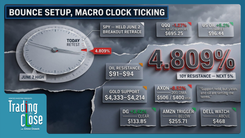

My Trading Game Plan Revealed - 02/17/2026: S&P Head and Shoulders Alert, AI Capex Reckoning, and Key Swing Trades

The markets are waking up to a harsh reality regarding Artificial Intelligence capital expenditures, creating a divergence between the NASDAQ and the Dow Jones Industrial Average. As investors grapple with the sustainability of massive tech spending, the S&P 500 sits precariously on the edge of a significant technical breakdown. In this morning's My Trading Game Plan show, Gareth Soloway, Chief Market Strategist at Verified Investing, broke down the critical "Head and Shoulders" pattern forming on the indices, the paradigm shift in interest rate correlations, and the specific price levels traders need to watch for swing trade opportunities.
The AI Capex Reality Check
For months, the market has been fueled by an unbridled enthusiasm for Artificial Intelligence, with companies pouring hundreds of billions into infrastructure. However, a shift in sentiment is occurring. The NASDAQ is showing relative weakness compared to the S&P and the Dow, driven by a growing concern regarding the massive capital expenditure (capex) spending in the AI sector.
Investors are beginning to run for cover as the realization sets in that not every company spending $100 billion or $200 billion in 2026 will emerge as a winner. The math simply does not add up for everyone to succeed at this scale. As Gareth noted during the show:
"Most of these, or at least some of these investments will not pay off. That is going to ultimately create some bankruptcies, although probably not in the mega cap players, but it will mean there are losers."
This creates a scenario where the market is repricing risk. The companies that have leveraged themselves to the hilt—spending tens or hundreds of billions on AI infrastructure—are counting on immediate, massive returns starting as early as this year. If there is even a small delay in revenue generation, perhaps due to energy grid limitations or slower adoption, the financial strain could be catastrophic for second and third-tier names.
Gareth compared this situation to a trader using excessive leverage: "It's like an investor using 100X leverage and needing that trade to come in with them within a day or two. And if it goes against them slightly, it's going to blow up their entire account." While giants like NVIDIA or Alphabet have enough insulation to survive a downturn, the broader tech sector is vulnerable to a significant washout as this "survival of the fittest" phase begins.
S&P 500: The Head and Shoulders Breakdown
While the fundamental narrative shifts, the technical picture on the S&P 500 is flashing a serious warning signal. The index has broken initial support and is currently "hanging out with a basic cliff dive" scenario. The most concerning formation on the daily chart is a clear Head and Shoulders pattern—a classic bearish reversal formation that often precedes significant downtrends.
The critical level to watch is the neckline of this pattern, which sits right around 6,790. The market has not yet broken this level, but it is testing it. A daily close below 6,790 would trigger the pattern, potentially starting the next phase of free fall for the S&P 500.
This setup is compounded by the overhead pressure from previous trendlines. The market recently broke a white upward-sloping trendline that had acted as support. Furthermore, a larger parallel channel going back to previous market highs and lows is creating massive overhead resistance.
For technical traders, this is a binary moment. As long as the neckline holds, there is a chance for chop or a minor bounce. However, if that 6,790 level gives way on a closing basis, the probabilities shift dramatically toward a deeper correction. This aligns with the weakness seen in the NASDAQ, which has already broken major support, retraced, and is now rolling over, effectively leading the charge to the downside.
The Defensive Trap: Valuation Concerns in the Dow
In contrast to the tech-heavy indices, the Dow Jones Industrial Average has shown relative strength. However, this strength may be deceptive. Money has rotated into "defensive" names like Walmart, pushing the index higher even as tech falters. But a closer look at these defensive stocks reveals extreme overvaluation.
Walmart, traditionally viewed as a safe haven during economic uncertainty, is now trading at a forward Price-to-Earnings (PE) ratio of 50. For a company with growth rates in the low single digits, this valuation is historically unjustifiable.
"Is this a chart where we think, you know, when you go into a Walmart, you buy some goods there, a shirt, this or that? Is this the chart that we should be seeing? Probably not."
This phenomenon represents an "overcrowded trade." Investors, fleeing the volatility of AI stocks, have piled into defensive names without regard for valuation, creating a bubble in safety. Gareth predicts a reversion trade is inevitable over the next six months. When the market realizes that a PE of 50 is unsustainable for a low-growth retailer, the unwind could be as sharp as what we have seen in the AI sector.
This dynamic serves as a reminder that safety is not just about the type of business; it is about the price you pay for it. Overpaying for safety can be just as risky as speculating on growth.
The Interest Rate Paradigm Shift
A fascinating change in character has occurred regarding the relationship between interest rates and equity markets. For years, the narrative was simple: lower rates were good for stocks (cheap money), and higher rates were bad. However, recent price action in the 10-year yield suggests a fundamental flip in this correlation.
Gareth pointed out that during intraday trading, as interest rates on the 10-year yield pushed up, the S&P futures also pushed up. Conversely, when rates dropped, the market showed weakness.
"We're now seeing the worry about the U.S. economy take the forefront, where when rates go down, people are saying, uh-oh, the U.S. economy is starting to slow. That means lower corporate profits."
This indicates that the market is moving from an inflation-focused narrative to a growth-focused narrative. Rising rates are being interpreted as a sign of economic resilience, while falling rates are signaling potential recessionary fears. Traders must update their mental models: "Bad news is bad news" again. If rates fall sharply, it may no longer trigger a "Fed pivot party" but rather a "recession panic."
Strategic Swing Trade Opportunities
Despite the bearish macro backdrop, volatility creates opportunity. Gareth outlined several specific setups based on technical levels and historical precedents.
NuScale Power: The Reversion Trade
NuScale Power, once a darling of the nuclear energy/AI data center narrative, has collapsed 75% from its October highs. This drastic drop is typical of "meme-type excitement plays." Gareth drew parallels to First Solar in the mid-2000s and Tesla in 2021, both of which saw massive drawdowns after parabolic runs.
However, after a 75% decline, value begins to emerge for disciplined swing traders. Gareth identified a buy zone between $11.25 and $10.25. This level coincides with a pivot low and previous support structures. It is a classic example of waiting for the "falling knife" to hit the floor before attempting to catch it.
Netflix: A Technical Long Setup
Netflix shares bounced slightly following news that Warner Bros Discovery might not be acquired, suggesting investors prefer Netflix to conserve capital rather than overpay for legacy media assets. Despite the bounce, the stock remains in a downtrend.
Gareth is eyeing a specific zone for a potential long position: the $69 to $68 level. "If we continue to see weakness in the tech sector and in this stock, this could get into this range, and at that point, for me at least, it would be worth from a technical probability-based standpoint that would actually be a good swing trade long."
Vulcan Materials and Medtronic
For shorter-term traders, Vulcan Materials presents a potential day trade opportunity following a pre-market drop. The area between $296 and $295 represents a level where previous resistance could flip to support.
Medtronic, falling on earnings, is approaching support around $95, but a more significant swing trade level exists lower, around $85 to $86. This lower level aligns with longer-term trendlines, offering a "two-factor" support zone that raises the probability of a successful trade.
Commodities: The Shale Depletion Narrative
In the commodities market, a long-term narrative is quietly building that could reshape the energy landscape. While oil prices have remained suppressed recently, Gareth highlighted research suggesting that the U.S. shale boom may be nearing its end.
"Within two to three years, the U.S. may not be as energy independent as it once was as the shale side of things gets depleted very, very quickly."
If U.S. production drops significantly—potentially up to 80% from shale sources over the next few years—the supply-demand imbalance could send oil prices back above $100 per barrel. Currently, oil is forming a flag pattern, and Gareth remains bullish on the commodity, viewing the current lull as a potential accumulation phase before the supply realities hit the market.
Natural Gas also presents a technical opportunity. The daily chart shows the commodity approaching key support. A dip to sub-$3 levels would enter a buy zone for a technical bounce.
Precious Metals and Bitcoin
Gold and Silver Divergence
Gold continues to consolidate, holding resistance between $5,125 and $5,100, while support sits at $4,400 to $4,300. The pattern remains a bearish consolidation (inside bar chop) unless the resistance level is breached to the upside.
Silver is showing relative weakness compared to gold, trading much closer to its technical support at $71 to $70. Gareth maintains a long-term accumulation target for silver between $50 and $54. This zone represents a major value area for long-term investors looking to hedge against debt monetization and de-dollarization.
Bitcoin's Dual Timeframes
Bitcoin presents a conflicting picture depending on the timeframe. On the micro (short-term) level, it is forming a bullish inside bar pattern, suggesting a potential pop higher in the immediate future. However, the macro (1-3 month) pattern remains bearish.
"Micro pattern, short-term bullish on Bitcoin, macro pattern bearish, meaning I'm still bearish over the next one, two, three months on this chart."
This distinction is crucial for traders. A day trader might take a long position based on the micro pattern, while a swing trader might remain on the sidelines or look for short entries, respecting the larger bearish structure.
Conclusion: Logic Over Hype
The overarching theme of today's analysis is the triumph of logic and technicals over hype and narratives. Whether it is the AI capex reality check, the valuation absurdity in defensive stocks like Walmart, or the shifting correlations in interest rates, the market is in a process of rediscovering fundamental truths.
As Gareth emphasized regarding his own journey: "I was a losing trader until I mastered technical analysis. Logic and charts beat hype and narratives every time."
In this environment, chasing FOMO or adhering to outdated narratives is a recipe for disaster. The disciplined trader waits for price to reach specific levels—like $11.25 on NuScale or 6,790 on the S&P—before acting. By relying on probability-based setups and ignoring the emotional noise of the crowd, investors can navigate the coming volatility with confidence.
Trading involves substantial risk. All content is for educational purposes only and should not be considered financial advice or recommendations to buy or sell any asset. Read full terms of service.