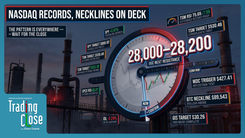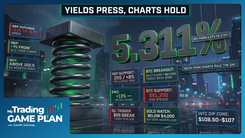

My Trading Game Plan Revealed - 02/20/2026: Stagflation Alert S&P 500 Head and Shoulders Threatens 6580

The economic landscape shifted dramatically this morning as fresh data hit the wires, confirming a scenario that many economists fear most: stagflation. With GDP growth slowing significantly while inflation metrics tick upward, the markets are facing a complex and treacherous environment. In this morning’s My Trading Game Plan show, Gareth Soloway, Chief Market Strategist at Verified Investing, broke down the "epic" economic data, the looming technical breakdown in the S&P 500, and the critical levels for major assets from Bitcoin to Microsoft.
The Stagflation Reality: A Macroeconomic Warning
The latest economic release delivered a one-two punch to the bullish narrative that has sustained markets recently. On one hand, economic growth is stalling; on the other, the cost of living continues to rise. This combination creates a policy nightmare for the Federal Reserve and a difficult environment for equities.
The numbers tell a stark story. GDP came in at a sluggish 1.4%, a massive miss compared to the 2.8% forecast. While some of this deceleration can be attributed to the government shutdown in the fourth quarter, the weakness is undeniable. Simultaneously, the inflation data—specifically the PCE (Personal Consumption Expenditures)—came in hotter than expected. The monthly PCE rose 0.4% versus a 0.3% expectation, and the year-over-year number hit 2.9%, edging out the 2.8% forecast.
Gareth didn't mince words regarding the implications of this data:
"The recipe or definition of that is stagflation. It's the worst of all scenarios… I've said, listen, we got that CPI data a week or so ago, which showed less inflation. And I said, guys, look at me… Do we really, when we go out and about, think that inflation is all of a sudden heading back to 2%? Certainly not."
This data contextualizes the recent Fed minutes, which surprisingly showed a policy inclination toward holding rates steady or even hiking them. The market had been pricing in cuts, but with core inflation metrics rising across the board, the Federal Reserve’s hands may be tied. They cannot cut rates to stimulate the slowing growth (GDP) without risking an explosion in inflation (PCE). This leaves the market vulnerable, caught between a slowing economy and a hawkish central bank.
S&P 500: The Head and Shoulders Threat
The technical damage on the S&P 500 is becoming increasingly difficult to ignore. Following the release of the economic data, S&P futures, which had topped out around 6,900 in the pre-market, dumped nearly 40 handles. This price action is occurring within the context of a potentially bearish technical formation known as a Head and Shoulders pattern.
This classic reversal pattern consists of a peak (the head) flanked by two lower peaks (the shoulders). The critical level to watch is the "neckline," which acts as the support floor for the pattern. As of this morning, the pattern has not yet triggered, but the threat is imminent.
"For those of you that are new, head and shoulders patterns are bearish formations, but they trigger only when you get a daily close below the neckline… Wouldn't that be something on a Friday if we saw this market break and close and trigger the head and shoulders pattern?"
Should the market close below this neckline, technical analysis allows us to project a downside target. By measuring the distance from the top of the head to the neckline and mirroring that distance downward from the breakdown point, we arrive at a target of approximately 6,580.
This target of 6,580 is not arbitrary; it aligns perfectly with a significant zone of historical support. In technical analysis, when a projected target aligns with previous support levels, it reinforces the probability of the move. However, until that daily close below the neckline occurs, the pattern remains a potential threat rather than a confirmed breakdown.
The Yield Paradox and Currency Outlook
An interesting anomaly occurred in the bond market following the data release. Typically, hot inflation data sends yields soaring as bond traders anticipate higher interest rates. Conversely, weak economic growth data usually sends yields lower as traders anticipate rate cuts.
Today, we received both simultaneously. The result was a stalemate in the 10-year Treasury yield.
"We have a positive forcing yields up, which is inflation, but then a weaker economy keeping it, pushing it down. And so essentially what they're doing is they're canceling each other out."
This "canceling out" effect is a sophisticated institutional-level observation. While the yields remained flat, the implications for the U.S. Dollar are evolving. The Dollar Index (DXY) is currently holding support, but the long-term technical structure suggests weakness ahead. Gareth forecasts that later this year, we could see a significant break in the dollar, potentially driving the DXY below 90. This would have profound implications for multinational earnings and commodity prices, but for now, the greenback remains in a holding pattern.
Mega Cap Tech: Best of Breed at Critical Support
The "Magnificent Seven" and other mega-cap tech stocks have been the generals leading the market army, but many are now testing critical support lines. The divergence between these stocks holding support or breaking down will likely determine the fate of the broader indices.
Microsoft: Microsoft represents a key battleground. The stock has retraced into "massive support," prompting Gareth to initiate a small long position. This trade is based on the principle of buying "best of breed" companies at major technical levels. However, the risk management parameters here are strict. If Microsoft breaks this current support level, the downside risk is substantial—potentially a drop of another $30 to $40, or roughly 10-15%.
Meta: Meta is currently testing a long-term trend line. While it is down slightly today, the price action over the next week will be pivotal. A break of this trend line would not only spell trouble for Meta shareholders but would also remove a key pillar of support for the Nasdaq and S&P 500.
Amazon: Amazon has already corrected significantly from its highs of roughly $260 down to $205. The key level to watch is the gap fill at $193. Gap fills often act as magnets for price action, and this level represents a major line in the sand for the e-commerce giant.
Akamai: On the earnings front, Akamai took a significant hit, though it recovered about 50% of the drop in pre-market trading. For traders looking at this name, the chart suggests caution. A gap fill level exists at the $91.35 area, with secondary support around $88. However, given the technical damage, this is viewed strictly as a potential day trade setup rather than a swing trade investment.
Bitcoin and Precious Metals: The Safe Haven Rotation?
With the economy showing signs of stagflation and equities under pressure, capital often seeks alternative homes. This dynamic is creating interesting setups in cryptocurrencies and precious metals.
Bitcoin: Despite a mid-to-long-term bearish outlook that could see Bitcoin revisit the $50,000 level or lower, the short-term setup favors a bounce. Sentiment has become excessively bearish, evidenced by the high volume of put options at the $40,000 strike price. When the crowd leans too heavily to one side, markets often snap back in the opposite direction.
"I do think there's an opening here for Bitcoin to bounce back to $80,000 to $85,000… At some point, I do think there's a reversion trade away from stocks and maybe a little safe haven going into Bitcoin overall."
This potential move to $80,000-$85,000 represents a counter-trend rally within a broader corrective phase, offering a tactical opportunity for nimble traders.
Gold and Silver: Gold is ticking higher on the stagflation news, acting as a pure-play safe haven. However, it faces resistance between $5,100 and $5,125. A breakout above this zone is required to open the door for a retest of the highs. Until then, the resistance must be respected.
Silver is showing a similar technical posture. While it has bounced over the last three days, it remains range-bound. Support is firm at $70-$71, but a breakout is not in play until the metal can clear resistance at $92-$93.
The Psychology of the "Casino"
One of the most valuable lessons from today’s session revolved around the mindset of a successful trader. Gareth recently closed a long position in oil for a 17% gain. While geopolitical tensions could potentially drive oil higher, the decision to exit was based on discipline rather than greed.
This approach highlights the difference between the "gambler" and the "casino." The gambler bets on hope, looking for the home run, often holding too long and giving back profits. The casino plays the probabilities, taking consistent wins when the mathematical edge is present.
"You should be the casino, not the gambler. The casino, sure, will lose occasionally… But if you look at all my calls, a high percentage of them are correct because I'm playing the charts, playing the probability."
By taking the 17% profit in oil, the capital is secured. If oil continues to rise, it is simply a missed opportunity, not a loss. But if oil reverses—a distinct possibility given the technicals—the profit is protected. This disciplined approach to profit-taking is what separates professional traders from amateurs.
Conclusion: A Market on the Edge
As we head into the weekend, the market stands on a precipice. The stagflationary economic data has removed a key support for the bullish thesis, and the S&P 500 is threatening to trigger a major bearish pattern.
The coming week will be critical, with Nvidia set to report earnings. Can the AI giant save the market once again, or will the weight of the macro data and technical breakdowns prove too heavy?
For now, the probabilities favor caution. The "buy the dip" mentality that has worked for years is being challenged by the reality of higher inflation and slowing growth. By focusing on the charts, respecting the levels, and maintaining the discipline of the "casino," investors can navigate this volatility without falling victim to the hype or the fear.
Stay tuned to the charts, watch the S&P 500 neckline closely, and prepare for what could be a pivotal week ahead.
Trading involves substantial risk. All content is for educational purposes only and should not be considered financial advice or recommendations to buy or sell any asset. Read full terms of service.