
Trading The Close Market Recap - 04/07/2026: Oil Breakdown & 10-Year Yield Signal Equity Bounce, Tech and Healthcare Lead

The financial markets are currently navigating a treacherous landscape defined by geopolitical uncertainty, algorithmic volatility, and critical technical inflection points. Despite the looming threat of conflict and shifting deadlines, major indices managed to close in the green today. However, beneath the surface of these positive closes lies a complex web of low volume, intermarket correlations, and precise technical levels that demand every trader's attention.
In this afternoon's Trading The Close, Verified Pro Trader Drew Dosek at Verified Investing broke down the exact mechanisms driving today's price action. From the algorithmic reactions to Middle East news to the profound impact of U.S. Oil and Treasury yields on equity markets, today's analysis provides a masterclass in probability-based trading. Here is a deeper look into the key themes, technical setups, and psychological factors shaping the current market environment.
The Geopolitical Tug-of-War and Algorithmic Reactions
Today's market action was a textbook example of headline-driven algorithmic trading. While the major indices closed in the green, the volume on the S&P 500 ETF (SPY) was notably light at just 62 million shares. This low volume combined with high volatility paints a clear picture: institutional human traders largely sat on their hands, unwilling to load the boat ahead of tonight's geopolitical deadlines, leaving the algorithms to whip price action around based on news flow.
"Volatility was not missing, guys. Volatility was not," Pro Trader Drew noted, highlighting the dramatic intraday swings. The market sold off steadily until roughly 11:00 a.m. Eastern, perfectly coinciding with the peak in U.S. Oil prices. When news broke via Pakistan that Iran was requesting a potential two-week delay to the conflict deadline—and the U.S. confirmed receipt of the request—the algorithms instantly reacted. The result was a massive influx of buy orders, printing two massive green candles on the 10-minute charts and rocketing equities higher.
From a technical perspective, the S&P 500 ETF (SPY) printed a major long wick on the bottom of its daily candle, signaling strong rejection of lower prices. If the Strait of Hormuz remains open and geopolitical pressures ease, the resulting flood of sidelined capital could trigger a powerful near-term bounce. The technical target for this move sits at an inclining trend line roughly at $682.24.
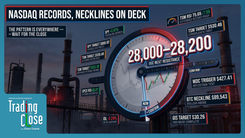
The Nasdaq also managed to save itself from a technical breakdown. After trading underneath its parallel channel earlier in the session, it reversed course, successfully holding support established two days prior. If positive news continues to flow, the Nasdaq faces immediate resistance at 24,503 points, followed by the 50% area of its parallel channel, which currently coincides with an inclining trend line near 25,000 points.
Intermarket Analysis: Oil and the 10-Year Yield
To truly understand equity market direction right now, traders must look beyond stock charts. As Drew emphasized: "This market is really ruled by two things, guys. Remember, there are two things. It's oil and it's news, especially with the geopolitical conflict."
The U.S. Oil chart is currently flashing significant warning signs that a geopolitical resolution—or at least a de-escalation—might be imminent. At midnight, oil printed an hourly topping tail right at the top of a multi-week parallel channel. This technical rejection pushed the price down to test a massive, long-term inclining trend line dating all the way back to June 2008 (connected through the June 2022 highs).
After multiple tests since April 2nd, oil finally broke below this historic trend line today, even piercing the next critical support level at $110.33. This breakdown in oil is the exact catalyst equities need to rally. The inverse correlation between the two assets is currently ironclad; when oil marches up, markets pull back, and when oil breaks support, equities rip higher.
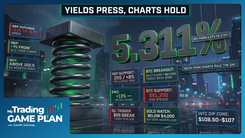
Simultaneously, the 10-year Treasury yield is acting as a leading indicator for stock market strength. The critical line in the sand is 4.3%. Today, the yield hovered right at 4.301%. A daily close decisively under the 4.3% threshold will alleviate pressure on growth valuations and serve as a massive green light for a near-term market rally.
Healthcare Sector Surges on Fundamental Catalysts
While macro forces dictated the broader indices, the healthcare sector experienced massive, stock-specific volatility driven by government policy. The Centers for Medicare & Medicaid Services (CMS) announced an unexpected approval to increase Medicare Advantage spending from a previously proposed 0.09% to a robust 2.48%. This translates to roughly $13 billion in extra Medicare payments by 2027, sending managed care stocks soaring.
UnitedHealth Group (UNH) exploded higher by 9.37%. From a technical standpoint, UNH has been trapped in a declining parallel channel since June 2022. Today's massive surge pushed the price right into a critical, long-term trend line dating back to 2016. Traders must closely monitor the $307.49 level. A daily close above both this trend line and today's high will flip multi-year resistance into support. If successful, the next upside targets are the 50% area of the parallel channel at $342.25, followed by a higher declining trend line near $360.
Humana followed suit, jumping 7.94% and bouncing perfectly off the bottom of its own parallel channel. However, Humana's chart offers a profound lesson in trading psychology and overhead supply. While the aggressive technical target sits at the bottom of an inclining parallel channel at $234.96, a more conservative target lies at $221.50.
Why is $221.50 so critical? This level represents a major pivot low created by a previous gap down. In technical analysis, this area is filled with "trapped buyers"—investors who bought the initial dip, failed to average down, and have been suffering through massive drawdowns all year. As the price finally returns to their break-even point, the psychological relief will prompt many of these investors to sell, creating a wall of resistance. Professional traders anticipate this human behavior and plan their exits accordingly.
Semiconductor Resilience and Tech Leadership
The semiconductor space showed remarkable resilience today, highlighted by the SMH ETF reclaiming its position inside a critical parallel channel. To confirm this breakout, SMH needs follow-through price action tomorrow to flip resistance at $401.93 into support. Once confirmed, the probabilities shift toward a move to $413, and eventually a retest of the recent double top around $428.
Broadcom (AVGO) was a standout leader, surging 6.21% on the back of fundamentally bullish news. The company secured multi-year deals through 2031 to supply custom TPUs and networking gear for Google's AI data centers. Technically, AVGO broke out of a bearish consolidation pattern, slicing through a long-term inclining yellow trend line. The 10-minute chart revealed a textbook "retest bounce play"—price broke through resistance, pulled back to test the line as new support, and exploded higher. AVGO now needs to confirm above $328.14 to target $352.34, with the ultimate goal being the 50% parallel area at $400.
Intel (INTC) presents a more complex, yet highly tradable, setup. Closing at $52.91, the stock has been on a strong run but is rapidly approaching a massive technical barrier: a weekly topping tail at $54.60. A weekly topping tail is a powerful bearish reversal signal indicating that buyers were exhausted and sellers took absolute control.
Because of this heavy resistance, Drew does not anticipate Intel breaking $54.60 on its first attempt. Instead, he expects a pullback, offering a strategic entry point for patient traders. Historically, Intel has found strong support at its 20-day moving average before rocketing higher. With the 20 DMA and 50 DMA converging, an aggressive entry could present itself near $46.03. Should the stock pull back further, additional support levels sit at $49, $40, and $36.13. Buying on these technical pullbacks rather than chasing resistance is the hallmark of disciplined, probability-based trading.
Commodities and Crypto: Diverging Technical Paths
The precious metals and cryptocurrency markets are currently painting very different technical pictures, requiring traders to adapt their strategies to each specific asset's behavior.
Gold managed a 1.21% gain today, but the broader context shows sideways consolidation. For the past three trading days, gold has repeatedly tagged minor support at $4,603. In technical analysis, the more a support level is tested, the weaker it becomes. Bulls need to see price separate from this $4,603 floor and consolidate near the top of its range around $4,800. Building momentum at that higher level is required to fuel a breakout toward the bottom of the parallel channel at $5,070.
Silver has shown relative weakness compared to gold, but the micro-structure of the chart offers a glimmer of hope. The daily candles have printed three consecutive bottom wicks, indicating intraday buying pressure. However, to shift the near-term probabilities from bearish to bullish, silver must secure a daily close above $75.33.
Natural Gas remains in a holding pattern, up 1.45% but still consolidating at the bottom of its range. Patient traders are simply waiting for price to come to them, with predefined buy zones sitting lower at $2.71 and potentially $2.41.
Finally, Bitcoin is exhibiting a fascinating dual personality. In the near term, Bitcoin is acting as a "crypto winner." If risk-on sentiment floods back into the market (potentially triggered by the Strait of Hormuz remaining open), a daily close above $73,173 could easily propel Bitcoin toward the $80,000 to $84,000 range.
However, the macro picture tells a much more cautionary tale. The longer-term chart has formed a massive head and shoulders pattern coupled with a bear flag. These are definitively bearish structures. Once the near-term bounce exhausts itself, the measured move for these macro patterns suggests Bitcoin is ultimately headed back under $50,000. This stark contrast between micro and macro timeframes perfectly illustrates why traders must clearly define their holding periods and respect their stop losses.
Conclusion: Discipline in the Face of Volatility
Today's market action serves as a powerful reminder that trading is not about predicting the future; it is about reacting logically to the data presented. When geopolitical headlines trigger algorithmic buying and selling, human emotion is the trader's greatest enemy.
By relying on concrete technical levels—whether it's the 4.3% threshold on the 10-year yield, the $110.33 breakdown level in U.S. Oil, or the psychological resistance of trapped buyers in Humana at $221.50—investors can strip the emotion out of their decision-making process.
As Drew highlighted, the charts are already whispering the likelihood of a geopolitical resolution through the breakdown in oil prices. By monitoring these intermarket relationships, respecting historical trend lines, and waiting for high-probability setups like the moving average pullbacks on Intel, traders can navigate this wild and wacky environment with confidence. Stay patient, trust the levels, and let the market come to you.
Trading involves substantial risk. All content is for educational purposes only and should not be considered financial advice or recommendations to buy or sell any asset. Read full terms of service.