
Trading The Close Market Recap - 06/25/2026: Core PCE Hot but Within Expectations — Tech Holds; SMH & Bitcoin at Critical Levels

The headline into the close was not that Core PCE came in hot. The real takeaway was that the market did not break on it.
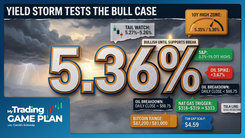
In today’s Trading the Close Market Review, Verified Investing Pro Trader Drew Dosek focused on the difference between a hot inflation print and a surprising inflation print. Core PCE remains the Federal Reserve’s preferred inflation gauge, and today’s number kept rate-hike expectations alive. But because the print stayed within Wall Street’s expected range, sellers did not get the kind of shock they needed to force a deeper risk-off move.
That is why the reaction mattered more than the data itself. The market had every reason to sell hard, especially with rate-cut optimism already under pressure. Instead, equities held up, the 10-year Treasury yield pulled back, and technology continued to support the broader tape.
This was not a clean risk-on session. It was a market held together by expectations, yields, and semiconductors.
The 10-Year Yield Gave Tech Room To Breathe
The most important cross-market signal came from the 10-year Treasury yield. Even with hot Core PCE, the 10-year failed to confirm a breakout and instead pulled back toward the next major support area near 4.307%.
That matters because the current market is still highly sensitive to rates. Higher yields usually pressure long-duration growth stocks, especially high-multiple technology names. A falling 10-year does the opposite. It gives tech room to breathe, even when the inflation data itself argues for a tighter Fed path.
That tension defined the day. Macro pressure did not disappear. Rate-hike expectations did not go away. But the bond market did not confirm the bearish equity read, and that helped keep buyers engaged into the afternoon.
Drew’s point was simple: markets price expectations, not just numbers. A hot print that is already expected can produce a very different reaction than a hot print that surprises the market.
The Indexes Held, But the Structure Is Not Clean
The S&P 500 finished positive by 0.14%, but the candle told a less comfortable story. The index opened higher, sold off quickly, bounced hard, then settled into a more sideways afternoon structure. That left a red daily candle despite the positive close.
The key issue is still the inclining trend line. The S&P 500 has now spent three consecutive sessions below that line, which keeps the near-term structure vulnerable. A reclaim of 740.31 would help restore the bullish posture and put the upper portion of the channel back in play. Failure to regain that area keeps support at 728.28 in focus.
QQQ showed the same tension with more strength. The Nasdaq 100 ETF closed up 0.81% after a sharp intraday reversal helped interrupt what could have become a more bearish consolidation pattern. The early gap, the fast selloff, and the 10:00 AM reversal candle all point to a market still willing to buy tech weakness, but not without volatility.
For QQQ, the upside gap-fill area near $737 remains the next major resistance reference. Support sits at $703.09. As long as tech keeps holding, the broader market can stay resilient. But the more the market relies on one leadership group, the more important that group becomes.
Semiconductors Are Still the Market’s Tell
Drew continues to treat SMH as one of the most important leading indicators in this market, and for good reason. The semiconductor trade remains the center of the AI data-center buildout theme. If semiconductors hold, the broader growth trade has support. If semiconductors start to break, the rest of the market becomes much harder to trust.
SMH had a strong intraday bounce, even stronger than QQQ, but the broader technical picture still carries risk. The ETF has now closed below its inclining trend line for three straight sessions. That does not confirm a full breakdown by itself, but it does tell traders the tape is no longer clean.
The key downside level is the June 23 low at $617.27. A daily close below that level while SMH remains under the inclining trend line would increase the odds of a broader tech pullback. On the other side, a close back above $648.91 would weaken the bearish read and reset the structure back in favor of buyers.
That is the main market read from today: the indexes can still hold, but semiconductors need to confirm. Without SMH, the broader rally loses its most important engine.
Commodities Responded To the Yield Move
Gold and silver both benefited from the pullback in yields. Gold bounced off yesterday’s low near $3,959 and now has minor resistance near $4,122. The larger resistance level remains the declining trend line near $4,295. If the current bounce fails, major structural support sits lower at $3,886.
Silver also bounced, but the lesson there was patience. Price turned higher from $55.62, just above the cleaner support level at $55.09. That is the kind of move that can frustrate traders who were waiting for a precise level, but Drew’s framework was clear: missing a level is not a reason to chase. The better read is to let the chart prove whether the bounce has real strength.
For silver, the important support zone remains $55.09, with deeper support near $49.96. If price can push through the 50% midline of its channel, resistance near $61.52 becomes the next major area to watch.
Oil was also sitting on an important technical level. U.S. Oil found support at $75.56, a trend line that has been active on the chart for months, while RSI was already stretched below the oversold 30 level. Geopolitical headlines around the Strait of Hormuz added another layer, but the technical read remains the same. Hold $75.56 and the bounce attempt stays alive. Lose that level with bearish consolidation and the next major support does not come in until $62.33.
Bitcoin Is Trying To Diverge, But It Has Not Confirmed Yet
Crypto remains a market where Bitcoin has to be read first. If Bitcoin loses structure, the altcoin space usually follows.
Bitcoin is still fighting to avoid a daily close below the June 5 low. If that level gives way, the next major downside area is near $53,000. The larger bearish overhang remains the head and shoulders measured move, which points much lower toward $37,508 if the pattern fully plays out.
The one constructive signal is RSI divergence. During the early June selloff, Bitcoin’s RSI reached an extreme oversold reading near 15. Now, as price retests the same general zone, RSI is closer to 30. That shows selling pressure may be weakening, but divergence alone is not confirmation.
For Bitcoin to improve the structure, price needs to reclaim resistance near the inclining trend line at $63,449. Until then, the chart remains at risk.
That weakness is also weighing on XLM. Stellar is sitting near critical support at $0.173, an area with multiple prior pivot points. A reclaim of $0.195 would help shift momentum back toward buyers. A failure at support, especially if Bitcoin breaks lower, opens the door to a move toward $0.1395.
Individual Stocks Showed Why Levels Matter More Than Headlines
Qualcomm was one of the cleaner examples of why the close matters more than the headline. The stock initially gapped higher on positive news, but the move failed intraday and left a large upper wick. Price pushed through the top of its parallel channel, then rejected.
That puts resistance near the declining trend line around $227 in focus. More importantly, the chart is also working through a larger head and shoulders structure. The neckline sits near $191.02, and a break there would put the measured move toward $121.37 in play. That does not mean the move has to happen, but it does mean the level deserves respect.
BlackBerry delivered the strongest single-stock move of the session, jumping roughly 20% ahead of earnings. The key level is $10.93. A weekly close above that area would help negate the prior bearish weekly topping tail. Failure to hold the breakout would put the top of the parallel channel near $7.26 back in focus. If momentum continues, upside levels sit at $11.21 and $12.39.
Corning also stood out, surging to new all-time highs after a major breakout. The stock is now battling the top of its inclining parallel channel near $229.59. If it clears that area, the next major resistance zone sits near $239.25.
Bottom Line
Today’s session was not about a clean bullish breakout or a clean bearish reversal. It was about a market absorbing bad macro news better than it probably should have.
Core PCE was hot, but not hotter than expected. The 10-year yield pulled back instead of confirming a breakout. Tech held. Semiconductors bounced intraday, but remain below an important trend line. Bitcoin is showing potential divergence, but still has not confirmed a reversal.
That leaves the market in a narrow but important window. If SMH reclaims $648.91, QQQ continues to hold, and yields stay contained, buyers can keep control. If SMH loses $617.27 and the indexes remain below their trend lines, today’s resilience may turn out to be a pause before the next pullback.
For traders, this is a tape to read through levels, not headlines. The reaction mattered more than the print, and semiconductors remain the signal to watch next.
Trading involves substantial risk. All content is for educational purposes only and should not be considered financial advice or recommendations to buy or sell any asset. Read full terms of service.