
My Trading Game Plan Revealed - 02/24/2026: S&P Rounded Top, Private Credit Crisis, and Chip vs Software Trade Ideas

The markets are navigating a complex landscape of conflicting signals, from renewed AI competition to looming credit concerns. In this morning's My Trading Game Plan show, Gareth Soloway, Chief Market Strategist at VerifiedInvesting.com, broke down the critical technical levels and macroeconomic headwinds facing investors. With the S&P 500 hovering near all-time highs and a potential private credit crisis brewing, the need for disciplined, chart-based analysis has never been greater.
The Macro Backdrop: Credit Crises and AI Competition
Two major narratives are currently driving market sentiment, creating a push-pull dynamic between fear and greed. On one hand, we have news that DeepSeek out of China is utilizing Blackwell chips, reigniting competition concerns in the AI space. On the other, a darker cloud is forming over the financial sector.
We are hearing growing concerns regarding a private credit crisis, a situation serious enough that Treasury Secretary Besant has voiced apprehension. This macro fear is beginning to manifest in the price action of major financial institutions, with JP Morgan and other bank stocks starting to tumble.
"There could be a private credit crisis that could be a contagion event on the horizon."
This potential contagion event aligns with the broader technical view that markets have been topping out since the start of the year, preparing for a larger corrective move.
S&P 500: The Rounded Top and Retail Psychology
While S&P 500 futures remain neutral to flat today, the daily chart reveals a more concerning structure. The index is currently trading at the high end of a parallel channel that dates back to 2020. More importantly, price action is forming what technical analysts call a "rounded top."
This pattern is significant because it illustrates a divergence in market participation. A rounded top typically signifies that institutional money is distributing (selling) positions while retail investors continue to buy.
"With the retail crowd still going in, thinking the markets will ultimately always go up, that is explaining why the markets haven't gone up more because institutional money has been unloading."
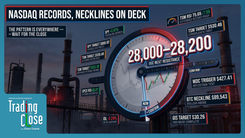
Traders must watch the head and shoulders pattern developing on the S&P 500. The critical neckline sits right around 6,790. While it has not triggered yet, a close below this level would confirm the pattern and signal further downside. With the State of the Union address tonight and NVIDIA earnings tomorrow, volatility could be the catalyst that resolves this pattern one way or the other.
The Great Divergence: Chips vs. Software
A fascinating "pairs trade" opportunity is emerging between the semiconductor sector and software stocks. Chip stocks remain relatively strong, bolstered by news that Meta has struck a 5-year deal with AMD, sending AMD shares up 10%. Conversely, software stocks have been "insanely weak," taking a beating on fears that AI will displace traditional software models.
Gareth drew a parallel to January 2025, when chip stocks collapsed 20-40% on fears that DeepSeek’s efficiency would reduce demand for expensive hardware. That fear proved temporary, and chip stocks rallied. Now, we are seeing the inverse: extreme fear in software.
"It's not to say that AI won't displace and kind of take over some of the software stuff, but I'm just saying it ultimately to me, the fear trade has gotten far too far in that direction."
This creates a scenario where chip stocks are overextended and due for a pullback (shorts), while beaten-down software names like Workday and Intuit are hitting major support zones (longs).
Workday and Intuit: Technical Value
- Workday: Down 40% since the start of the year, Workday is approaching a zone of massive support ahead of its earnings report. While a flush to $116 is possible, the risk-reward for a bounce is becoming attractive.
- Intuit: The stock has fallen from $675 to $350. It is currently bouncing off a technical zone hit yesterday, offering a prime example of a software play that has reached a statistical extreme.
Banking on a Breakdown: JP Morgan
The stress in the private credit market is visible in the charts of major banks. JP Morgan Chase has closed below a trendline that has been respected since July of last year. While we await confirmation of this breakdown, the downside targets are significant.
If the breakdown confirms, the first target is the former pivot high around $280, followed by a lower target of $266. Furthermore, a head and shoulders pattern on the daily chart suggests a measured move target as low as $256.
"If this confirms a breakdown, this should have significantly further downside to go."
Trading the Extremes: AMD and Keysight
In the current environment, finding an edge requires identifying stocks at technical extremes.
AMD: Following the Meta news, AMD spiked. However, chasing a gap up is rarely a winning strategy. The stock pierced resistance at $220. The next tradable intraday short levels to watch are $235.50 and the gap fill at $242.
Keysight Technologies: This stock is trading in the stratosphere at all-time highs around $277. When a stock goes vertical without clear historical resistance, finding a short entry is difficult. In these rare "blue sky" scenarios, traders often look to psychological round numbers. For Keysight, the $300 level serves as the only potential resistance anchor in the absence of other technical structures.
Home Depot: Conversely, Home Depot serves as a lesson in discipline. Despite rallying on earnings, the stock is neither at the highs nor the lows of its range. It sits in the "middle zone," offering no statistical advantage to the trader.
"Believe it or not, when you look at 10 stocks, maybe 9 of the 10 are no-touches… You're just really looking for that 1 out of 10 or 1 out of 20 that gives you that statistical high probability advantage."
Bitcoin and the Software Correlation
Bitcoin is currently trading below $63,000, sitting at the lower end of a bullish consolidation channel. Despite the Fear and Greed index hitting an extreme low of 5, the technical structure remains neutral to bullish as long as the channel holds.
A profound insight from today's analysis is the correlation between Bitcoin and the IGV (Expanded Tech Software ETF). When overlaid, the charts are nearly identical.
"It's very clear that Bitcoin is trading with software… It's also the fear that could AI crack crypto."
This correlation suggests that the market currently views crypto and software through the same lens—assets potentially disrupted by AI or linked to the same liquidity cycles. Traders should monitor the IGV for clues on Bitcoin's next move.
Commodities: Gold, Silver, and the End of Shale
The precious metals sector is showing signs of fatigue. Gold is pulling back, forming a potential bear wedge or inside bar consolidation. Silver remains trapped in a sideways chop with insane volatility—swinging from $72 to $89 in under a week—yet failing to crack resistance at $91-$92.
Oil: The energy sector presents a compelling long-term narrative. While short-term price action is dictated by geopolitical tensions involving Iran, the longer-term chart supports a bullish outlook based on the "End of the Shale Boom."
Data suggests that US shale drilling yields are depleting. After two years of drilling, wells are often 80% depleted. We are approaching a horizon where the US may lose its energy independence within five years.
"Think about that in six months, 12 months, when you start hearing that narrative, if oil starts to rally higher."
This structural supply issue, combined with geopolitical instability, suggests that oil remains a "buy on dip" asset for the patient investor.
Conclusion: Probabilities Over Narratives
As we look toward the State of the Union and key earnings reports, the market is filled with noise. However, the charts cut through the hype. Whether it is the topping pattern in the S&P 500, the breakdown in banking stocks, or the opportunity in beaten-down software, the key to success lies in ignoring the narrative and trading the probabilities.
By waiting for price to hit specific technical levels—like the $235.50 mark on AMD or the support zones in software—traders can maintain an edge. Remember, it is not about being right every time; it is about batting a high percentage and managing risk when the market moves against you.
Trading involves substantial risk. All content is for educational purposes only and should not be considered financial advice or recommendations to buy or sell any asset. Read full terms of service.