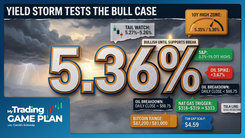

My Trading Game Plan Revealed - 03/13/2026: Oil Shock, Private Credit Risk, and Key Technical Targets

The financial markets are currently navigating a treacherous landscape of geopolitical conflict, shifting macroeconomic data, and extreme technical volatility. As traders digest a significant downward revision in GDP and the ongoing implications of the U.S. and Iran conflict, the importance of stripping away emotion and focusing purely on price action has never been more critical. In this morning's Friday edition of the My Trading Game Plan show, Gareth Soloway, Chief Market Strategist at VerifiedInvesting.com, broke down the exact levels, intermarket relationships, and hidden risks that institutional players are currently monitoring.
As Gareth frequently reminds his viewers: "Logic and charts beat hype and narratives every time." Today's article dives deeper into the technical setups and macroeconomic crosscurrents discussed in the show, providing traders with a comprehensive roadmap for the days and weeks ahead.
Macro Crosscurrents: GDP Revisions and the Inflation Illusion
The morning kicked off with a critical piece of macroeconomic data: the second revision of the Q4 2025 GDP. The numbers revealed a stark deceleration in economic growth.
"The initial number was a big 1.5% growth in the quarter. It's now been revised down to less than half of that number," Gareth noted, pointing out that the final print came in sharply weaker at just 0.7% growth.
For the average consumer feeling the pinch of the current economy, this downward revision aligns perfectly with reality. However, the market's reaction to this significant miss highlights a classic Wall Street dynamic: bad news can often be interpreted as good news. Equities largely shrugged off the weak growth data because a slowing economy suggests that runaway inflation might be contained, potentially bringing Federal Reserve rate cuts back to the table in 2026.
Simultaneously, the latest PCE (Personal Consumption Expenditures) data—the Fed's preferred inflation gauge—came in essentially in line with estimates. But there is a massive caveat that retail investors are missing: this PCE data is entirely backward-looking. It was collected before the recent geopolitical escalation and subsequent spike in energy markets. The market is ignoring this data because it knows the real inflation story will be told by the duration and severity of the current oil shock.
The S&P 500's Inverse Dance with Oil
To understand where the broader market is heading, traders must look at the energy sector. A fascinating inverse correlation played out in the pre-market hours, perfectly illustrating how energy prices are currently dictating equity flows.
Around 4:00 a.m., S&P 500 futures were trending lower while oil was pushing higher. But as soon as oil began to pull back on the 10-minute chart, equity futures caught a bid and reversed upward. With oil trading down slightly at $93.85 a barrel during the morning session, the S&P 500 was set to open in the green.
However, Friday trading sessions in the midst of a geopolitical crisis carry a unique psychological weight. Traders must navigate "weekend risk."
"Remember, last Sunday night, we went into the weekend with oil around $90 a barrel. By Sunday night into Monday, we had hit $120 a barrel," Gareth warned.
This memory is fresh in the minds of institutional traders. The closure of the Straits of Hormuz and the conflict between the U.S. and Iran means that holding short positions in oil over the weekend is incredibly dangerous. If fear escalates into Friday's close, we could see massive short covering in oil. If oil floats higher on weekend anxiety, traders should anticipate the S&P 500 to face heavy selling pressure.
S&P 500 Technicals: The Rounded Top
Looking at the daily chart of the S&P 500, the technical structure paints a cautious picture. The index remains trapped within a longer-term parallel channel, and a clear "rounded top" formation is essentially complete.
Historically, when the S&P 500 tags the upper parallel line of this channel—as it did during the 2021 bull market highs—it results in a significant sell-off. The index recently kissed this exact resistance trend line and was rejected, solidifying Gareth's strong bearish bias on the broader market.
While news-driven bounces are inevitable (such as a potential reopening of the Straits of Hormuz), the technical base case points to a pullback toward the 5,700 target zone. Should the selling accelerate, the ultimate downside target sits much lower, in the 5,500 to 5,600 range, where the upsloping ascending trend line currently resides.
The Hidden Threat: Private Credit and $40 Trillion in Debt
While retail investors are hyper-focused on oil prices and headline inflation, Gareth raised a massive red flag regarding a systemic risk that is flying under the radar: the private credit markets.
Mega-cap institutional money is currently under immense pressure, and there are deep structural issues brewing in private debt. "I think everyone right now is focusing on oil, but they really should be, it should be 50-50," Gareth explained. While $90 to $100 oil will undoubtedly slow the economy and drive inflation above 5% in the coming months, a crisis in the financial plumbing of the private credit markets could be equally, if not more, detrimental to the global economy.
This credit risk is compounded by the staggering trajectory of U.S. government debt. The massive expenditures associated with the Iran conflict are accelerating the nation's borrowing. The U.S. is currently crossing the $39 trillion debt threshold and is on pace to hit $40 trillion in just a couple of months.
This historic debt load is wreaking havoc on the bond market. While the 10-year yield was down slightly on the weak GDP print, the 30-year bond yield is trading very close to 52-week highs. Bond vigilantes are demanding higher interest rates to take on long-dated U.S. debt, a dynamic that will continue to pressure growth stocks and corporate borrowing costs.
Earnings Carnage: Strategic Setups in Adobe, SentinelOne, and Ulta
Earnings season continues to create extreme volatility, offering lucrative setups for traders who know how to separate day trades from swing trades. Gareth highlighted three specific names experiencing massive post-earnings distribution.
Adobe: A Historic Technical Breakdown
Adobe's chart is a testament to how far former market darlings can fall. Following weak guidance, the stock has been absolutely crushed. To put this in perspective: in February 2024, Adobe was trading above $640. Today, it is trading at $248.
More shockingly, Adobe has now broken below its 2020 COVID-19 crash lows. When a mega-cap technology stock breaks a multi-year foundational support level like a pandemic low, it signals a massive shift in institutional sentiment.
However, extreme sell-offs create technical inefficiencies, specifically gap fills. Gareth identified two precise day-trading levels for Adobe: a small gap fill at $238, and a secondary gap fill just below it at $235.
It is crucial to understand the psychological difference between a day trade and a swing trade. A day trade at $238 is meant to capture a quick intraday bounce—netting profits in minutes or hours based on a sudden technical reaction. A swing trade, however, requires a much more significant structural support level to hold for days or weeks. For Adobe, that swing trade level doesn't trigger until the stock reaches the major pivot lows around $206.
Ulta Beauty and SentinelOne
Ulta Beauty also faced heavy selling, dropping roughly 7% on lighter volume. The chart reveals a massive gap waiting to be filled at exactly $533.75. This serves as the primary day trade level. Should the weakness persist, the stock becomes an attractive swing trade candidate only if it flushes below the psychological $500 level.
Similarly, cybersecurity firm SentinelOne is facing post-earnings pressure. The stock has been trapped under a relentless descending trend line that has acted as resistance for an extended period. The immediate day trade support sits at a pivot low of $12.40.
The discipline required to wait for these exact levels—rather than catching falling knives in the middle of a panic—is what separates professional traders from retail gamblers.
Bitcoin: The Art of Trendlines and Shifting Sentiment
The cryptocurrency market provided one of the most profound lessons in market psychology and technical analysis. Back in October 2025, when Bitcoin was trading at $127,000, the mainstream narrative was overwhelmingly euphoric. Pundits like Tom Lee were calling for $250,000 by year-end.
Instead of following the hype, Gareth looked at a major trend line dating back to 2017 that connected through the 2021 highs. Bitcoin was hammering into that exact line. Recognizing it as massive historical resistance, he called the top.
Fast forward to today, and the sentiment has completely inverted. The crowd went from uber-bullish at the top to uber-bearish at the bottom. Yet, Bitcoin is now pushing higher, up $2,300 (+3.3%) on the day, trading near $72,000 to $73,000.
Finessing the Charts
During the show, Gareth demonstrated a high-level technical concept: the evolution of trend lines.
"Maybe the right trend line, and this is the amazing thing about trading, right, is that you have to be an artist in a way," he explained while adjusting his support line to connect a series of high-to-high pivots that the price had pierced but never closed above, before finally breaking out and retesting the "scene of the crime."
This adjustment confirmed that Bitcoin has likely already triggered a bullish breakout. The immediate technical hurdle is the $74,000 level. If Bitcoin can break and close above $74,000, it opens the door to Gareth's long-standing upside target of $80,000 to $85,000. The inside bar formation on the daily chart remains intact, signaling that the bulls are quietly accumulating for the next leg higher.
Precious Metals: Diverging Paths for Gold and Silver
The precious metals complex is currently flashing warning signs, with both gold and silver exhibiting bearish near-term patterns.
Gold is firmly entrenched in a bear flag formation. This pattern—characterized by a sharp drop followed by a weak, upward-drifting consolidation—typically resolves to the downside. Traders should anticipate a flush early next week, with the next major support level sitting at $4,865. Conversely, if gold invalidates the bear flag and breaks above the $5,400 pivot with confirmation, it would set the stage for a retest of the all-time highs at $5,600.
Silver is painting a similarly precarious picture. After a sharp down move, it formed an inside bar and is currently experiencing a flat trading day. The technicals suggest that within the next two weeks, silver will test critical support in the $70 to $71 range.
Traders must watch this $70 to $71 level on silver with extreme caution. If that support breaks, there is a severe lack of historical price structure below it. It opens what technicians call a "trap door," potentially sending silver into a freefall down to the $50 to $54 range.
Interestingly, natural gas—typically one of the most volatile commodities on the board—is experiencing a relatively quiet pullback. The historical volatility dynamic between oil and natural gas has completely flipped, with geopolitical events forcing oil to take the driver's seat while natural gas consolidates without offering any immediate high-probability trade setups.
Conclusion: Discipline in the Face of Volatility
The current market environment is a masterclass in conflicting signals. We have weakening GDP data masked by the threat of $100 oil, a stock market ignoring a looming $40 trillion debt crisis, and extreme emotional swings in assets like Bitcoin and mega-cap tech.
Navigating this requires an unwavering commitment to price action. Whether it is waiting for Adobe to hit $238 for a day trade, monitoring the S&P 500's reaction to the 5,700 level, or watching for Bitcoin to clear $74,000, success in this market relies on predefined levels and strict risk management.
As we head into a weekend fraught with geopolitical headline risk, traders must remain objective. The charts will always reveal the footprints of institutional money—it is simply up to the disciplined trader to read them and execute without emotion.
Trading involves substantial risk. All content is for educational purposes only and should not be considered financial advice or recommendations to buy or sell any asset. Read full terms of service.