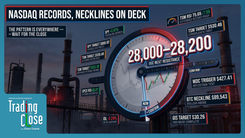

Trading The Close Market Recap - 03/11/2026: Oil Spike Threatens Equities; Bitcoin Make-or-Break at $73K

The latest inflation data may have come in line with expectations this morning, but beneath the surface of the headline numbers, a complex and potentially volatile market environment is brewing. While the broader markets initially attempted to digest the data, the underlying reality of spiking energy prices threatens to introduce delayed inflationary effects that institutions are already positioning for. In this afternoon's Trading The Close show, Pro Trader Drew Dosek at Verified Investing broke down the muted price action, the critical inverse relationship between oil and equities, and the precise technical levels that will dictate the market's next major move.
For traders navigating this choppy environment, understanding the deeper technical structures and the psychology driving institutional capital is paramount to finding success.
The Volume Void and S&P 500 Vulnerability
One of the most glaring warning signs in today's market was the severe lack of institutional participation. When major players step aside, markets often drift aimlessly or become susceptible to sudden, news-driven algorithmic spikes.
"A lot of muted price action today in the markets, and it's very evident institutions aren't participating," Drew noted.
This absence of volume was starkly visible on the S&P 500. Yesterday, the index saw 81 million shares traded, with a significant portion of that volume flooding in late in the day due to breaking geopolitical news regarding mines in the Strait of Hormuz. Today, however, volume completely dried up, with only 66 million shares traded for the session—and a mere 47 million by 2:20 PM Eastern. Historically, when volume evaporates at pivotal chart locations, it often signals a top or a major change in directional trend.
From a technical perspective, the S&P 500 is walking a tightrope. The SPY exchange-traded fund needs to close underneath a critical red candle level at 669.76 to confirm a breakdown. If price action confirms a close under this level, the probabilities dramatically increase for a flush down to the next major support target at 652.84. Conversely, if the index remains underneath its inclining trend line and closes right at 679.18, the probabilities still heavily favor more downside in the future.
Traders must remember that low-volume environments are notoriously tricky. Without the heavy hand of institutional buying to support elevated prices, the path of least resistance often skews downward, particularly when external macroeconomic pressures begin to mount.
The Oil-Equity Inverse Relationship: The Real Story
While the broader indices chopped sideways, the true driver of current market mechanics is happening in the energy sector. The geopolitical tensions in the Strait of Hormuz have created a massive spike in US Oil, and this price action is acting as a direct headwind for equities.
"When oil goes up, the S&P 500 is going down," Drew explained, highlighting the intense sensitivity between these two assets.
However, parabolic moves in commodities often create exceptional trading opportunities for those who rely on technicals rather than emotional news narratives. The massive spike in oil earlier this week ran directly into a declining trend line, printing a textbook daily topping tail. While retail traders were panicking over headlines, the Verified Investing live day trading room trusted the charts, utilizing the SCO (ProShares UltraShort Bloomberg Crude Oil) to bank nearly $40,000 in profit on Monday alone.
This is the power of technical analysis. A violent, sharp move into major resistance should always yield a pause and a likely rejection. Currently, oil is maintaining its range, but the levels are clearly defined. If oil pushes higher and breaks $98.11, investors can almost guarantee the S&P 500 will suffer a severe pullback as capital flees the stock market. Conversely, if geopolitical tensions ease, oil has a clear path to break through support at $75, eventually targeting $71.26.
Interestingly, Natural Gas—which also flows through the Strait of Hormuz—has not seen the same sustained panic buying, indicating that investors are still dumping the asset despite geopolitical risks. Natural gas recently regained entrance into its parallel channel, and a daily close above $3.22 will open the door for a high-probability push to $3.58.
Earnings Psychology and The "Priced to Perfection" Reversal
Earnings season is a psychological battlefield, and today's reaction to Oracle's (ORCL) report provided a masterclass in market expectations versus technical realities. Oracle reported decent, albeit not stellar, earnings and guidance. Yet, the stock caught a bid. To understand why, we have to look at the historical chart context.
Oracle had recently suffered a brutal decline, plummeting from $340 down to under $150—an over 50% haircut without a substantial bounce. When a stock is beaten down this severely, the bar for "good news" is drastically lowered.
"It not only needed a perfect beat, but it needed perfect guidance above analyst expectations," Drew noted, explaining why high-flying stocks often crash on great earnings. The inverse is true for crushed stocks like Oracle; they are priced for disaster, so any mediocre news sparks a relief rally.
Technically, Oracle's bounce is fascinating. The stock paused precisely at the 50% mark of a massive parallel channel that dates back 26 years to the dot-com bubble burst. Price action halted right at $168.33 before attempting to push higher. Looking ahead, Oracle faces its next major resistance at $177.16, followed by $187. This setup perfectly illustrates why traders must zoom out to weekly and monthly timeframes to find the true algorithmic levels governing price action.
Moving Average Mastery: Microsoft and Tesla
Understanding how institutional algorithms interact with simple moving averages (SMAs) is crucial for navigating mega-cap tech stocks. Today's analysis of Microsoft (MSFT) and Tesla (TSLA) provided excellent examples of these mechanics in real-time.
Microsoft has managed to climb back inside its parallel channel and is currently trading above its 20-day moving average. However, the 50-day moving average is barreling down from above, acting as dynamic resistance. Currently sitting at $432.90, this 50 SMA will continue to drop each day, eventually meeting price action. Traders should watch this level closely; as long as Microsoft stays above the 20 SMA, it has the probability to push up and test that 50 SMA rejection point.
Tesla, meanwhile, offered a lesson in trend line exhaustion and the power of the 200-day SMA. Despite positive news that year-over-year sales in China increased by 91%, Tesla spiked directly into a declining trend line and was rejected. This marks the third hit on this specific resistance line. In technical analysis, the more a level is tested, the weaker it becomes. The fourth hit will present a 50-50 chance of breaking through to the next resistance target at $426.26.
Supporting Tesla from below is the 200-day moving average, often referred to by Drew as the "brick wall." When price drops sharply into the 200 SMA, it typically yields a massive bounce. Because Tesla has chopped sideways into this moving average rather than dropping sharply, the bounce has been muted—like skipping a stone across water. Still, this area, coupled with horizontal support at $387.50, provides a massive floor for the stock as it battles overhead resistance.
The Cryptocurrency Crossroads: Bitcoin's Make or Break
Bitcoin is currently trading at a generational inflection point. While the cryptocurrency managed a slight 0.72% gain today, it is trapped under a massive technical ceiling that will dictate its macro trend for the remainder of the year.
"That line, $73,173, is seriously the make or break point for Bitcoin on a daily closing basis," Drew emphasized.
In technical analysis, intraday wicks are noise; daily closes are the signal. If Bitcoin can secure a daily close above $73,173, the probabilities shift heavily in favor of the bulls, opening the door for a run to resistance at $80,000, and ultimately the massive head and shoulders neckline at $84,000.
However, if Bitcoin fails to close above $73,173, the macro head and shoulders pattern remains valid. As long as price remains under that $84,000 neckline, the measured move target for this bearish formation points to a devastating drop under $40,000. Traders must remain nimble and strip away their long-term biases. Near-term bullish bounces can be highly profitable, but the overarching macro structure demands strict risk management.
Sector Rotations: Semiconductors and Precious Metals
While the broader markets stalled, the semiconductor sector showed relative strength. The SMH ETF led the indices, up 0.93%, though it remained trapped within the previous day's trading range. The levels here are clearly defined: resistance sits overhead at $407.40, with support at the bottom of the parallel channel at $385.49, followed by previous pivot support at $379.05.
Within the sector, NBIS provided a textbook "gap and go" river theory setup following news of a $2 billion investment from Nvidia. The stock gapped over its declining trend line resistance at $102, though it failed to reach the next major target at $115.28. The play here is patience. Traders should wait for a confirmed daily close above today's candle. If that occurs, any pullback to the declining trend line at $98.22, or the inclining trend line at $96.42, becomes a high-probability buying opportunity. The ultimate macro target for NBIS, based on a weekly trend line dating back to 2013, sits at $134.93.
Finally, the precious metals market is flashing warning signs. Gold is currently forming a bearish consolidation pattern. The longer it chops sideways without testing the top of its recent range, the higher the probability of a breakdown. The critical trend line support to watch tomorrow sits at $5,081.05; if that breaks, gold is likely heading down to $4,837.
Silver is exhibiting similar weakness, pulling back inside its parallel channel. While it has made higher lows recently, it desperately needs to break above the top of its channel to negate the bearish structure. If it fails, probabilities dictate a drop down to inclining trend line support near $62.
The Discipline of the Chart
Today's market action serves as a powerful reminder that narratives and news headlines are secondary to price action and volume. Whether it's the lack of institutional participation in the S&P 500, the inverse relationship between oil and equities, or the make-or-break levels on Bitcoin, the charts provide a roadmap devoid of emotion.
By focusing on multi-factor technical analysis, respecting historical parallel channels, and understanding the psychology behind earnings reactions, traders can position themselves alongside institutional capital rather than becoming liquidity for it. As we move forward into the rest of the week, maintaining strict discipline, honoring stop losses, and waiting for price to come to your predefined levels will be the keys to navigating this complex market environment.
Trading involves substantial risk. All content is for educational purposes only and should not be considered financial advice or recommendations to buy or sell any asset. Read full terms of service.