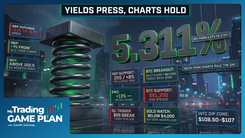

Trading The Close Market Recap - 03/10/2026: Strait of Hormuz Shock Sparks Oil Surge and S&P Breakdown

The financial markets are a delicate ecosystem, highly sensitive to the sudden shockwaves of geopolitical events. Today's trading session served as a textbook example of how rapidly sentiment can shift when global supply chains are threatened. After staging an impressive rally for most of the day, equities violently reversed course in the afternoon following alarming news out of the Middle East. In today's Trading The Close, Pro Trader Drew Dosek at VerifiedInvesting.com broke down the technical damage, the critical support levels to watch, and the psychological discipline required to navigate this sudden "fog of war."
The Geopolitical Shockwave and Market Volume
The defining moment of today's session arrived at 2:00 PM EST with the announcement that Iran was placing mines in the Strait of Hormuz. Historically, the Strait of Hormuz is the world's most critical chokepoint for global energy supplies. Any disruption there doesn't just impact the price of crude; it sends a ripple effect through the cost of all transported goods, immediately reigniting inflation fears.
As Drew noted, "That's obviously going to disrupt the transition of goods through that Strait, and that's really been the highlight of what the market's been paying attention to recently."
However, the most telling aspect of today's market action wasn't just the news itself, but the volume footprint left behind. The S&P 500 traded 80 million shares today. While that figure appears healthy on the surface, a deeper dive into the 10-minute chart reveals a concerning reality for the bulls: the morning's upward price action lacked institutional muscle.
"If you look a little bit closer into the markets, you can start to see that this rally didn't really have the muscle behind it, and what I'm talking about is volume," Drew explained. The lion's share of today's 80 million shares was transacted after the 2:00 PM geopolitical announcement, indicating that institutional distribution (selling) was the dominant force of the day.
S&P 500 and NASDAQ: Technical Vulnerability
From a technical standpoint, the S&P 500 has been trapped in a frustrating sideways consolidation range since October of last year. Today's afternoon selloff pushed the index to close on the underside of its primary make-or-break trend line.
While closing beneath this trend line shifts the probabilities in favor of the bears, confirmation is still required. To solidify this breakdown, the S&P 500 needs to close beneath the low of the red candle established on Friday, March 6, which sits at 669.76 on the SPY ETF. Until that level is breached, the trend line remains vulnerable to an upside reclaim. However, if 669.76 is lost, the floodgates for selling pressure will likely open, targeting the next major support zone at 652.84.
The NASDAQ paints a similarly precarious picture. The tech-heavy index has developed a bearish wedge pattern following the break of its macro trend from the April lows. Today, price action was rejected precisely at the 50% area of a smaller parallel channel, closing within the confines of the wedge. The NASDAQ now faces immediate resistance at 25,486, with critical downside support levels waiting at 24,117 and 23,823.
The Fog of War: Oil Spikes While Gold Hesitates
When geopolitical tensions escalate, intermarket analysis becomes a trader's most valuable tool. The immediate reaction in US Oil was explosive. Following the 2:00 PM announcement, oil ripped higher from $81 directly to $86, slicing through intraday resistance levels.
Prior to the news, oil had printed a daily topping tail—a classic bearish reversal signal. However, news supersedes technicals in the immediate short term. Oil now sits on a newly established support level at $86.46. If the turmoil in the Middle East continues to escalate, the next upside targets for crude are $98.11, followed by a potential surge to $103.15.
While oil's reaction was entirely predictable, the precious metals market is flashing a curious divergence. Gold finished the day up 1%, tagging $5,233, but it remains trapped underneath the 61.8% Fibonacci retracement level. More importantly, it is struggling to reclaim the 50% retracement area at $5,188.
"The markets right now are in a bit of a fog," Drew observed. "Investors, when they don't know what's happening, they go into gold… Gold should be pushing much, much higher right now, and it's not doing that. And I think that's very curious."
This hesitation in gold is a massive "tell" for astute traders. In a true panic, safe-haven assets should be breaking to new all-time highs. The fact that gold is consolidating rather than exploding suggests that smart money may be waiting for further confirmation before fully pricing in a worst-case geopolitical scenario. Probabilities will only shift back to the bulls if gold can secure a daily close above the $5,188 level.
Silver, meanwhile, showed relative strength, pushing up 1.83% and breaking above the top end of its parallel channel. If it can maintain this breakout, the next near-term resistance sits at $96.39. However, traders must remain vigilant, as the broader macro pattern for silver remains bearish, with a potential downside target looming near $62.
Semiconductors: The Market's Leading Indicator
To gauge the true health of the equity markets, professional traders look to the semiconductors. The SMH ETF acts as the ultimate leading indicator for risk appetite. Today, the SMH finished up 0.75%, leading the broader market until the afternoon news struck. Going into tomorrow, traders must watch resistance at $407.40 and critical parallel bottom support at $382.60.
Individual semiconductor names provided some of the day's most compelling technical setups:
Micron (MU): Despite selling off late in the day, Micron managed to close up 3.54%, maintaining its position inside the top 50% of its parallel channel. Tomorrow is a pivotal day; if bulls can push the price higher, it will flip the 50% area into firm support at $393.37, opening the door for a re-attack of the highs at $454.
Coherent Corp (COHR): COHR pushed higher today but left a noticeable upper wick. It must hold support at $250.75. If it can maintain its footing in the upper half of its channel, a run to all-time highs at $312.28 is on the table.
Western Digital (WDC): WDC printed a daily topping tail, closing at $266.22. It faces heavy resistance at $287. If it manages to clear that hurdle, it has a clear path to all-time highs between 288 and 307, with a psychological pit stop at $300. This setup is particularly ripe for a potential short-term swing trade short if the price becomes overextended.
The Psychology of the Break and Retest
Perhaps the most valuable segment of today's Trading The Close Market Recap was Pro Trader Drew's masterclass on trading psychology and the "break and retest" strategy, perfectly illustrated by the chart of Applied Materials (AMAT).
AMAT finished the day up 2.05%, halting its advance precisely at the 50% parallel resistance level of $350.95. But the real lesson was in how AMAT arrived there. Recently, the stock broke out of a parallel channel, surged higher, and then violently pulled back to retest the exact top of the channel it had just broken out of. This retest resulted in a massive 30% bounce.
Retail traders often fall victim to FOMO (Fear Of Missing Out) when a stock breaks out, buying at the absolute top only to be crushed by the inevitable pullback. Professional traders take the opposite approach.
"These are some of my favorite plays to make in the stock market," Drew emphasized. "When you notice a breakout situation, and you may be kicking yourself, saying, 'Man, I should have gotten in this stock, I knew what was going to break out.' Don't hurt yourself mentally going through that trouble. Instead, sit back, set a reminder when price is going to retrace to this area, and then buy the stock at that point."
This level of patience is what separates consistently profitable traders from gamblers. The market is a psychological battlefield. As Drew candidly pointed out, "The markets are designed to whip us out of positions, put us at our max stress levels so that we just don't want to do anything else but get out of the trade." By waiting for the retest, you align your entry with institutional support, drastically reducing your risk and emotional stress.
We saw a similar retest play out today in APP, which went all the way back up to test a broken trend line before facing selling pressure. APP now looks toward support at $426.39 as its next battleground.
The Crypto Complex: A Tale of Two Timeframes
The cryptocurrency market provided a fascinating study in conflicting timeframes today. Bitcoin enjoyed a solid session, closing up 2.67%. It is currently pressing against a critical resistance line that it has tested multiple times since early March. If Bitcoin can secure a daily close above this line, the immediate bullish target is an inclining trend line near $84,000.
However, traders must not let near-term bullishness blind them to macro dangers. Zooming out, Bitcoin is carving out a massive head and shoulders pattern.
"I want to caution you to be nimble at this certain level because this is a larger head and shoulders pattern… with a potential measured move down here under $40,000, one that I do think can get hit this year," Drew warned. For long-term investors, this implies that hoarding cash now could provide a generational buying opportunity sub-$50,000, or even sub-$40,000, by August or September.
This duality is mirrored in MicroStrategy (MSTR). The stock has suffered a brutal 60% haircut since July, with its recent lows representing a 77% drawdown. Currently down 69% from its peak, MSTR has formed a V-shaped recovery and is in a phase of bullish consolidation. If Bitcoin pushes toward $84,000, MSTR is primed to hit resistance at $187.49, with an ultimate bullish target of $239.03.
Broader Market Weakness: IWM and Natural Gas
While tech and crypto battled resistance, other areas of the market showed distinct weakness. The Russell 2000 (IWM) printed a narrow body bar candle, giving up early gains to finish down 0.1%. The small-cap index remains under the heavy influence of a head and shoulders pattern, with a measured move target pointing directly to the $241 level.
Natural Gas took a relatively quiet day, finishing up 0.76%. However, it remains trapped at the bottom of a parallel channel, facing resistance at $3.58. Interestingly, Natural Gas recently missed tagging a prime buy-zone target at $2.71. If geopolitical tensions ease, expect Natural Gas to make another attempt at that lower support level.
Conclusion: Preparation Meets Opportunity
Today's market action is a stark reminder that technical levels are the only objective truth in a market driven by unpredictable headlines. The sudden escalation in the Strait of Hormuz completely derailed a low-volume rally, trapping late buyers and rewarding patient short-sellers who respected key resistance zones.
As we look toward tomorrow, the stakes are raised even higher. At 8:30 AM EST, critical inflation data will be released, virtually guaranteeing extreme pre-market and opening bell volatility. In environments like this, guessing is a recipe for disaster. Success requires mapping out your levels, understanding the probabilities, and waiting for the market to come to you.
The value of this disciplined, probability-based approach is undeniable. As Drew Dosek highlighted, the Verified Investing live day trading room has already secured over $76,000 in profit this week alone by strictly adhering to these technical principles and ignoring the emotional noise of the news cycle.
Whether the S&P 500 confirms its breakdown tomorrow or stages a miraculous recovery, the blueprint is set. Manage your risk, respect the volume, and never let the fog of war cloud your technical judgment.
Trading involves substantial risk. All content is for educational purposes only and should not be considered financial advice or recommendations to buy or sell any asset. Read full terms of service.