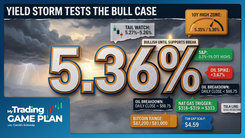

Trading The Close Market Recap - 03/09/2026: S&P Trendline Test After Oil Plunge, Bitcoin Warning & Semis Risk

The trading session we just witnessed will likely go down as a textbook example of why emotional control and technical discipline are paramount in modern markets. If you stepped away from your screens and only checked the closing bells, you might assume it was a quiet, bullish day. However, beneath the surface of the final green prints lay a volatile, news-driven rollercoaster that tested key technical levels across equities, commodities, and cryptocurrencies.
In this afternoon's Trading The Close, Pro Trader Drew Dosek at Verified Investing broke down the intraday whiplash, highlighting how a massive geopolitical shift in the energy sector sparked a dramatic market reversal. With critical inflation data looming on Wednesday morning at 8:30 AM EST and GDP numbers arriving Friday, understanding the technical architecture of today's price action is crucial for positioning heading into the rest of the week.
The S&P 500 and Nasdaq: A Tale of Two Technicals
The broader market narrative today was defined by a massive intraday recovery. Early in the session, the S&P 500 looked incredibly vulnerable, trading heavily to the downside. As Drew noted:
"…the markets, oh my gosh, you would just almost wake up and look at the markets right now. If you took a nap all day, you would think nothing was wrong."
The S&P 500 briefly plunged beneath critical support at 671.26 on the SPY ETF, threatening a severe technical breakdown. However, the index staged a mammoth rally to close the day right underneath a key inclining trend line. This specific closing print is technically fascinating. By closing just below the trend line, the market has not yet confirmed a bullish reclamation, nor has it confirmed a catastrophic breakdown. It is effectively in technical purgatory.
Historically, when an index breaks a major trend line and rallies back to "kiss" the underside of it, it sets up a binary outcome. It either serves as the ultimate lower-high before a deeper selloff, or it acts as a springboard to trap early short-sellers. Tomorrow, the absolute make-or-break level to watch on the SPY is 678.97. A failure to overtake this level could invite the bears back in force.
The Nasdaq, meanwhile, displayed relative strength, pushing up 1.32% on the day. Unlike the S&P 500, the Nasdaq managed to secure itself back above its own inclining trend line, closing above the critical 24,696 point level. This effectively negated Friday's bearish price action. However, the tech-heavy index has been trapped in a sideways consolidation phase since February 12th. Until it breaks decisively from this range, traders should expect continued chop and respect the boundaries of this multi-week consolidation.
The Oil Collapse: Deflating the Stagflation Fear
The true catalyst for the equity market's miraculous recovery was the spectacular collapse in crude oil. Overnight, US oil futures went parabolic, ripping upward by over 20% in a move that sent shockwaves through premarket trading.
"When stocks or commodities rip off the charts, it creates air pockets," Drew explained, highlighting the danger of chasing extended moves.
Gravity eventually took hold, driven by a major geopolitical headline. The administration announced that the four-to-five-week operation in Iran is largely complete, potentially cutting the timeline short by two weeks. While the exact end date remains somewhat vague, the market immediately priced in the de-escalation. Oil slammed into a massive declining trend line dating back to June of 2022, formed a 10-minute topping tail, and subsequently collapsed to $85.33.
This drop in oil was the exact relief valve the equity markets needed. Prior to the collapse, investors were aggressively pricing in stagflation—the dreaded economic combination of stagnant growth and high inflation. Spiking oil prices threatened to force the FOMC's hand, potentially taking rate cuts off the table entirely. As oil plummeted, those fears subsided, allowing equities to catch a massive bid.
While Pro Trader Drew anticipates a potential technical reflex bounce in oil back up toward the $100 level due to the sheer velocity of the drop, the broader trajectory points to further downside.
In the natural gas sector, the commodity attempted to push up to resistance at $3.58 but was aggressively rejected by the end of the day. It remains trapped underneath a parallel channel, marking its fourth failed attempt to break back inside since February 23rd. The technicals suggest that the $2.71 level must be tagged before any sustainable upward momentum can materialize.
Sector Spotlights: Semiconductors and Small Caps
The semiconductor space, tracked via the SMH ETF, provided a masterclass in repetitive market geometry. After several days of declining price action, the SMH tagged a familiar inclining yellow trend line and an inclining parallel channel, sparking a sharp bounce.
However, traders need to zoom out and look at the broader pattern forming. The SMH is currently carving out what appears to be the right shoulder of a massive Head and Shoulders pattern. While this pattern is still in its formative stages (TBD on whether it fully triggers), it is a structural warning sign. If the current rally continues, heavy resistance sits at $410.33, with the ultimate bullish target resting at the 50% area of the parallel channel at $418.93.
The Russell 2000 (IWM) offers a look at a chart that has already triggered its Head and Shoulders pattern. The small-cap index broke its neckline, confirming the bearish setup, yet managed to rally back today to save the psychological $250 level as support, finishing the day up over 1%.
Despite today's impressive 1% recovery, the triggered pattern dictates caution. The next overhead resistance sits at $256.80, and the overarching technical probabilities suggest the IWM will eventually meander down to its target of $241.78. Small caps are notoriously sensitive to interest rates and inflation data, making this week's upcoming macro reports critical for the IWM's next directional move.
Bitcoin's Warning and the Precious Metals Divergence
One of the most profound technical insights from today's show involved using Bitcoin's historical price action as a leading indicator for the S&P 500.
Pro Trader Drew drew a direct parallel between Bitcoin's recent chart breakdown and the current precarious position of the S&P 500. Recently, Bitcoin broke its key inclining trend line, retested the underside of it three or four times, and then collapsed lower. With the S&P 500 currently retesting the underside of its own broken trend line, equity traders should view Bitcoin's past behavior as a stark warning of what could happen if the S&P fails to reclaim its trend.
For Bitcoin itself, the cryptocurrency remains stuck in a tight consolidation range. The absolute line in the sand is the high of the Thursday, February 5th red candle at $73,173. Bitcoin has repeatedly failed to close above this level. Traders must watch the 8:00 PM Eastern time daily close; if Bitcoin can secure a daily close above $73,173, it opens the door for a push to $80,000, and potentially as high as $84,000. Until then, it is dead money trapped in a range.
In the precious metals market, Gold experienced a slight decline but remains entrenched in a bearish consolidation pattern. Despite the "risk-on" rally in equities, Gold tested its trend line and the 50% area of its parallel channel as support. If this bearish consolidation persists, probabilities point to further downside toward the next major support at $4,846.
Silver, conversely, had a strong showing, up 2.27% on the day. However, this single-day pop does not negate the broader bearish structure. The metal is still consolidating sideways after a move down from the highs. The one silver lining for bulls is that the metal is carving out higher lows during this consolidation. Still, until it breaks out, the technical expectation remains a deeper decline to $62.26.
The Airlines, Fibonacci Precision, and Premarket Illusions
The airline sector bore the brunt of the early morning oil spike, but the subsequent technical recoveries provided incredible trading opportunities for those who understand Fibonacci retracements and multi-factor support.
Southwest Airlines (LUV) suffered a dramatic early decline, dropping as low as $38.82. For the untrained eye, this looked like a freefall. But for technical traders, it was a precise strike of the 61.8% Fibonacci retracement level—often referred to as the "golden ratio" and one of the highest-probability bounce zones in technical analysis.
Furthermore, this Fibonacci level perfectly coincided with a longer-term trend line, creating a multi-factor support zone. LUV bounced beautifully off this level. Should the stock face further pressure, additional support rests at $38.25 and $37.68. The conservative bounce target for this recovery is now set at $46.72.
United Airlines (UAL) mirrored this price action, facing mammoth early pressure before finishing the day up 2.66%. The stock was technically oversold heading into major support at $85.60, with secondary support waiting at the 50% parallel area of $82.63. The sharp technical bounce played out exactly as historical chart patterns dictate.
Elsewhere in the market, Dow Inc. (DOW) has been on an absolute tear, pushing up 62% since its November lows. However, this high-flying momentum is bringing the stock into overbought territory as it approaches a major declining resistance trend line at $38.44. This level represents a highly logical area for traders to lock in profits and wait for a technical pullback before re-engaging.
Similarly, Vertiv (VRT) is breaking off the charts at all-time highs. The stock is perfectly respecting the top end of an inclining parallel channel. Chasing the stock at these extended levels carries immense risk. Patient traders should wait for a pullback to the bottom inclining trend line, which coincides with the 50% parallel area around $186.80, offering a much higher-probability entry point.
Finally, Western Digital (WDC) provided a crucial lesson in market mechanics. In premarket trading, WDC was trading comfortably beneath its parallel channel, leading many to anticipate a plunge down to the 220 level. However, once the opening bell rang, the stock opened right on the bottom of the parallel channel and surged higher.
"…premarket trading action is less and lighter in volume. All of the action during regular market hours trumps anything pre- or post-market," Drew emphasized.
This is a vital reminder that premarket price action is often a mirage driven by low liquidity and emotional retail reactions. True technical levels are validated by institutional volume during regular trading hours.
Conclusion: Discipline Ahead of the Data
Today's session was a vivid reminder that market narratives can flip in an instant. The overnight panic surrounding oil and stagflation evaporated by the afternoon, replaced by a furious short-covering rally that brought major indices right back to the brink of critical resistance.
As we look toward Wednesday's pre-market inflation data and Friday's GDP numbers, the technical lines in the sand have been clearly drawn. Whether it's the S&P 500's battle at 678.97, Bitcoin's struggle at $73,173, or the looming Head and Shoulders patterns in the semiconductor and small-cap spaces, the market is coiled for its next major directional move.
Success in this environment requires stripping away the emotional noise of the news cycle and relying strictly on the charts. By waiting for multi-factor technical setups, respecting regular trading hour volume, and understanding the macroeconomic currents driving the tape, traders can navigate the volatility with confidence. Stay disciplined, trust your levels, and let the probabilities play out.
Trading involves substantial risk. All content is for educational purposes only and should not be considered financial advice or recommendations to buy or sell any asset. Read full terms of service.