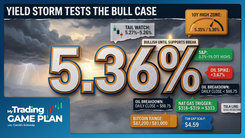

My Trading Game Plan Revealed - 03/25/2026: S&P 500 Head and Shoulders Warning as Oil Collapse Sparks Multi-Week Bounce

Overnight geopolitical developments have sent shockwaves through the financial markets, creating a complex web of technical setups that savvy investors must navigate with precision. Following news of a potential 15-point peace plan sent by the US to Iran, oil markets collapsed while equity futures surged, setting the stage for a highly technical trading environment.
In this morning's My Trading Game Plan show, Gareth Soloway, Chief Market Strategist at Verified Investing, broke down the intricate relationship between these macro catalysts and the charts. By stripping away the emotional hype and focusing purely on technical analysis and data, he revealed a roadmap for what could be a deceptive multi-week market bounce, alongside critical setups in crypto, precious metals, and individual equities.
The S&P 500: A Multi-Week Bounce or a Bull Trap?
The overnight action in the S&P 500 futures provided a masterclass in technical support and resistance. Following the after-hours news, the futures market saw an immediate surge. The high of that initial pop quickly established itself as short-term resistance, while the underbelly of the pullback formed a rigid support floor.
Looking at the broader daily chart, the S&P 500 is entering what appears to be a multi-week bounce phase. However, understanding why this bounce is occurring is what separates professional traders from retail gamblers. It is not simply a matter of the market being "oversold." Instead, it is the result of a powerful multi-factor technical confluence.
"Once you start adding additional factors, it creates a firmer level of support," Gareth explained.
By drawing a Fibonacci retracement tool from the tariff sell-off low of April 2025 directly to the all-time high, a precise 0.236 Fibonacci level emerges. When this mathematical retracement aligns perfectly with a historical trendline zone, it creates a high-probability bounce area.
However, investors should not mistake this anticipated 1-to-2-week choppy upward movement for a return to all-time highs. The broader technical structure is painting a much more ominous picture.
The Looming Head and Shoulders
While the near-term action may get the bulls back on board, the structural pattern forming on the S&P 500 is highly concerning. The recent market top has formed the "head" of a massive Head and Shoulders pattern. The current multi-week bounce that Gareth is projecting will likely serve to form the "right shoulder" of this bearish formation.
The psychology behind this pattern is crucial to understand. As the market bounces and chops its way higher over the next couple of weeks, fear will dissipate. Retail investors will assume the worst is over and rush back into the market, driven by greed.
"The more fear, the more likely we bounce. The more greed in the markets, the more likely we fall. It's usually inverse when you get the crowds at extremes," Gareth noted.
Once this right shoulder completes, the technical targets to the downside are severe. The initial target sits at 6,800, with secondary targets at 6,100, and eventually a drop to 5,600 at the low end of the broader parallel channel.
The Macro Triad: Oil, Yields, and the Dollar
To understand the equity market's bounce, one must look at the interconnected macro triad: oil, the US Dollar, and Treasury yields. The overnight news regarding the Middle East acted as the fundamental catalyst, but the charts were already primed for these moves.
Oil, which had been trading above $100, formed a textbook inside bar pattern followed by a bear flag. This bearish setup triggered a sharp drop, and the technical trajectory suggests oil is heading back below $80 a barrel.
This decline in energy prices provides immediate psychological relief regarding sticky inflation. Consequently, this impacts the bond market. Treasury yields had recently spiked into a massive zone of historical resistance. With oil cooling off, yields are naturally pulling back from this resistance ceiling.
Simultaneously, the US Dollar just hit what Gareth described as "epic resistance." When the Dollar pulls back, it signals an abatement of the global fear trade. A weaker Dollar and falling yields historically provide the exact liquidity relief needed to spark a multi-week rally in risk assets like the S&P 500.
The Hidden Threat: Private Credit
While the mainstream financial media focuses on the Middle East and oil prices, the true systemic risk may lie elsewhere. Gareth drew a chilling parallel to early 2008, noting that the private credit crisis is not over—it is just beginning.
"Oil was just a distraction… you have the private credit markets. We saw yesterday, Oracle falling again, Microsoft falling again… these software stocks are beginning to roll over again," he warned.
Professional traders must think like chess players, looking three to four moves ahead. The current sequence—oil dropping, yields falling, and the market bouncing—is only the first few moves. The subsequent moves will likely be dictated by a slowing economy, sticky core inflation, and the unraveling of the private credit markets, which will ultimately trigger the breakdown of the S&P 500's Head and Shoulders pattern.
Precious Metals: The Safe Haven Paradox
The precious metals market is currently exhibiting fascinating price action that reveals a lot about underlying market psychology. While Gareth is near-term bullish on both gold and silver, he emphasized that they have not yet reached their ultimate, long-term macro bottoms.
The telltale sign? Gold and silver are currently moving in tandem with risk assets like the stock market.
Historically, gold is the ultimate safe-haven asset. It should move inversely to risk assets during times of panic. The fact that gold is bouncing with the stock market indicates that the speculative "weak hands" have not yet been fully flushed out of the trade.
"You need to wipe out the weak hands that bought this because they thought it was easy money… Once it gets back to, oh, the stock market's getting scary, gold goes up, that's when you know the bottom has been reached," Gareth explained.
From a technical standpoint, gold is currently holding a beautiful support zone, but the broader pattern consists of lower highs and lower lows—a definitively bearish structure in the medium term.
Silver, meanwhile, offers a clearer near-term trading setup. The metal recently pierced the crucial $70 to $71 level, closing below it briefly before reversing. Because it never confirmed the breakdown by closing below the low of that initial breakdown candle, it triggered a false breakdown scenario. Silver is now poised for a near-term bounce back to the $81 to $82 range.
For long-term investors, patience is key. The ultimate accumulation zones remain significantly lower, with silver's long-term buy level sitting between $50 to $54. The fundamental thesis for these hard assets remains ironclad: as global governments continue to run up debt and essentially print money to stimulate economies, hard assets will eventually become the only reliable store of value.
Crypto Markets: Navigating the Parallels
The cryptocurrency sector experienced significant volatility yesterday, driven by regulatory news surrounding stablecoins like Tether and USDC. Bitcoin dropped into the $68,000 range, dragging the broader crypto market down with it. However, the technical structures remain intact for near-term bullishness.
Bitcoin is currently trading within a well-defined parallel channel. As long as it remains inside this channel, the near-term trajectory points toward the $80,000 level. However, traders must remain hyper-vigilant regarding the lower boundary of this channel.
"If we ever break and confirm below this trend line here, which is now around $69,000 or so, that would be very problematic," Gareth warned.
A confirmed breakdown below $69,000 would trigger the larger macro bear flag pattern, signaling a much deeper correction.
Altcoin Setups: Solana and Ethereum
The altcoin market is providing textbook examples of technical pattern resolution. Solana recently formed a classic wedge pattern, characterized by a bullish reversal bottoming tail and an inside bar bull flag. After breaking out of the wedge, Solana perfectly retraced to test the trendline before making a higher low. The next technical targets for this sequence are $100 to $102, with a larger timeframe target zone sitting at $118 to $119.
Ethereum (ETH) is exhibiting a nearly identical setup. After breaking out of its own wedge pattern and completing the retrace, ETH is establishing higher lows. The technical projection points to a test of the underbelly resistance levels between $2,600 and $2,800.
Additionally, Circle—which took a heavy hit during yesterday's stablecoin regulatory scare—is bouncing today in sympathy with the broader crypto market. However, Gareth noted that there is a fantastic zone of technical support lower down on the chart, which would serve as an ideal swing trade entry if the asset were to flush again.
The AI Trade: Cracks in the Armor
The artificial intelligence sector has been the undisputed darling of the market, but fundamental shifts are beginning to manifest on the charts. Today, ARM Holdings made a significant move following the announcement that they will be producing their own AI chips.
The stock surged as high as $154 per share in the pre-market before pulling back to $147. While this looks like a bullish headline, the broader implications for the AI sector are distinctly bearish.
As more companies like ARM develop their own silicon, they cease to be customers of dominant players like Nvidia. This influx of competition will inevitably commoditize the technology. Even if new chips aren't immediately on par with Nvidia's flagship products, the technological gap will close over time, driving down costs and severely compressing the massive profit margins that have fueled the AI stock bubble.
For traders looking at ARM Holdings today, the chart dictates extreme caution. Gareth identified a massive wall of resistance at $164 to $165.
"Would I go long this? Hell no. Not considering the move up it already has. Would I short this as a swing trade? No. This to me is, as of now, only day-tradable at this level," he stated.
This level of discipline—knowing exactly what timeframe a setup is valid for and refusing to chase extended moves—is the hallmark of a seasoned professional.
The Psychology of the Casino
Perhaps the most valuable takeaway from today's market analysis is the underlying philosophy of probability-based trading. The market is an endless stream of opportunities. Every single day, there are assets breaking out, pulling back to support, or slamming into resistance across equities, commodities, and cryptocurrencies.
Retail traders often fall into the trap of FOMO (Fear Of Missing Out). When they see a stock running, they abandon their levels and chase the price, usually buying right at the top.
Professional traders operate with a completely different mindset. They rely on technical analysis to enforce discipline. By mapping out precise levels in advance, they remove emotion from the equation.
"Once you understand that there's always another trade coming… you kind of are like, okay, no big deal. I miss 50 trades a day. But what are the three that I catch? That's all I need to catch," Gareth shared.
This is the essence of "being the casino." A casino does not win every single hand of blackjack, nor do they expect to. They understand that the gambler will occasionally win. However, the casino possesses a mathematical edge. Over a large enough sample size of hands, the casino's edge guarantees profitability.
By utilizing multi-factor technical analysis—combining trendlines, Fibonacci retracements, and pattern recognition—traders can establish their own mathematical edge. You will not win 100% of your trades. Losses are a guaranteed part of the business. But by executing high-probability setups with strict risk management, you position yourself to win the majority of the time.
Conclusion: Navigating the Chessboard
As we enter this highly anticipated multi-week bounce in the S&P 500, investors must remain objective. The relief in oil prices and the pullback in Treasury yields will likely create a euphoric sentiment in the short term. However, the looming Head and Shoulders pattern, coupled with the underlying rot in the private credit markets, suggests that this is a time for tactical trading, not complacent investing.
Whether you are looking to short the resistance levels on ARM Holdings, buy the pullbacks in silver toward $50 to $54, or trade the parallel channels in Bitcoin, the game plan remains the same. Trust the data, respect the charts, and leave the emotional hype behind. By maintaining discipline and acting as the casino, traders can confidently navigate whatever the market throws their way in the weeks to come.
Trading involves substantial risk. All content is for educational purposes only and should not be considered financial advice or recommendations to buy or sell any asset. Read full terms of service.