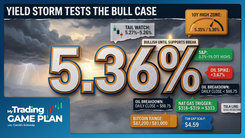

My Trading Game Plan Revealed - 06/17/2026: Fed Communication Shift S&P Trend Risk SOXX Topping Tail Oil Silver Bitcoin Setups

Markets are heading into a key Fed session with the interest rate decision due at 2:00 p.m. ET and the press conference at 2:30 p.m. ET. No rate change is expected, but that is not the main issue. The real question is how the market reacts, especially in bonds, equities, semiconductors, oil, and Bitcoin.
On this morning’s My Trading Game Plan Revealed, Gareth Soloway focused on the same framework he uses every day: ignore the noise, identify the levels, and wait for confirmation. Today’s setup is especially important because the S&P 500 has already shown early signs of weakening structure. The next few daily closes may decide whether this is just another pullback or the start of a broader trend change.
The Fed: Watch the Reaction, Not Just the Decision
The Fed is not expected to move rates today, so traders will be watching the voting breakdown and press conference for clues on how hawkish or dovish the central bank sounds. The market wants signs that inflation is under control, but it does not want a message that pushes yields sharply higher.
Gareth also discussed the risk that Fed communication could become less transparent going forward. Any shift away from clear guidance, press conferences, or dot plots would force markets to rely more heavily on incoming data and price action.
That makes the 10-year Treasury yield one of the most important charts today. It is testing a key trendline. A break lower would suggest yields are easing, which could support equities. A bounce from that level could pressure stocks.
Trader takeaway: The Fed statement matters, but the bond market reaction matters more. Watch the 10-year yield trendline for confirmation.
S&P 500: The Lower High Is the Key
The S&P 500 is the main chart Gareth is watching for broader market direction. After the recent sell-off, futures bounced overnight, but the bounce was already fading before the open.
The issue is market structure. The S&P 500 has already made a lower low, which weakens the prior uptrend. What matters now is whether the current bounce forms a lower high. If the market prints both a lower low and a lower high, that would confirm a meaningful trend shift.
A lower low by itself does not end the bull case. It tells traders the move is weakening. A confirmed lower high would be the bigger warning.
Trader takeaway: If the S&P 500 rallies and fails below the prior high, trend-change risk rises. If buyers reclaim momentum and push back toward the highs, the bull case stays alive.
Semiconductors: SOXX Topping Tail Still Matters
Semiconductors remain one of the most important parts of the market because of their weight and leadership role. Gareth pointed to the SOXX weekly chart, which recently printed a topping tail at a major high.
That candle matters because it shows buyers pushed price to new highs, but sellers took control and forced the close near the lows. The signal remains active unless price can negate it.
The key level is the high of the topping-tail wick, near $620. A weekly close above that level would weaken the bearish signal. Until then, the topping tail remains a warning for the semiconductor sector and the broader market.
Gareth also compared the setup to prior topping-tail reversals in silver. The point was not that semiconductors must follow the same path, but that major topping tails at stretched highs deserve respect until price proves otherwise.
Trader takeaway: SOXX needs a close above the wick high near $620 to negate the bearish signal. Without that, semiconductor risk remains elevated.
SpaceX: Supply Risk Near Resistance
SpaceX remains an important sentiment read because of the size of the move and the potential for additional supply if lockup-related conditions are met. Gareth noted that price recently pushed into the $225 area before pulling back sharply.
The level to watch is $225. That is where the recent move stalled, and it remains the area traders will watch if price pushes back higher.
The supply issue does not guarantee immediate selling, but it does create a real headwind. If more shares become available while price is near resistance, buyers may need to absorb a much larger amount of supply for the move to continue.
Trader takeaway: $225 is the key resistance zone. A clean move above it shows buyers are still in control. A rejection there keeps the setup vulnerable.
Tesla: Let the Wedge Break First
Tesla is still trading inside a large wedge pattern, with price compressing between lower highs and higher lows. Gareth’s message was patience. The trade is not to guess the break. The trade is to wait for confirmation.
A break above the upper wedge trendline would shift momentum back toward the bulls and put the prior highs back in play. A break below the lower wedge trendline would flip the setup bearish and increase downside risk.
Trader takeaway: Tesla is a confirmation setup. Wait for the wedge to break before assigning direction.
Software and Netflix: Rotation Watch
While semiconductors are showing risk near the highs, software has already been under pressure. Gareth highlighted the IGV software ETF as a potential rotation area if money starts moving out of crowded AI and semiconductor names.
The key level on IGV is the gap fill near $88.60. If that area holds, software could start to attract capital from traders looking for beaten-down sectors at support. If it fails, the rotation thesis weakens.
Netflix has a similar setup. The stock has pulled back as capital shifted elsewhere, but Gareth pointed to the $73 to $75 area as a potential swing trade zone. That zone matters because it gives traders a defined area to manage risk.
Trader takeaway: IGV needs to hold $88.60, and Netflix needs to hold the $73 to $75 zone. Lose those levels and the bullish rotation setups weaken.
Oil: Pullback Into a Key Zone
Oil pulled back after headlines around a potential Iran-related deal and reduced Strait of Hormuz risk. WTI briefly traded below $75, putting crude into an important support area.
Gareth’s focus was not the headline alone. It was whether the chart confirms that the geopolitical premium is being removed or whether the dip becomes a buying opportunity.
If oil reclaims $75 and holds, the bounce setup improves. If it stays below that level and continues lower, the market is signaling that risk premium is fading for now.
Trader takeaway: $75 is the key near-term level. Reclaiming it supports a bounce. Failing below it keeps pressure on crude.
Gold and Silver: Bounce Meets Resistance
Gold has bounced from the $4,100 support area, but the bounce still needs to prove itself. The next test is the descending trendline and the $4,400 to $4,450 resistance zone.
A breakout through that area would strengthen the bullish case. Failure there would suggest the bounce is running into supply and could roll back over.
Silver still has short-term upside potential toward the next resistance area, but Gareth’s broader message was caution. The metal has already shown how quickly sentiment can reverse when a crowded move runs into a major technical signal.
If silver breaks support, downside risk opens. If it flushes into the larger long-term buy zone below, that is where patient accumulators may become interested.
Trader takeaway: Gold needs to clear $4,400 to $4,450 to keep momentum. Silver remains a caution setup unless support holds.
Bitcoin: $64,000 to $64,500 Is the Line
Bitcoin is pulling back after a strong move from the $59,000 area toward $67,000. Gareth framed the pullback as healthy as long as price holds the right support zone.
That zone is $64,000 to $64,500. If Bitcoin retests and holds that area, the breakout remains intact and the upside target near $75,000 stays in play. If it loses that level, the breakout weakens and traders need to reassess.
Trader takeaway: Bitcoin stays constructive above $64,000 to $64,500. A clean break below that zone weakens the bullish setup.
The Bottom Line
Today’s market is about confirmation. The Fed decision is the headline, but the real tells are in the charts.
The S&P 500 needs to avoid confirming a lower high. SOXX needs to reclaim the topping-tail wick near $620. The 10-year yield needs to show whether rates are breaking lower or bouncing from support. Oil, gold, silver, software, Netflix, Tesla, SpaceX, and Bitcoin all have defined levels that will decide whether their setups remain valid.
Gareth’s message was clear: do not trade the noise. Trade the levels, respect confirmation, and let the market show whether this pullback is a reset or the beginning of a larger trend change.
Trading involves substantial risk. All content is for educational purposes only and should not be considered financial advice or recommendations to buy or sell any asset. Read full terms of service.