
My Trading Game Plan Revealed - 12/05/2025: Institutional Selling, S&P Resistance, Tech Breakdowns, Yen Liquidity Risk

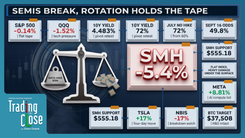
Good morning and happy Friday. The market is sending subtle but important signals that every trader needs to understand. While major indices hover near critical resistance levels, a look beneath the surface reveals a potential shift in character, with institutional players showing a new sense of urgency. In this morning's My Trading Game Plan, Gareth Soloway, Chief Market Strategist at Verified Investing, peeled back the layers of the chart to expose these dynamics, highlighting key breakdowns in tech giants and the macroeconomic factors that could dictate the market's next major move.
Today, we’ll dive deeper into these crucial themes, exploring the psychology behind the institutional selling patterns, the technical ceilings facing the S&P 500 and Nasdaq, and the specific trade setups that are flashing warning signs and opportunities across the market.
A Shift in Market Character
For days, a distinct pattern has emerged in the market's intraday price action. Sharp, aggressive dumps are quickly met by a wave of retail buying, creating a choppy, saw-toothed chart. This isn't random noise; it's a battle between two different market participants with very different motives.
"What we're seeing here is more aggressive selling by institutions, but they still don't want to just basically dump and crash the market… It's a little bit of a change in character. To me it tells me there's a little bit more urgency in the essential selling pressure from institutional money."
This observation is critical. For a long time, institutional selling, or distribution, was more subtle, designed to fly under the radar. Now, the selling is coming in large, aggressive blocks. The institutions then step back, allowing the "buy the dip" retail crowd to push prices back up, providing a fresh wave of liquidity for the institutions to sell into.
This dynamic reveals a few key things about the current market environment:
- Urgency: The increased aggression suggests that large players feel a need to unload positions now, rather than later. This could be due to a belief that the market is overvalued, that a catalyst for a downturn is approaching, or simply that they have hit their profit targets.
- Retail as Exit Liquidity: The unwavering faith of the retail "buy the dipper" is being actively used by professional money managers as their exit strategy. This is a classic late-stage market behavior where retail optimism fuels the final leg of a rally, allowing smart money to distribute their shares at elevated prices.
- The Fragility of Support: While the dip-buying has been effective so far, the question is how long it can last. If institutional selling continues to overwhelm retail buying, the "spigot" of buying could get shut off, leading to a much more significant and sustained decline.
Understanding this underlying flow of funds is essential. It provides the context for the technical pictures we see on the charts of the major indices.
The S&P 500's Technical Ceiling
The institutional urgency makes perfect sense when you zoom out and look at the weekly chart of the S&P 500. The index is currently pressing up against a massive, multi-year trend line that has marked major market tops in the past. This isn't just a minor level of resistance; it's a formidable technical barrier.
How much upside is left? According to Gareth's analysis, not much. "If we do a measurement of the current price per yesterday's close to this trend line, there's about 1.6% upside until you tag that level."
A mere 1.6% of potential gain before hitting a wall of resistance explains why institutions are selling with more vigor. The risk/reward proposition at these levels is heavily skewed to the downside. For a money manager responsible for billions of dollars, trying to squeeze out the last 1-2% of a move is not worth the risk of being caught in a major reversal.
This is where the power of probability-based trading comes into play. The chart doesn't guarantee a reversal, but it signals that the probability of a significant pullback from this level is extremely high. This technical reality, combined with the "change in character" of institutional selling, creates a compelling narrative for caution at these heights.
While the S&P 500 still has a tiny bit of room to run, the tech-heavy Nasdaq 100 is telling an even more immediate story of resistance. The QQQ has rallied directly back to a major trendline that previously acted as support. This classic technical pattern is known as a "retrace to the scene of the crime," where old support becomes new resistance. The QQQ is hitting this level now, suggesting that the technology sector may be the first to feel the pressure of a market-wide pullback.
The Looming Liquidity Threat
Beyond the U.S. charts, a critical macro story is unfolding in Japan that could have profound implications for global market liquidity. For years, the "Yen Carry Trade" has provided a tailwind for U.S. assets. Japanese investors, faced with near-zero interest rates at home, borrowed trillions of dollars in Yen for free and invested that capital in higher-yielding U.S. markets.
This flow of capital is now under threat. The Japanese 10-year yield has been rising sharply and is now approaching a critical threshold.
"Watch 2%… That to me is the line in the sand where the markets start to really get nervous here in the US."
As the Japanese 10-year yield approaches 2% (currently at 1.95%), the incentive for Japanese investors to keep their money in the U.S. diminishes. Why take on currency risk and invest abroad when you can get a decent, risk-free return at home? A move above 2% could trigger a mass repatriation of funds, as trillions of dollars are pulled out of U.S. markets and sent back to Japan. This would be a massive "sucking out of liquidity" that could act as a powerful headwind for U.S. stocks and bonds.
This is likely one of the reasons the Federal Reserve is poised to cut interest rates next week. A rate cut would help to counteract this potential liquidity crunch. However, traders must watch the Japanese 10-year yield closely. A decisive break above 2% could be a major catalyst for a market correction, regardless of what the Fed does.
Tech Giants on Shaky Ground
The selling pressure is becoming most evident in the charts of individual mega-cap tech stocks, many of which are exhibiting classic topping or breakdown patterns.
Netflix: The Secret Sauce is Gone
Netflix is down significantly on news of a deal to acquire Warner Brothers Discovery for $82 billion USD. This isn't just a typical merger-related dip. This move fundamentally alters the investment thesis for Netflix. For years, Netflix commanded a premium valuation and a high P/E ratio because it had the "secret sauce" for growth and profitability in the streaming world.
By acquiring a legacy media company, Netflix is signaling to the market that its organic growth engine has stalled. "The fact that they're willing to buy someone else out for $82 billion is telling investors… our secret sauce is essentially gone." This will inevitably lead to a contraction of its P/E ratio as it becomes valued more like its traditional media peers. This narrative shift is confirmed on the chart, where Netflix has suffered a major trendline breakdown, violating a line that has held as support since October 2023.
Apple: A Perfect Short Setup
Earlier this week, Gareth identified a "dead on short" opportunity in Apple as it pierced the top of a perfectly formed parallel channel. That trade is already well in the money. Now, Apple is forming a potential "topping tail" candlestick on the daily chart. This bearish reversal signal, occurring in conjunction with the tag of major channel resistance, is a powerful sign that the stock has likely put in a near-term top. The first logical target for a pullback is the $258 to $260 USD area.
NVIDIA and Microsoft: Bearish Formations
Other tech leaders are also showing signs of fatigue. NVIDIA, despite a recent bounce, appears to be consolidating in a classic bear flag pattern. This formation—a slight upward drift after a sharp decline—often resolves with another leg down. Microsoft has been weak since its double top in late October and continues to look vulnerable. A break of its recent lows would open the door to a much larger decline, with a major gap fill from years ago serving as the ultimate long-term target.
The Psychology of Position Sizing
In a market environment filled with such complex signals and potential turning points, the psychological aspect of trading becomes paramount. The difference between success and failure often comes down not to picking the right direction, but to managing risk and emotion. Gareth’s analysis of Natural Gas, which is approaching a key shorting level, provided a masterclass in this concept.
"I don't jump all in. I don't jump in the cold pool. I just dip a toe and start… Anytime you feel uncomfortable in a position, it's either telling you that the pattern is telling you the opposite of what you want to happen or it's telling you you allocated too much capital to that position."
This is one of the most important lessons in trading. Over-allocating capital is the single biggest driver of emotional decision-making. When too much money is on the line, logic and discipline are replaced by fear and greed. The market gains an edge because you are no longer thinking clearly.
By starting with a small "starter" position, you can test your thesis without being emotionally compromised. If the trade moves against you, the loss is manageable. If it moves in your favor, you can add to the position from a place of strength. This disciplined approach keeps logic in the driver's seat and ensures that you, not your emotions, are in control of your trading.
Conclusion: Navigating the Turning Point
The market is at a fascinating and potentially perilous juncture. Institutional players are showing an urgency to sell, using retail's "buy the dip" mentality as exit liquidity. The S&P 500 and Nasdaq are pressed against formidable technical resistance with very little upside remaining. Major tech leaders like Netflix and Apple are breaking down from key patterns, and a looming liquidity crisis tied to the Yen carry trade adds a significant macro risk.
In this environment, discipline is everything. The charts are providing a clear road map, signaling where the risks and opportunities lie. By focusing on probability, respecting key technical levels, and, most importantly, managing position size to keep emotion at bay, traders can navigate this potential turning point with clarity and confidence. The market is speaking; the key is to listen to the logic of the charts, not the hype of the narrative.
Trading involves substantial risk. All content is for educational purposes only and should not be considered financial advice or recommendations to buy or sell any asset. Read full terms of service.