
My Trading Game Plan Revealed - 12/31/2025: Contrarian 2026 Setups, Stocks, Bonds, Commodities

As the final trading session of 2025 winds down on predictably light volume, the market’s collective gaze shifts from the day’s minor fluctuations to the vast possibilities of the year ahead. While futures staged a modest recovery this morning, the real story isn’t about ending the year on a green or red note. The more profound questions are being asked about the setup for 2026. In this morning’s My Trading Game Plan, Gareth Soloway, Chief Market Strategist at Verified Investing, cut through the year-end noise to deliver a masterclass on contrarian thinking, technical discipline, and the probability-based setups that will define the new year.
A Wall of Worry or a Wall of Hype?
One of the most striking observations heading into the new year is the overwhelming consensus among Wall Street analysts. For the first time in recent memory, the sentiment is almost unanimously bullish for 2026. While this might seem like a cause for celebration, for a seasoned chartist, it’s a major red flag.
“One of the big things that struck me is I literally read over the last couple of days… how every major analyst is bullish for 2026. And again, that honestly has almost never happened. And so when I see that, I think contrarian.”
This isn’t just about being a contrarian for the sake of it; it’s rooted in a deep understanding of market psychology. Markets are auction mechanisms that thrive on differing opinions. When everyone—from major institutions to the average investor who follows their advice—is positioned on the same side of the boat, it becomes dangerously lopsided. Historically, markets have a cruel tendency to move in the direction that causes the most pain to the most people.
This unanimous sentiment must be weighed against the hard data of the charts. The S&P 500 weekly chart, which provides a clearer long-term perspective, shows the index approaching a formidable barrier. A trendline connecting the 2021 pivot high, with a parallel line marking every major low for the past five years, converges near the 7,000 level. This technical confluence suggests that while a small push higher is possible early in the year, 7,000 represents a massive brick wall. The charts are signaling caution precisely when the talking heads are preaching euphoria.
The Bond Market’s Ominous Signal
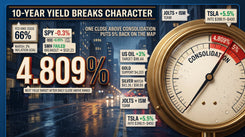
While most investors are focused on equities, a significant risk for 2026 may be brewing in the bond market. The common narrative is that with the Federal Reserve expected to lower rates, yields on government bonds will naturally decline. However, the chart of the 10-year Treasury yield tells a potentially different story.
The 10-year yield is currently consolidating in what technical analysts recognize as a bullish flag pattern. This pattern, characterized by a sharp move up (the flagpole) followed by a period of sideways-to-downward consolidation (the flag), typically resolves with another powerful move to the upside. This is critical because the Fed only directly controls the short end of the yield curve. The long end—the 10-, 20-, and 30-year yields—is driven by market forces, inflation expectations, and global demand for debt.
“I've been talking about one of the big risks for 2026 is that yields actually go higher on the long end of the yield curve… this actually could be what spooks the market in the year.”
A breakout higher in long-term yields would be directly counter to mainstream expectations and could create significant headwinds for the stock market, particularly for growth and tech stocks whose valuations are sensitive to interest rates. This divergence between the chart’s message and the popular narrative is another key piece of the contrarian puzzle for 2026.
Key Stocks at Decisive Inflection Points
The broader market indexes are only part of the story. Several bellwether stocks are trading at critical technical junctures that could dictate their direction for months to come.
Tesla: The Battleground Between Two Lines
Tesla finds itself in a classic technical predicament, caught between powerful forces of support and resistance. A double top has formed near the $490 level, marking the highs from both December 2024 and December 2025. This level represents a clear ceiling that bulls must decisively break and confirm to unlock the next major leg up toward potential targets of $600 or $700.
Simultaneously, a lower trendline is providing support. The stock is effectively being squeezed between these two levels. This is a scenario where patience is paramount. As Gareth notes, there is no need to gamble on direction. The chart will provide the answer. A confirmed break above $490 is a clear long signal, while a confirmed breakdown below the trendline signals a move lower. Until then, the highest probability trade is no trade at all.
NVIDIA and Robinhood: Echoes of a Breakdown
In contrast to Tesla’s neutrality, the charts for NVIDIA and Robinhood are flashing more definitive bearish signals for 2026. Both stocks share a similar pattern: a clear break of a multi-month uptrend line, followed by a retracement to retest the line from below, and a subsequent rejection.
For NVIDIA, this pattern suggests a continued downtrend is now in place. The next logical target in 2026 would be a retest of the former highs from 2024, around the $150 level. This would represent a significant drop of about 20% from current prices.
Robinhood exhibits an even clearer version of this breakdown, followed by bearish consolidation. This technical posture points toward a much deeper correction in the new year. Gareth’s analysis points to a potential 2026 price target in the $65 to $66 range, a move that would likely surprise many who have recently bought into the stock.
The January Effect: A Bullish Opportunity in the Carnage
While the broader outlook is cautious, specific opportunities arise from seasonal market patterns. One of the most powerful is the "January Effect," a phenomenon driven by tax-loss selling. Gareth highlighted Figma as a prime candidate to benefit from this effect.
Here’s how it works: Investors who have realized capital gains during a profitable year (like 2025) often look for losing positions in their portfolio to sell before the year-end deadline. By selling a stock like Figma at a loss, they can use that loss to offset their gains, thereby reducing their tax bill. This creates artificial selling pressure on beaten-down stocks throughout December.
“The January Effect comes into play where essentially the selling for tax purposes artificially keeps some of these stocks under pressure in December… The great thing is that once you click to January, that selling pressure is no longer there.”
Once the calendar flips to January 1st, this tax-motivated selling evaporates. With a major source of supply removed from the market, even a normal level of buying demand can cause the stock to appreciate significantly. The key is to identify stocks that have been heavily sold off but are now showing signs of bottoming at key technical levels.
Figma fits this profile perfectly. After a massive post-IPO run from about $85 to $143, the stock has collapsed. It is now forming a bullish pattern of higher lows. This technical setup, combined with the likely cessation of tax-loss selling, creates a high-probability bullish trade for early 2026.
Commodities in Motion: Gold, Silver, and Oil
The commodity markets are offering some of the clearest and most active charts heading into the new year.
Gold is at a moment of truth. The precious metal is testing a defining uptrend line that has held since August. Every significant dip has found support at this line, making it the bull’s last line of defense. A daily close and confirmation below this trendline would be a technically significant event, signaling a break in the uptrend and likely spooking large institutional money. Such a break would open the door to corrections toward support levels at $4,200, then $4,000, and potentially as low as $3,900.
Silver has already shown its hand. The massive bearish reversal candle from a few days ago has seen decisive follow-through to the downside, validating the signal. The key level to watch now is the support zone around $70.00 to $70.50. This area has halted every recent sell-off. A break below this floor would likely trigger the next wave of selling, with an initial target of $64 and a potential 2026 target near $54.
Oil, meanwhile, continues to consolidate and hammer against resistance. Gareth remains bullish on oil for 2026, viewing it as a potential "sleeper play" that could surprise to the upside if it can achieve a clean breakout.
Conclusion: Trading with Probability in 2026
As we close the book on 2025, the path forward is a study in contrasts. On one side, you have a nearly unanimous bullish forecast from Wall Street. On the other, you have charts signaling major overhead resistance in the S&P 500, a potential spike in bond yields, and bearish breakdowns in key technology stocks.
Navigating this environment requires a disciplined, unbiased approach. It means trusting the data on the charts over the hype in the headlines. It means understanding seasonal patterns like the January Effect to find opportunities in beaten-down names. And most importantly, it means embracing the mindset of a probability trader.
“I'm a probability trader, as you guys know. And I go by the charts. No matter what, I focus on what the charts tell me. The second I deviate… I always lose.”
Success in 2026 won’t be about being right on every single call. It will be about identifying high-probability setups where the technical factors align, defining your risk, and executing with discipline. Whether the market soars, stalls, or stumbles, the charts will provide the roadmap for those willing to listen.
Trading involves substantial risk. All content is for educational purposes only and should not be considered financial advice or recommendations to buy or sell any asset. Read full terms of service.