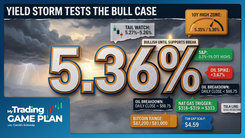

My Trading Game Plan Revealed - 12/19/2025: Japan Yield Shock Squeezes Liquidity As S&P 500 Faces Bearish Trend

After a bout of volatile price action, the market staged a rebound yesterday, keeping hopes alive for a traditional year-end rally. But beneath the surface of this potential holiday float, significant macro pressures are building that could define the trading landscape heading into the new year. In this morning’s My Trading Game Plan, Gareth Soloway, Chief Market Strategist at Verified Investing, broke down the critical crosscurrents at play, from a major policy shift in Japan to the chart-based signals that are predicting news before it even happens.
The Macro Tug-of-War: A Holiday Float in a Bearish Sea
While a short-term drift higher into the final weeks of the year is plausible, it’s crucial to understand the broader context. The primary trend, as seen on the larger timeframes, remains decidedly bearish. As Gareth notes, the weekly and monthly charts for major indices like the S&P 500 are flashing warning signs.
When viewing the S&P 500 weekly chart, the logic is inescapable. A clear descending trendline has capped every significant rally, acting as a major resistance level. From the current price, a rally back to that trendline represents a potential upside of only about 3%. This presents a skewed risk-reward scenario for investors looking to deploy significant capital. While short-term long positions can be managed, the environment does not favor being heavily long from a multi-month perspective.
This doesn't mean there are no opportunities. In fact, this is the time of year when savvy traders begin hunting for "January Effect" plays. These are stocks that have been aggressively sold throughout the fourth quarter as investors lock in losses for tax purposes. This artificial selling pressure often subsides once the calendar flips to a new year, creating the potential for sharp rebound rallies in these beaten-down names.
The Shot Heard 'Round the World: Japan's Yields Break Out
Perhaps the most significant macro development occurred overnight in Japan, where the Bank of Japan raised interest rates, sending the Japanese 10-year yield surging through the 2% level. While this may seem like a distant event, its implications for global liquidity are profound and could be the catalyst for major market shifts.
There are two primary reasons this is so critical:
- The Unwinding of the Yen Carry Trade: For years, global investors have borrowed money in Japan at near-zero interest rates and invested it in higher-yielding assets, particularly in the U.S. This is known as the "Yen carry trade." As Japanese interest rates rise, the spread between U.S. and Japanese yields narrows, making this trade less profitable. The U.S. 10-year yield is hovering around 4%, while Japan’s is now above 2%. As that gap closes, investors will begin to unwind these trades, which involves selling U.S. assets and converting the dollars back to yen. This process effectively sucks liquidity out of the U.S. markets.
- Global Bond Market Contagion: Japan has a staggering debt-to-GDP ratio of 240%. If a country with such a massive debt burden sees its borrowing costs (yields) relentlessly marching higher, it sets a dangerous precedent for other indebted nations, including the United States, which has a debt-to-GDP of 130%. This could put upward pressure on U.S. long-term yields, even if the Federal Reserve begins cutting short-term rates. As Gareth emphasized, it’s critical to remember: “Fed controls the short end, not the long end. They control short end yields, not 10-, 20-, 30-year yields. The market controls those.”
A scenario where the Fed is cutting rates but the 10-year and 30-year yields are rising would create an earthquake in the U.S. bond market, with severe ripple effects across the entire financial system.
The Chart Before the News: An Oracle Case Study
How can traders position themselves ahead of these major moves? The answer lies in disciplined technical analysis, and the recent action in Oracle provides a perfect case study. Just a few days ago, Gareth highlighted that Oracle’s chart had become bullish after pulling back to a precise technical level known as a "gap fill." This level, around $176 USD to $177 USD, represented a high-probability buy signal based purely on the chart.
Then, this morning, news broke that Oracle is solidifying its role with TikTok’s U.S. operations. The stock surged over 5%, trading as high as $192 USD. This is a powerful illustration of a core principle of professional trading.
“It's remarkable how the charts can dictate the news. They don't know what news is coming, but when you hit a level and you're going to bounce, then all of a sudden magically some news occurs and the bounce ensues.”
This is the fundamental difference between professional and retail approaches. Professionals anticipate moves by identifying key technical levels where probabilities shift in their favor. Retail traders, lacking this framework, often react to headlines, chasing a move that has already happened and taking on far greater risk.
The Art of Catching a Falling Knife
The Oracle trade also serves to debunk a common market cliché: "don't catch a falling knife." While this is sound advice for those trading on emotion or without a clear methodology, it doesn't apply to technicians who can read the language of the charts.
Consider the context of Oracle’s setup. The stock had fallen 50% from its highs following a previous earnings report. Human psychology often causes investors to become fearful when an asset’s price drops precipitously. Yet, in any other aspect of life, a 50% discount is seen as a fantastic opportunity.
As Gareth explained, "You go to the mall, you need a new pair of jeans. Your favorite jeans are 50 percent off. You might even buy two pair… But for some reason, investors don't."
When you combine a steep 50% discount with a precise, high-probability technical support level like a gap fill, the act of "catching the knife" transforms from a gamble into a calculated, probability-based trade. It requires discipline, a defined risk level (a stop-loss), and the ability to trust the charts over fear.
Earnings Fallout: Navigating Key Setups
Earnings season continues to produce volatility and opportunity. Here are the key levels to watch in stocks that made big moves this morning:
- Nike (NKE): The stock fell around 10% after reporting a 17% decline in China sales and warning on the next quarter. For active day traders, minor support pivots exist just below $55 USD and a more significant zone around $52 USD to $53 USD. However, the major swing trade opportunity lies much lower. A critical pivot area dating back to 2014 exists just below $50 USD. This level is psychologically powerful. Many investors will place their stop-loss orders at the even $50 USD number. Professional traders and algorithms know this, and often, price will be pushed just below that level to trigger those stops before a real reversal begins. A patient entry in the $49 USD to $50 USD range could present a prime swing trading opportunity.
- FedEx (FDX): Also falling on earnings, FedEx has now broken a key uptrend line, suggesting more downside is likely. While there may be minor day trade levels on the way down, the high-probability swing trade support zone is located around $246 USD to $247 USD, still about $30 USD away from current prices.
- KB Home (KBH): Reflecting the ongoing stagnation in the housing market, KBH is trading lower. For a day trade, a key gap fill level sits around $55.25 USD, with a secondary support level near $54.25 USD. These could provide technical bounces for nimble traders.
Probabilities Over Prayers: The Trader's Mindset
Whether analyzing Bitcoin’s bear flag or a setup in gold, the underlying principle is the same: successful trading is about replacing emotion with logic and probability. Most market participants trade based on feelings—hope, fear, greed. They pray for a trade to work out. This is a futile approach.
"The chart to me is the only way I've found that probability goes in my favor. And it doesn't mean I win all the time… But if you look at my overall calls because I'm using charts, I win probably 70 to 80 percent of the time."
This is the mindset of a casino. A casino doesn't win every hand, but it operates with a mathematical edge that guarantees profitability over time. By using technical analysis to identify setups where the odds are stacked in your favor, you can operate like the house, not the gambler. Bitcoin is currently holding a bear flag pattern; if it breaks the lower trendline, the probabilities favor a move down to the $69,000 USD to $74,000 USD zone. If it breaks the upper trendline, the bullish case resumes. The chart provides a clear, logical roadmap, free of emotion.
Conclusion: Navigating the Calm Before the Storm
As we head into the final two holiday weeks, the market is likely to be dominated by retail investors while institutions are away. This typically leads to a "neutral to upside float." However, traders must not be lulled into complacency. The macro storm clouds are gathering, with the situation in Japan representing a significant potential disruption to global liquidity.
The key is to remain disciplined, focusing on high-probability technical setups in individual names while respecting the bearish macro backdrop. Keep an eye on oil, which is deeply undervalued on an inflation-adjusted basis and relative to other commodities. As Gareth boldly stated, oil "could be the best performer out there" for a portion of 2026, even if it sees a move down to $50 USD first.
By letting the charts guide your decisions and trading based on logic and probabilities, you can navigate the year-end currents and position yourself for the challenges and opportunities that lie ahead.
Trading involves substantial risk. All content is for educational purposes only and should not be considered financial advice or recommendations to buy or sell any asset. Read full terms of service.