
My Trading Game Plan Revealed - 12/17/2025: Institutional Selling, AI Trade at Risk and Micron's Make or Break Earnings

In this morning's My Trading Game Plan, Gareth Soloway, Chief Market Strategist at Verified Investing, peeled back the layers of the current market action, revealing a fascinating and potentially precarious setup as we head into the holidays. Beneath the surface of a seemingly calm market, institutional selling patterns, pivotal Federal Reserve commentary, and cracks in the AI narrative are creating a complex environment. Today, we'll dive deeper into these key themes, exploring the technical ceilings facing the major indices and the single earnings report that could make or break the AI trade into year-end.
The Quiet Distribution
For several days, a subtle yet significant pattern has emerged in the market's daily rhythm. While the indices may appear stable or even slightly bullish on the surface, the underlying flow of capital tells a different story. As Gareth pointed out, the market has been consistently experiencing selling pressure in the morning sessions, only to see it fade in the lower-volume afternoon hours.
“Every day… you're seeing early morning, mid-morning selling pressure, which then abates by mid to early afternoon… that's the volume period of the market… And that means institutions are unloading into that early buy-the-dip mentality into the holidays.”
This isn't random noise; it's a classic sign of institutional distribution. Professional money managers, who execute the largest trades, are most active during the morning when market liquidity is highest. They appear to be using the persistent retail "buy the dip" sentiment as an opportunity to offload positions at favorable prices. As the holiday season approaches, trading volumes naturally thin out, making these morning moves even more pronounced. This pattern serves as a quiet warning that while the market floats higher in the afternoons, the "smart money" may be methodically reducing its exposure.
Fed Politics and a Hawkish Hiccup
The market's morning routine was briefly interrupted by comments from Federal Reserve President Christopher Waller, a leading candidate to become the next Fed Chairman. In a media interview, Waller struck a slightly more hawkish tone than investors were anticipating, causing a minor dip in equity futures and a pop in the U.S. dollar. He acknowledged a weaker labor market but suggested it could be a temporary effect of AI implementation, hinting that a wave of hiring—and thus fewer rate cuts—could be on the horizon next year.
The timing of these comments is critical. Waller is scheduled to meet with President Trump to be interviewed for the top job at the Fed. This creates a complex dynamic where his public statements must maintain the Fed's credibility and inflation-fighting stance, while his private conversations may address different priorities. As Gareth noted, “what he says behind closed doors will be a different story.” This intersection of monetary policy and political maneuvering adds a layer of uncertainty for investors, reminding us that Fed-related volatility can stem not just from data, but from personalities and politics as well.
Cracks in the AI Foundation: The Oracle Anomaly
Adding to the morning's concerns was a significant sell-off in Oracle. The drop was triggered by news that Blue Owl Capital, a key financial partner, was pulling its backing from a massive $10 billion data center project. While a single deal might seem isolated, it taps into a much larger concern that Gareth has been highlighting for weeks.
“This is more of what I've been warning about is that the proliferation of data centers, number one, there's no energy to fuel these things… And you also have other scenarios of how fast technology is moving forward. Do we need these massive data centers…?”
The AI revolution has been built on the assumption of a near-infinite buildout of data centers. However, this narrative is facing two major real-world constraints: energy and obsolescence. The power grid is already strained, and the energy required to power these massive facilities is staggering. Furthermore, the relentless pace of technological advancement raises a crucial question: will a data center built today, at the cost of tens of billions of dollars, be obsolete in five years? Oracle has taken on $115 billion in debt to fund its expansion, a monumental risk if the technology it's built on is quickly surpassed. This news from Blue Owl Capital could be the first sign that major financial backers are starting to question the long-term viability and ROI of these capital-intensive projects.
For traders watching Oracle's chart, Gareth remains patient, identifying a key technical level around $176 USD as a potential major bounce zone, still about $10 USD away from current prices.
The Unbreakable Ceiling: Why Charts Trump Hype
While analysts are busy publishing bullish targets for 2026, the charts are telling a much more grounded and immediate story. Across the major indices, powerful technical resistance levels are capping the market's upside potential. This is where the discipline of technical analysis becomes paramount, filtering out the noise of forecasts and focusing on the pure reality of price action.
“The charts, to me, are always paramount. It's true. It's no bias. A chart has no agenda to it, right? It just is what it is… it's literally just follow the charts, and I have my best chance of making money.”
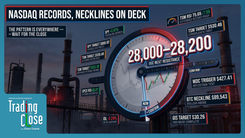
On the S&P 500 daily chart, a massive parallel channel drawn from previous highs is acting as a formidable ceiling. The index has been rejected from this line and, even with a year-end rally, the maximum upside is limited to approximately 2.5% from current levels. This technical barrier provides a dose of realism, grounding speculative targets like 8,000 or 10,000 on the S&P. Until that line is broken, it remains the market's hard cap.
The Nasdaq 100 (QQQ) and the Russell 2000 show similar patterns of exhaustion. The QQQ broke a key support trendline, and that same line has now flipped to become major resistance, rejecting the recent bounce. The Russell 2000, which tracks small-cap stocks, has also slammed directly into a multi-year trendline and been rejected twice. The charts of all three major indices are in agreement: the market has reached a critical inflection point where the path of least resistance may soon be to the downside.
Micron's Moment of Truth
Against this backdrop of technical resistance and emerging fundamental concerns, the entire market is now focused on one event: Micron's earnings report after the bell. In a typical market, a memory chip company's earnings would be important but not pivotal. In the current environment, it has become a referendum on the entire AI trade.
The setup is dramatic. First, NVIDIA, the king of AI, reported stellar earnings, yet the stock gapped up and reversed violently, trading poorly ever since. Then, Oracle and Broadcom, two massive AI infrastructure players, both tanked on their earnings reports. This "one-two punch," as Gareth described it, has shaken confidence in the sector. Now, the fate of the AI narrative into year-end rests on Micron's shoulders.
“My thesis would be that Micron either saves the AI trade into year-end and we see a rally and flow back up into January, or it tanks it and we just keep selling in the AI trade.”
Investors will be scrutinizing Micron's results not just for their own performance, but for any signs of the margin pressure and demand shifts that have plagued its peers. A positive report could restore faith and trigger a relief rally. A negative one could be the final straw, confirming that the AI sector is undergoing a significant correction and potentially dragging the entire market down with it.
Cross-Asset Check-Up: Key Levels in Crypto and Commodities
- Bitcoin: The crypto leader remains locked in a bear flag pattern. While this formation allows for a near-term rally, potentially back toward the $100,000 USD max upside target, the key is the lower trendline. A definitive break of that support would confirm the bearish pattern is playing out, opening the door to a downside target between $69,000 and $74,000 USD.
- Gold: The precious metal is coiling in a bullish consolidation pattern, with price being squeezed between a flat top and a rising trendline. This pattern needs to resolve to the upside soon, ideally by the end of the week, with a push to a new all-time high. Failure to do so could see the pattern fail, triggering a move down toward the $4,200 USD level.
- Silver: After hitting a new all-time high, silver is providing a masterclass in trendline analysis. A key line, respected multiple times as both support and resistance, can be used to project a parallel upside target. This technique points to a potential major resistance zone around $69 USD per ounce.
- Oil: The energy commodity is in a precarious spot. A bullish "ladle" pattern failed yesterday, but prices are bouncing today from a double-bottom support level around $55.90 USD. The double bottom is still technically intact, but a confirmed close back below that level would open up a logical downside target of $50 USD.
- Natural Gas: After being severely oversold, natural gas is finally catching a bounce. While a deeper flush to fill a lower gap is still possible, the probabilities favor a relief rally. The maximum upside for such a bounce would be around the $4.40 USD level, which represents a 50% retracement of the recent drop.
Conclusion: Navigating the Year-End Crossroads
The market is sending a series of complex and conflicting signals. We have institutional players selling into retail optimism, a potential new Fed chair navigating a political minefield, and the foundational narrative of the AI boom facing its first serious questions. Towering above it all are the technical charts, which clearly show the major indices pressing against a ceiling that has, thus far, proven unbreakable.
In this environment, discipline and a probability-based approach are a trader's greatest assets. The path forward will likely be determined by the outcome of Micron's earnings. A positive report could fuel one final push into the year-end, testing those overhead resistance lines one more time. A negative report could validate the institutional selling and confirm the technical rejections, ushering in a period of deeper correction. By staying grounded in the logic of the charts, traders can navigate this critical crossroads with clarity and confidence.
Trading involves substantial risk. All content is for educational purposes only and should not be considered financial advice or recommendations to buy or sell any asset. Read full terms of service.