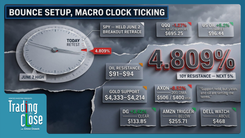

Trading The Close Market Recap - 12/16/2025: Micron Earnings Make-or-Break for Santa Rally as Semis, Trendlines Cap Upside

The market is holding its breath. With the year rapidly drawing to a close, traders are anxiously watching to see if the traditional "Santa Claus rally" will deliver one last gift. However, as Gareth Soloway of Verified Investing (filling in for Pro Trader Gareth Dosek, who is out sick) detailed in this afternoon's Trading The Close show, the path higher is fraught with technical resistance, and one pivotal earnings report could be the single event that determines the market's fate. The charts are signaling limited upside, and a disciplined, probability-based approach is more critical than ever.
Micron Earnings: The Catalyst for a Year-End Float or a Semis Fall?
All eyes are on Micron Technology, which is set to report earnings after the bell tomorrow. This is not just another earnings report; it's a potential linchpin for the entire market's year-end trajectory. The semiconductor sector has been a primary driver of the market's performance, fueled by the powerful AI narrative. Micron's results and guidance will serve as a crucial barometer for the health of this trade.
Gareth laid out two distinct and opposing scenarios. A positive report could act as a relief valve for the overbought semiconductor space, allowing the broader market to float higher into the new year. This could mirror the price action from 2021, where the S&P 500 pushed to its upper trendline for a final tap before a correction.
However, the downside risk is equally significant. A disappointing report from Micron could be the catalyst that brings the high-flying semiconductor sector back to earth. As Gareth warned, “If Micron disappoints, the semis are gonna get hammered again, folks. There's still many companies, including the Micron chart, that are overbought. And this would really put a nail in the coffin of that AI trade, at least in the near term.” This single event has the power to either validate the recent rally or trigger a sharp reversal, making it the most important data point for traders to watch this week.
The Technical Ceiling: Why Major Indices Face Limited Upside
While many investors are piling into the market, hoping to catch a final wave of momentum, the charts are telling a very different story—one of caution and clearly defined limits. Across multiple major indices, powerful trendlines are converging to form a formidable ceiling of resistance, suggesting that the room to run is much smaller than sentiment might suggest.
The NASDAQ 100 (QQQ), despite a small gain today, remains in a technically precarious position. After breaking a key support level, it rallied back to test that same area from below—a classic technical pattern known as "retracing to the scene of the crime"—and was rejected. While another attempt at this line is possible, the overhead trendline resistance severely caps the upside potential. Gareth estimates a potential move of just 3% to 3.5% before the index slams into what he describes as "epic resistance."
This theme of limited upside is even more pronounced in the Russell 2000. The small-cap index has been a recent standout, hitting a new all-time high last week. Yet, that strength was immediately met by a brick wall in the form of a long-term trendline. The index rallied directly into this line and was decisively rejected, underperforming the other indices today. This price action is a textbook example of how technical levels can override short-term momentum.
The Power of a Line: An Ode to Trendline Analysis
The rejection of the Russell 2000 at its trendline provides a perfect case study in the power of this fundamental technical tool. For many, drawing lines on a chart can seem subjective, but when done correctly, it provides an invaluable edge.
"Drawing trend lines can be hard to get the hang of," Gareth explained. "It's partially a science, partially an art, but when you can draw a line and it gives you the odds, the probabilities that markets will either bounce off that level or a stock or a crypto or a commodity will bounce off that level. It's incredible."
Trendlines work because they are a visual representation of market psychology and supply and demand. An established trendline represents a price zone where buyers or sellers have consistently stepped in. When price returns to that line, market participants who remember the previous interactions are likely to act again, creating a self-fulfilling prophecy. The Russell 2000 chart, with its multiple precise rejections from the same descending line, is a masterclass in this principle. It demonstrates how a simple line can define risk and identify high-probability turning points long before they occur.
The Casino Edge: Trading as a Game of Probabilities
Underpinning all of this technical analysis is a core philosophy that separates professional traders from the crowd: viewing the market not as a prediction machine, but as a probability game. This mental framework is essential for long-term survival and success.
Gareth perfectly articulated this with an analogy: “We have to understand it's a probability game a la the house, the casino, right? The casino makes money hand over fist. Doesn't mean they win with every gambler that walks into the doors.”
Casinos don't know the outcome of the next spin of the roulette wheel, but they know that over thousands of spins, their statistical edge will guarantee profitability. Similarly, a trader doesn't need to be right on every trade. Instead, the goal is to consistently identify and execute on setups where the probabilities are in their favor. The trendline analysis on the Russell 2000, for example, didn't guarantee a rejection, but it heavily skewed the odds in favor of sellers at that specific level. This mindset fosters discipline, prevents emotional decision-making, and allows a trader to withstand the inevitable losing trades that are simply a cost of doing business.
Key Setups in Focus: Patience, Confirmation, and Contrarian Thinking
Today's market action provided several distinct examples of this probability-based approach in action, from confirmed breakouts to live earnings breakdowns.
Tesla (TSLA): The electric vehicle giant has a confirmed breakout, having closed above its wedge pattern and then confirming that move by closing above the prior day's high. While this is a bullish signal, it doesn't mean it's an automatic buy. Gareth cautioned against chasing the move, noting the stock has run nearly vertical from $388. A disciplined trader waits for a better entry. "If it consolidates and builds a high probability bull flag above support, yes, then it becomes a viable opportunity for me." This is the essence of patience: letting the high-probability setup come to you rather than chasing a stock that is already extended.
Lennar (LEN): In a fascinating live-market event, homebuilder Lennar reported earnings during the show. Gareth had identified a key gap-fill support level at $109.33 beforehand. As the stock sold off sharply on the news, it plunged directly toward that level, hitting a low of $110 before bouncing. This demonstrated the power of pre-defining key levels for potential trades. The weak report also serves as a warning sign for the housing market, reinforcing the idea that chasing assets—whether stocks or real estate—at peak prices is a losing strategy.
Natural Gas: The chart of natural gas offers a masterclass in contrarian, probability-based trading. The commodity has fallen 32% in just eight trading days, putting it in a deeply oversold condition. Instead of panicking, Gareth is using this weakness as an opportunity. "I slowly inch in dollar cost averaging, dollar cost averaging till we get that bounce." This strategy is not based on a long-term belief in natural gas but on the high probability that such an extreme, one-sided move will eventually experience a significant technical bounce. The potential target of $4.40 represents a 20-25% move from current levels, showcasing an asymmetric risk/reward opportunity born from market panic.
Commodities at a Crossroads
The commodity complex is presenting a mixed but fascinating picture, with several key assets at critical inflection points.
Crude Oil: The bullish cup and handle pattern in oil has officially failed. A key rule for this pattern is that price cannot close below the low of the "cup." With that level now breached, the bullish thesis is negated. If the breakdown is confirmed with another close below the line, the technical target shifts dramatically lower to the $50 per barrel level.
Bitcoin: The crypto leader is consolidating within what appears to be a bear flag pattern. The parallel channel is perfectly defined. A confirmed break below the lower trendline would strongly favor a move down to the $80,000 level, and potentially lower. Conversely, as long as it remains in the channel, a rally back toward the upper end near $97,000 is still possible.
Precious Metals: Gold and Silver remain in a state of uncertainty. Gold has so far failed to make a new all-time high, creating a lower high on the chart, which is a technical concern. Silver is at a more immediate decision point. We don't yet have enough price data to know if the current consolidation is a bullish flag building for another leg up toward $70 per ounce, or if it's a top where institutions are distributing their positions. Patience is required until the chart provides more clarity.
Conclusion: Navigate the Year-End with Charts, Not Hype
As we head into the final trading days of the year, the market is balanced on a knife's edge. The narrative of a Santa Claus rally is compelling, but the charts are flashing clear warning signs of overhead resistance and limited upside. The fate of that rally may very well rest on the shoulders of Micron's earnings report tomorrow.
In this environment, the principles of technical, probability-based trading are paramount. By focusing on well-defined levels, understanding the art and science of trendlines, and maintaining the discipline to wait for high-probability setups, traders can navigate the uncertainty with confidence. Whether it's avoiding the chase on a breakout like Tesla or patiently accumulating an oversold asset like Natural Gas, the focus remains on the process, not the prediction. The charts have provided the roadmap; now it's up to traders to follow it with discipline.
Trading involves substantial risk. All content is for educational purposes only and should not be considered financial advice or recommendations to buy or sell any asset. Read full terms of service.