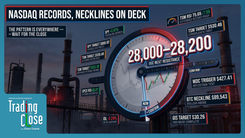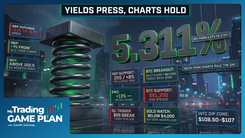

Trading The Close Market Recap - 07/01/2026: Semiconductor Breakdown & Tech Rotation as Rate Hike Odds Surge

Semiconductors Broke While the S&P Hid the Damage
The index headline did not tell the real story into the close.
The S&P 500 finished nearly flat, down just 0.14%, but that number masked a much sharper move underneath the surface. The Nasdaq 100 fell 1.52%. Semiconductors were hit harder, with SMH down 5.4%. That is the market signal Drew Dosek focused on during today’s Trading The Close: this was not a clean broad-market liquidation, but it was real technical damage in the part of the market that has carried the AI trade.
That difference matters for tomorrow’s setup. When everything sells together, the message is panic. When one leadership group breaks while capital rotates elsewhere, the message is more specific. The market is repricing risk, especially in high-multiple technology, while still looking for places to redeploy capital.
The driver was not a single earnings report. It was the same macro pressure that keeps coming back whenever economic data stays firm and yields start pushing higher again.
The Macro Signal Was Higher-for-Longer Pressure
The ISM manufacturing data came in slightly below expectations, but it still pointed to a resilient economy. That gave the market a brief intraday breather, but it did not remove the larger issue. Stronger economic data keeps the Federal Reserve’s path more complicated, especially with JOLTS already firm and non-farm payrolls due tomorrow morning.
Drew pointed out that FedWatch probabilities began shifting after the data. The important part was not one meeting probability in isolation. The important part was that the market started to account for a wider range of outcomes, including the possibility that rates stay higher for longer than equity bulls would like.
That showed up quickly in the 10-year Treasury yield, which pushed toward the 4.483% pivot level.
“If the Fed is forecasting rate hikes, we are certainly going to be having higher rates for longer,” Drew said during the show.
For tech, that is the pressure point. Higher yields make future earnings less valuable today, and that matters most for the stocks priced on growth far into the future. That is why the selling was concentrated in the Nasdaq and semiconductors rather than spread evenly across the entire tape.
SMH Gave the Cleanest Technical Read
The semiconductor chart was the center of the session.
SMH broke its trendline last Friday, bounced on Monday and Tuesday, then failed into the broken level. That is the key technical sequence Drew highlighted: breakdown, retrace, rejection.
“That's the break, it's the inverse, but it's a breakdown, retrace and breakdown play,” Drew said. “Whenever we retrace, we get rejected from that retrace.”
That is not just a chart pattern. It is trader psychology. When support breaks, buyers who entered near that level are suddenly trapped. If price rallies back into the breakdown area, many of those buyers use the bounce to get out near breakeven. That supply often turns old support into new resistance.
That is what made today’s SMH move important. The weekly bearish engulfing candle remains in play, and the next major support sits near $555.18. Drew also flagged the $582 area as a possible speed bump where stop-loss activity and short-term reactions could show up before the larger level is tested.
The bigger takeaway is simple: semiconductors are no longer acting like unquestioned leadership. Until that changes, the AI trade has a problem.
Rotation, Not Full Market Exit
Drew was clear that a semiconductor breakdown does not automatically mean capital is leaving the market altogether.
“The only time the entire market starts falling is when everybody sells everything. For right now, it's rotation,” he said.
That was the right framework for the session. Money was coming out of crowded semiconductor names, but it was not disappearing. Several individual stocks still showed strong relative strength, and those charts matter because they show where capital may be rotating next.
Meta was one of the clearest examples. The stock surged on news tied to monetizing AI compute capacity, but the technical reaction was just as important as the headline. Meta rallied into the lower end of a parallel channel that dates back to December 2023 and rejected near $627.62. That old line mattered again.
For bulls, the near-term job is straightforward: hold the $600 area, reclaim the channel, and then work toward the next resistance near $662.73. Without that reclaim, the move is still a rejection at a major technical level, even with a strong catalyst behind it.
Tesla also stood out. The stock is up roughly 17% over the last four sessions and has broken above a declining trendline. The next confirmation would be a daily close above today’s high, which would open room toward the $435 area and the May 13 pivot high.
Palantir is another rotation candidate. The stock has moved higher for five straight sessions and is now testing the 50% median line of a declining parallel channel. A confirmed daily close above $126.14 would change the read and turn that line into a key support area on any future pullback.
Reddit showed similar relative strength, breaking through a double layer of resistance, including a longer-term inclining trendline. The next bigger area to watch sits near the broader channel midpoint at $215.58. On the downside, $190.48 and $188.51 are the levels that need to hold to keep the breakout from turning into a trap.
Commodities and Crypto Remain Secondary, but Still Useful
Outside equities, the message was more defensive.
US Oil broke lower despite continued Middle East tension, which tells traders that supply and demand pressure is currently outweighing geopolitical risk premium. The next major support zone sits around $64.60 to $64.70, an area with several historical pivots.
Natural gas remains weak as well after confirming its own breakdown and rejecting at trendline resistance. The next major level Drew flagged sits near $3.03.
Gold and silver are still consolidating, but neither gave the same immediate market signal as semiconductors. They remain on watch, but they were not the main story of the session.
Bitcoin also remains stuck in a bearish consolidation. The weekly head and shoulders structure is still not negated, and if that pattern triggers, the measured move points below $40,000, with $37,508 as the specific projection. That does not mean price has to move there in a straight line. The $53,000 pivot and the $50,000 psychological level remain areas where buyers could attempt to defend.
NBIS Was the Risk Lesson
NBIS offered the cleanest reminder of why levels matter more than hope.
The stock had looked like it might reclaim the upper half of its parallel channel, but that setup failed fast. Once price lost the channel, the focus shifted from upside continuation to whether sellers could keep control below the $228.17 area.
If NBIS cannot reclaim that level, the breakdown pressure stays intact. The next levels to watch sit near $219.56 and then the April 2025 lows near $200.
That is the lesson from the session. When a chart loses the level it needed to hold, the story changes. The market does not care that the prior setup looked promising.
Bottom Line
Today’s market was not as calm as the S&P 500 made it look.
The real story was underneath the headline: yields pushed higher, Fed expectations stayed uncomfortable, semiconductors broke down, and capital rotated into select individual names rather than leaving the market entirely.
That makes tomorrow’s non-farm payrolls report important. A strong number could keep pressure on yields and make the semiconductor breakdown harder to repair. A softer number could give tech a relief window, but the burden is now on buyers to prove the damage in SMH was not the start of a larger leadership shift.
For now, the operator takeaway is clear: respect the rotation, do not ignore the semiconductor break, and let the levels decide whether this is contained damage or the start of something broader.
Verified Investing’s educational course catalog is currently on sale for up to 40% off through July 12th for traders who want to keep building that process.
Trading involves substantial risk. All content is for educational purposes only and should not be considered financial advice or recommendations to buy or sell any asset. Read full terms of service.