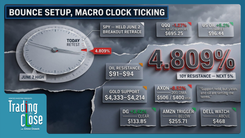

Trading The Close Market Recap - 12/17/2025: Year-End Fragility — Micron Pop, Apple Rejection and Tech-Led January Sell-Off Risk

As the year draws to a close, the market is grappling with a palpable sense of angst. While the holiday season often brings talk of a "Santa Claus rally," the underlying technicals and fundamental headwinds are painting a much more complex picture. In this afternoon's Trading The Close, Master Trader Gareth Soloway of Verified Investing dissected the critical charts and events shaping the market, revealing a downward bias that could intensify as we head into the new year.
From a pivotal earnings report in the semiconductor space to major technical tests in mega-cap stocks like Apple and Tesla, the market is sending clear signals to those who know how to read them. Today, we’ll dive deeper into these key themes, providing the context and analysis needed to navigate this uncertain environment.
The Year-End Float vs. The January Reality
While many market participants are hoping for a quiet drift higher into the final days of December, the charts are suggesting a different story is brewing just beneath the surface. A short-term float is certainly possible, but the dominant technical posture points toward weakness. As guest host Gareth explained, the current setup is one where the underlying bias remains bearish, regardless of any near-term strength.
"Based on charts, even if we float up, the bias remains down. And again, we could float into the year-end, but then starting in January, again, the charts are saying sell-off."
This perspective is not based on a hunch, but on a confluence of troubling factors that are unlikely to resolve themselves with the flip of the calendar. We are seeing financiers pull back from data center deals, a critical component of the AI infrastructure build-out. Companies are facing the logistical and financial challenge of finding enough energy to power these massive data centers. Furthermore, there are accounting questions surrounding the depreciation of AI chips, with some hyperscalers spreading the cost over seven years when the realistic lifespan is closer to two or three. This practice can artificially inflate current earnings, masking the true, recurring capital expenditures required to stay competitive.
These are not fleeting headlines; they are significant structural concerns that will carry over into the new year. While a low-volume holiday float might temporarily buoy sentiment, these issues will be waiting for the market in January, creating the potential for a very nasty start to 2026.
Semiconductor Shake-Up: Oracle's Test, Micron's Pop
The semiconductor sector, the engine of the market's AI-driven rally, is now showing signs of divergence and stress. Two key reports this week highlight this dynamic perfectly: Oracle and Micron.
Oracle took a significant tumble after news broke that it was losing the backing of a major AI financier. The sharp sell-off, however, brought the stock down to a critical technical level that was identified by Gareth in advance.
"I talked about this level. I did buy it with members… on a technical basis, gap filled. We filled the gap today on Oracle. Watch for a bounce here off of this level."
A "gap fill" occurs when a stock's price returns to an area where it previously gapped up or down, leaving an empty space on the chart. These gaps often act as magnets for price, and once filled, they frequently serve as powerful support or resistance. For Oracle, this level represented a logical point for buyers to step in, anticipating at least a short-term bounce.
In stark contrast to Oracle's weakness, Micron provided a much-needed dose of optimism with its earnings report after the bell. This report was especially important coming on the heels of not only Oracle's bad news but also Broadcom's recent report, which saw the stock sell off despite good numbers. The market was desperate for a win in the semiconductor space, and a bullish pattern forming into the close on Micron’s chart hinted that one might be coming.
"I looked at the Micron chart and I said, you know what? There's an inverse head and shoulders going into earnings. I wonder if this signals that smart money knows and there's going to be a pop."
An inverse head and shoulders is a classic bullish reversal pattern that often signals a bottom is in and a move higher is imminent. The pattern’s appearance just before a major catalyst like earnings suggested that informed market participants might be positioning for a positive surprise. Sure enough, Micron popped in after-hours trading.
However, a note of caution is warranted. We’ve seen this script play out before with stocks like Nvidia and Broadcom, which initially rallied on earnings only to see those gains fade and reverse. The key test for Micron, and for the broader market, will be whether it can hold onto these gains tomorrow. A successful follow-through could help settle the market and enable that year-end float. A failure could confirm the underlying weakness and accelerate the move lower.
Apple's Precarious Perch: A Textbook Technical Rejection
Mega-cap titan Apple has been a source of market weakness recently, and its chart provides a masterclass in the power of long-term technical analysis. A short position was recently initiated based on a precise and powerful parallel trendline that has defined the stock's major turning points for years.
This trendline connects the COVID low, the 2022 bear market low, and the April 2021 low. When a parallel copy of this line is extended to the upside, it perfectly pinpointed the bull market high of 2021 and, more recently, the December 2024 high.
"Notice the parallel COVID low bear market 2022 low and April ‘Liberation’ sell off low, but bull market 2021 high at the top of the parallel December 2024 before tariff collapse. And what did we hit right there? Boom."
The rejection from this level was immediate and forceful. The stock has since dropped approximately $17.00 USD, and the weekly chart is now showing a "topping tail," a bearish candlestick pattern that indicates sellers have taken firm control at the highs. While a short-term bounce is always possible after such a sharp decline, the larger technical picture for Apple suggests that the path of least resistance is now lower.
Tesla Holds the Line at Critical Support
While Apple’s chart looks increasingly bearish, Tesla is presenting a more constructive, albeit tentative, picture. The stock recently confirmed a breakout from a wedge pattern, a technical formation that often precedes a strong directional move. Following the breakout, the stock experienced a sharp pullback today, which can be alarming for inexperienced traders.
However, the pullback stopped at a crucial spot: the very trendline it had just broken out from. This is a classic technical phenomenon known as a "retest," where old resistance becomes new support.
"Look at where it stopped right at that level. So this trend line right here should act as major support… As long as we don't reconfirm below this level, Tesla remains a buy with a bullish bias on it into year-end."
This level is now the key line in the sand for Tesla bulls. As long as the stock holds above this retest level, the breakout remains valid, and the bias is for a move higher. A close back below this line would negate the breakout and turn the chart picture decidedly more bearish.
Reading the Tea Leaves in Risk Assets and Commodities
Bitcoin: The cryptocurrency is acting as a pure risk asset. It is currently consolidating in what appears to be a bear flag pattern, holding just above a key support level. A confirmed break of this support would open the door to a decline first to $80,000, and potentially down to the $69,000 to $74,000 range. Its price action today was telling; Bitcoin was positive early in the session when stocks were up, but sold off in tandem with the market as equities went into freefall. This tight correlation underscores its current role in the market.
"It is being valued as a risk asset, regardless of what you or I may think about its long term being a digital gold or something else. It doesn't matter right now. It's a risk asset. And if the stock market is going to fall, Bitcoin likely is going lower."
Gold & Silver: Gold is quietly inching higher, teasing a potential breakout to new all-time highs. For this to happen, it needs to show continuation and take out the prior high around 4,400 in the next few days. Silver, meanwhile, continues its strong rally and is approaching a major resistance zone around the $68.00 to $69.00 USD level, a logical spot for a pullback or consolidation.
Oil & Natural Gas: Crude oil recently avoided a major breakdown. It briefly dipped below a double bottom support level but failed to get a confirmation close below it, instead snapping back higher in what traders call a "fake out." While the immediate danger has passed, oil needs to reclaim key overhead resistance to signal a more significant rally. A confirmed breakdown below the recent lows would likely target $50.00 USD per barrel. Natural gas, after several days of accumulation, is finally getting the bounce that was anticipated. The move is expected to continue, with a potential target in the $4.35 to $4.40 USD range.
Conclusion: Santa Claus on Shaky Ground
The market is balanced on a knife's edge. Micron's positive earnings reaction has the potential to calm frayed nerves and provide the fuel for a neutral-to-positive float into the final days of the year. However, the underlying technical damage in key stocks like Apple and the persistent fundamental concerns surrounding the AI trade cannot be ignored.
Tomorrow's session will be pivotal. If Micron’s gains hold and the broader market stabilizes, the odds of a quiet end to the year increase. If, however, the selling pressure resumes and the market shrugs off the good news, it would be a significant sign of weakness. Such a failure would likely mean the Santa Claus rally is canceled, setting the stage for the bearish technical outlook to play out with a potentially vicious sell-off in January. For now, traders must remain disciplined, watch these key levels, and be prepared for whatever volatility the end of the year brings.
Trading involves substantial risk. All content is for educational purposes only and should not be considered financial advice or recommendations to buy or sell any asset. Read full terms of service.