
Trading The Close Market Recap - 02/09/2026: S&P Reclaims Wedge, QQQ Lags; Nvidia, Bitcoin, Silver Levels to Watch

Trading The Close Market Recap: 02/09/2026
In today’s edition of the Trading The Close Market, Verified Investing’s Lawton Ho stepped in for Pro Trader Drew Dosek, who is currently taking some well-deserved time off with his newborn daughter. While the session was marked by what Lawton described as a "sleepy market" with lower-than-average volume, the technical developments on the charts were anything but insignificant.
From the S&P 500 reclaiming a critical wedge pattern to the psychological warfare playing out in precious metals and cryptocurrencies, today’s price action offered a masterclass in technical discipline. Below, we expand on the key themes, specific price levels, and trading psychology discussed in this afternoon’s show.
The "Float" Phenomenon: A Day Trader’s Trap
One of the most dangerous environments for a day trader isn't necessarily a market crashing or ripping higher—it is the low-volume "float." Lawton opened the show by highlighting a specific market condition that can devastate unprepared traders: the lack of volatility.
In the Apex Live Day Trading Room, the team typically executes ten or more trades daily. Today, however, they took only four. This reduction in activity wasn't due to a lack of effort but rather a disciplined response to market conditions.
"In order to day trade, we need a couple things. We need volume and volatility… A lot of day traders got wrecked today. Not because there was crazy price action in the markets, because really, realistically, there wasn't, but because the markets just floated, and that is the worst enemy of any day trader out there."
When markets "float," they drift slowly in one direction (often upward) without significant pullbacks or volume spikes. This grinds out short sellers who are waiting for a technical rejection that never comes, simply because there isn't enough volume to trigger a reversal. Recognizing these conditions and reducing trade frequency is a hallmark of professional risk management.
Indices: The Tale of Two Wedges
The broader markets presented a tale of divergence today, specifically between the S&P 500 and the Nasdaq 100 (QQQ).
S&P 500: The Failed Breakdown?
Last week, the S&P 500 appeared to break down below a critical wedge pattern, dropping nearly 1.5%. However, today’s action saw the index storm back inside the wedge, closing firmly within the pattern. In technical analysis, a "failed breakdown"—where price breaks support but quickly reclaims it—can often lead to a sharp move in the opposite direction, potentially trapping bears.
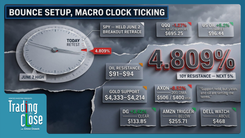
Lawton noted that the S&P is now eyeing resistance at the top of this trendline. If it holds within the wedge, the index could very well be headed toward brand-new all-time highs, challenging the record closes seen between January 12th and February 2nd.
Nasdaq 100 (QQQ): Relative Weakness
In contrast, the QQQ tells a story of relative weakness, largely driven by the software sector. While the S&P is threatening highs, the QQQ merely retraced to the bottom of its wedge pattern—a classic retest of a breakdown.
"We know that the software companies, the software market, the software sector, has been extremely weak… And the fact that the S&P is almost at all-time highs, but the Q's are still off of its highs could mean, just indicate relative weakness."
For the QQQ to match the S&P’s strength, it would need to rally another 3.5% to reach its highs. Currently, the bottom of that wedge acts as overhead resistance.
Dow Jones Industrial Average
The Dow continues to trade in a very tight, up-sloping wedge. While it is making new all-time highs, Lawton reminded viewers that up-sloping wedges are generally bearish reversal patterns. The next major resistance level for the Dow sits at the top of its trendline, approximately 50,400.
HIMS: News Catalysts and Technical Levels
The session highlighted the volatility inherent in individual stock names driven by headlines. HIMS (Hims & Hers Health, Inc.) opened down 22.5% following news of a legal dispute with Novo Nordisk regarding the sale of compounded products like Wegovy and Ozempic.
Despite the bearish news, the stock staged a massive intraday recovery, bouncing roughly 19% from its lows. This price action underscores the importance of technical levels over pure headline reactions.
Key Technical Levels for HIMS:
- Support: If the selling resumes, the primary buy zone is the 2024 lows around $13.50.
- Resistance: The first major hurdle is the gap fill at $23.00. Beyond that, the stock must clear a down-sloping trendline to unlock a potential move back toward $50.
Software Sector Recovery: Oracle and Amazon
The software sector has been the laggard of 2026 so far, but select names are showing signs of life.
Oracle (ORCL)
Oracle has staged a remarkable turnaround, bouncing 15.5% from its Thursday lows and reaching up 18% at today's highs. Lawton emphasized that this volatility is occurring in a mega-cap legacy tech name, not a speculative meme stock.
For traders looking at Oracle, the chart presents clear levels:
- Resistance: The immediate target is the down-sloping trendline connecting the pivot highs from October 16th and January 13th.
- Gap Fill: A significant level to watch is $182.15, which marks the gap from January 26th that initiated the recent 26% decline.
- Pivot High: Further resistance sits at approximately $207.
Amazon (AMZN)
Amazon continues to struggle with the fallout from its earnings miss. Today’s price action resulted in a "doji" candle—a sign of indecision where the open and close are nearly identical despite intraday volatility.
- Resistance: The stock faces a stiff trendline barrier at the $222–$223 level.
- Support: Downside targets include a gap fill at $193 (from May 8th) and the "Liberation Day" lows around $161.
Google (GOOGL)
Google managed a green day despite a lower open. The technical structure remains defined by trendlines.
- Short Setup: Lawton identified a potential shorting opportunity at the double top area around $350.
- Support: If the stock rolls over, support lies at the gap fill near $276 and consolidation zones around $255.
Nvidia: The Head and Shoulders Invalidation Zone
Nvidia (NVDA) remains a focal point for market participants. The stock has been tracing out a Head and Shoulders pattern, a classic bearish reversal formation. However, patterns are only valid until they are broken.
Lawton pointed out that Nvidia is currently pushing up against the right shoulder of the pattern.
- Invalidation Level: If Nvidia rallies another 11.5% to approximately $212, it would break above the right shoulder, effectively invalidating the bearish Head and Shoulders setup.
- Psychological Resistance: Before reaching that invalidation point, the stock must contend with the $200 psychological level. Lawton noted he would be looking to short the stock at that specific price point.
Crypto: The Power of Psychological Levels
Bitcoin provided a perfect example of why round numbers matter in trading. The cryptocurrency bounced precisely off the $60,000 level, a zone of heavy consolidation and psychological significance.
"A lot of times we talk about these kind of psychological levels and people think, well, it's just an arbitrary number… But in this case, it worked absolutely perfectly."
Bitcoin Technicals
Following the bounce, Bitcoin is forming what looks like a potential bull flag. However, significant overhead supply remains:
- Resistance 1: The "Liberation Day" pivot lows around $74,500.
- Resistance 2: The November 21st pivot lows around $80,300–$80,400.
- Resistance 3: The neckline of the larger Head and Shoulders pattern, sitting between $83,000 and $84,000.
Ethereum Outlook
Ethereum found support at the $1,800 level, a zone of historical consolidation from April and May of the previous year. While it may see a sympathetic bounce alongside Bitcoin, Lawton expressed skepticism about a return to highs.
- Resistance: Heavy overhead supply exists between $2,300 and $2,400.
- Outlook: A rally to $3,000 seems unlikely in the short term; the chart suggests a potential eventual fade back toward the $1,400–$1,500 range.
Precious Metals: The Retail Mindset in Silver
Gold and silver are showing divergent behaviors, but both are governed by strict technicals and human psychology.
Gold
Gold is up roughly 2%, attempting to retrace its recent move.
- Fibonacci Resistance: The 61.8% Fibonacci retracement from the recent highs sits at $5,142.
- Structural Resistance: The $5,200 level, which previously acted as support, has likely flipped to resistance. A break above this level is required to put new all-time highs back on the table.
Silver and the $100 Barrier
Silver recently experienced a historic 35% flush in a single day, followed by a bounce. It is currently respecting a parallel channel, with the bottom of that channel acting as resistance around $96.
However, the most potent resistance might be psychological. Lawton detailed the mindset of the retail investor who bought silver at lower prices ($30–$40), watched it hit $121, and then held through the crash.
"They're not going to say, ‘I'm going to sell silver when it gets to $96.42 and $96.43.’ No, they're going to say, if silver can just get back to that $100 level, I will sell my silver."
This "anchoring" bias creates a wall of sellers at round numbers. Investors who regret not selling at the top often promise themselves they will get out "if it just gets back to X." In this case, $100 is that number, creating a formidable ceiling for the metal.
Conclusion: Discipline in a Drifting Market
Today's market recap serves as a reminder that profitable trading isn't always about catching the biggest moves or trading the most volatile days. Sometimes, it is about recognizing when the market is "floating" and having the discipline to sit on your hands.
Whether it is waiting for Bitcoin to hit a specific pivot at $74,500, watching for Nvidia to test $200, or waiting for Amazon to fill a gap at $193, the edge lies in patience. As Lawton demonstrated with the HIMS and Oracle analysis, understanding the specific technical levels—gaps, trendlines, and psychological round numbers—allows traders to execute with precision rather than emotion.
Pro Trader Drew Dosek will return on Thursday to continue guiding us through these complex market conditions. Until then, keep your charts clean, watch your levels, and respect the probabilities.
Trading involves substantial risk. All content is for educational purposes only and should not be considered financial advice or recommendations to buy or sell any asset. Read full terms of service.