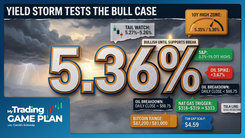

My Trading Game Plan Revealed - 02/05/2026: De-Risking Wave Hits Markets: S&P 500 Correction and Bitcoin Bounce

The markets are speaking, and the message is becoming increasingly clear: the de-risking event that Gareth Soloway, Chief Market Strategist at VerifiedInvesting.com, has been warning about is now underway. In this morning's My Trading Game Plan show, Gareth broke down the technical damage inflicted on the major indices, the shifting narrative around AI capital expenditures, and the specific "dominoes" that are falling across asset classes.
As we navigate this volatility, the distinction between emotional trading and logical, chart-based analysis becomes the difference between capital preservation and significant losses. Today’s session provided a masterclass in reading market signals, identifying high-probability entry points, and understanding the psychology of fear and greed.
The Macro Shift: Jobless Claims and the "Scene of the Crime"
The morning began with a look at fresh economic data that may signal a turning point for the U.S. economy. Jobless claims came in at 232,000, a number decently higher than the anticipated 212,000. While a single data point does not establish a trend, Gareth emphasized the importance of monitoring this metric closely. If filings for unemployment continue to increase week over week, it suggests that the economic resilience that has supported equity valuations may be fracturing.
This economic backdrop coincides with a critical technical breakdown in the S&P 500. Gareth revisited a concept he refers to as the "scene of the crime"—a technical level where a major trendline support was broken, and price subsequently retraced to test that breakdown level from below.
"Remember, support, support, support. Once you break support, it becomes resistance. What happens? It rejects price. And ultimately, again, we can see that happening in real time over the last few days as price again retraced to what I call the scene of the crime."
The S&P 500 is currently rejecting off this convergence of two major trendlines. From a probability standpoint, Gareth noted that the chance of price breaking back above two converging resistance lines was roughly 20%, leaving an 80% probability of the sell-off we are currently witnessing.
Intraday and Long-Term Targets
For traders navigating the immediate volatility, specific levels are in play. On the S&P 500, the first intraday support sits at 6,794, which represents a gap fill. Should that level break, the next intraday target is 6,721.
However, the broader implication of this rejection is the potential for a much larger correction. Gareth outlined a short-term downside target for 2026 at 6100. If that level is breached, the market could seek the low end of its parallel channel around 5,400 to 5,500. Such a move would represent an approximate 20% correction—a healthy, albeit painful, normalization of valuations.
The Domino Theory: Silver, Bitcoin, then Equities
One of the most compelling frameworks discussed in today's show is the "Domino Theory" of asset de-risking. In a liquidity-draining environment, assets tend to fall in a specific order based on their risk profile and liquidity.
- Domino 1: Silver. We witnessed silver collapsing first, a move that continued today with a massive drop of nearly 16%.
- Domino 2: Bitcoin. The cryptocurrency market followed suit, with Bitcoin dumping out and breaking below key psychological levels.
- Domino 3: The Stock Market. This is the final domino in the de-risking curve, and we are now seeing software stocks and semiconductors crumble.
"What's last in the de-risking curve? The stock market. And that is now starting to fall as we are seeing."
This sequence provides a roadmap for traders. By observing weakness in leading risk assets like silver and crypto, astute investors can anticipate the pressure eventually hitting the broader equity markets.
The AI Capex Reality Check: Alphabet and the Tech Sector
A significant shift in market sentiment is occurring regarding Artificial Intelligence. For the past two years, any company announcing massive AI spending was rewarded with higher stock prices. That narrative is flipping.
Alphabet (Google) reported strong numbers, yet the stock is under pressure, trading around $315. The concern lies in the massive capital expenditure—$170 billion projected for 2026—dedicated to building out AI infrastructure. Investors are no longer blindly celebrating this spend; they are now demanding to know the return on investment (ROI).
"The issue there is a year ago, six months ago, this would have been shooting higher. But now investors are becoming more aware of this massive spend, and they're starting to ask, all right, if you're going to spend $170 billion, what type of return are you going to get on that?"
Technical Levels for Alphabet
Despite the bearish sentiment, the charts provide clear levels where the stock becomes attractive again:
- Intraday: A gap fill and pivot low exist at $296.
- Secondary Support: A former gap area around $275.
- Swing Trade Zone: The most compelling level for a swing trade is approximately $240. This level aligns with a trendline connecting high pivots and, crucially, the 50% Fibonacci retracement of the major run from $140 to $350.
Gareth highlighted the "50% rule" and the 61.8% Fibonacci retracement as his favorite levels for catching falling knives, provided they align with other technical factors like trendlines or pivot points.
Semiconductor Weakness: Qualcomm and Arm Holdings
The semiconductor sector, long the darling of this bull market, is showing significant cracks. Qualcomm has experienced a nasty sell-off, trading around $132. The daily chart shows the stock sitting right at the low end of a parallel channel.
While this might usually signal a bounce, Gareth warned about the significance of premarket volume. When a support level is hammered with heavy volume before the bell, it weakens the structural integrity of that support.
- Qualcomm Strategy: The first day-tradeable level is the pivot low at $121. For swing traders, a break of the current parallel channel could open the door to a move between $100 and $110, where a gap fill ($110) and a pivot low ($103) provide structural support.
- Arm Holdings: Similarly, Arm is under pressure. The only level of interest for a potential bounce is the flush down to the pivot low at $80.50, with a massive gap fill waiting at $77.
Contrarian Opportunities: "So Bad It's Good"
In the midst of a sell-off, the disciplined trader looks for opportunities where sentiment has become too bearish. Gareth pointed to the software sector as an area where stocks are looking "so bad that they're almost good."
Oracle: The Dollar Cost Averaging Approach
Oracle has dropped almost vertically from $345 to below $145. However, a major trendline dating back to October 2022 comes into play around $140.
"That, to me, looks great as a swing trade. Now, just because it's great doesn't mean I go all-in on a position… Generally, when panic is hitting, stocks will pierce lows."
This introduces the critical concept of Dollar Cost Averaging (DCA). Rather than going "all in" at the first sign of support, a professional approach involves buying a starter position (e.g., 25%) at the key level. If the price pierces the level due to panic, the trader adds to the position at lower increments, lowering the cost basis while waiting for the inevitable technical bounce.
Microsoft and Palantir
- Microsoft: A confluence of technicals appears between $395 and $390, where a gap fill merges with a trendline. This represents a high-probability zone for a swing trade.
- Palantir: After an incredible collapse, Palantir is approaching a former pivot high around $124. This level, which previously acted as resistance before a breakout and consolidation, should now act as support.
Bitcoin and the Crypto Bounce
Bitcoin has been caught in the de-risking wave, falling below the psychological $70,000 mark to trade in the $69,000 range. However, unlike the broader equity market which may have further to fall, Gareth is flipping bullish on Bitcoin for a short-term bounce.
The technical reasoning is the test of the 2021 all-time high. In technical analysis, former all-time highs often act as major support when tested from above. Recognizing this, Gareth disclosed adding exposure to IBIT (Bitcoin ETF) and MicroStrategy, utilizing the same dollar-cost averaging discipline mentioned earlier.
"I picked up some IBIT today down here. Not a full position because it could go lower. But why do I like it? Number one, all of these technical levels here, but also look at this right there. Your bull market 2021 all-time high… I think you're due for a bounce in Bitcoin."
The Tale of Two Metals: Gold vs. Silver
The divergence between gold and silver today was stark and instructive regarding the current market psychology.
Silver plummeted nearly 16%, failing to even reach a 50% Fibonacci retracement on its minor bounce, stalling instead at the weak 38.2% level. This inability to bounce indicates intense selling pressure. Gareth's buy orders for silver are set significantly lower, in the $54 to $50 range.
Gold, conversely, held up relatively well, down only about 3%. This relative strength reinforces gold's status as a safe-haven asset and a central bank reserve currency. While silver behaves like a risk asset (similar to tech stocks or crypto) during de-risking events, gold benefits from flight-to-safety capital flows.
Conclusion: Logic Over Narrative
The overarching theme of today's analysis is the necessity of grounding trading decisions in logic and charts rather than media narratives. When the market is euphoric, narratives drive prices to irrational highs (greed). When the market corrects, fear drives prices to irrational lows.
As Gareth reminded viewers, "From fear and panic comes [the] opportunity to go long. From greed and euphoria comes [the] opportunity to go short."
The current environment is shifting from greed to fear. For the prepared trader, this transition is not a time to panic, but a time to consult the charts, identify the "scene of the crime," mark the gap fills, and execute trades based on probability rather than emotion. Whether it is waiting for the S&P to hit 6100, watching for Microsoft at $395, or accumulating Bitcoin at 2021 highs, the game plan relies on patience and precision.
By ignoring the noise and focusing on the data—from jobless claims to Fibonacci retracements—investors can navigate the coming volatility with a clear edge.
Trading involves substantial risk. All content is for educational purposes only and should not be considered financial advice or recommendations to buy or sell any asset. Read full terms of service.