
Trading The Close Market Recap - 02/03/2026: Tech Sector Sell-Off, Earnings Gap-Fills & Crypto Head-and-Shoulders Warning

In today’s combined edition of Earnings Central Live and the Trading The Close, Pro Trader Lawton Ho stepped in for Drew Dosek to navigate a high-velocity session defined by a massive tech sector sell-off and a flurry of earnings reports. With Drew away welcoming a new addition to his family, Lawton delivered a masterclass in real-time technical analysis, executing a "three for three" win rate on earnings trades while issuing stark warnings about developing patterns in the crypto markets.
The session was characterized by extreme volatility, particularly in software and technology names, with the Nasdaq 100 (QQQ) reversing from open highs to close down significantly. Amidst this chaos, the disciplined application of technical levels—specifically gap fills and historical supports—provided a sanctuary for traders looking to capitalize on the noise.
The "First Move" Fallacy: Navigating Earnings Volatility
One of the central themes of the afternoon was the deceptive nature of initial price reactions to earnings reports. As Lawton Ho prepared viewers for a barrage of reports from Amgen, Chipotle, and AMD, he emphasized a critical psychological component of earnings trading:
"One more thing to note, guys, the first move isn't always the correct move. Let's say Amgen collapses a little bit, pulls back a little initially, it might bounce and actually go green. Because… it's the algorithms reacting to the initial earnings reports."
This phenomenon was on full display throughout the session. Algorithmic trading systems often trigger immediate buy or sell orders based on headline numbers, creating "wicks" or "flushes" that do not necessarily reflect the true sentiment or the eventual direction of the stock once humans digest the guidance. For the professional trader, these initial overreactions are not signals to chase, but opportunities to wait for price to hit predetermined, high-probability technical levels.
Amgen (AMGN): The Flush and Bounce
Amgen provided the first textbook example of this dynamic. Reporting an expected EPS between $4.74 and $4.76 (a decrease of 10-11% year-over-year) and revenue of $9.46 billion, the stock initially flushed.
Lawton had identified a support zone at $330. In real-time, the stock pierced this level, dropping to the $329-$330 area before staging a remarkable reversal. The level acted as a springboard, with the stock bouncing approximately 5% from the lows. This trade highlighted the value of having levels drawn before the news hits; while the algorithms were selling the headline miss, technical traders were buying the structural support.
Chipotle Mexican Grill (CMG): Precision Gap Filling
Perhaps the most precise trade of the afternoon involved Chipotle. The stock initially pushed up to $41 (a 4% move) before the "rug pull" occurred, sending it tumbling 13%. This violent reversal underscores the danger of chasing the initial move.
Lawton had identified a specific gap fill level at $34.90. The stock dropped, hit $35 exactly—pennies away from the aggressive level—and immediately bounced.
"Right there, $35 and bounce. $34.90 was that level for me… And look at that bounce. About a 2% bounce there."
This sequence validated the strategy of identifying "aggressive" first levels versus "conservative" secondary levels. In a high-volatility event like earnings, the first significant technical barrier often provides a tradable bounce simply due to the exhaustion of immediate selling pressure.
AMD: The Support Hold
The highly anticipated report from AMD rounded out the "three for three" performance. With the tech sector already under heavy pressure, AMD initially pushed up before turning negative. Lawton had marked $230.65 as the critical support level, derived from a period of sideways consolidation on the chart.
The stock flushed to a low around $230.23, piercing the level by mere cents, before reclaiming it and bouncing approximately 1% into the close. This trade reinforced the importance of "volume, volatility, and velocity." As Lawton noted, traders need these three elements to maneuver, but they must also be wary of low-volume drifts that can occur ten to fifteen minutes after the report release.
Tech Sector Collapse: Analyzing the Indices
Transitioning from specific earnings plays to the broader market, the technical picture for the major indices suggests a precarious position. The session witnessed a "huge sell" in the QQQ (Nasdaq 100) and the S&P 500, driven largely by a collapse in software-related stocks.
The QQQ Wedge Pattern
The Nasdaq 100 opened higher but closed down 1.5%, representing a staggering 3% fall from its intraday highs. Lawton pointed out a distinct "wedge pattern" forming on the charts.
"We attempted to break to the downside here on the Qs, but we're unable to close below. So what does this mean? … We need to first break this wedge pattern. And if we see a break, I would look for a potential short, or a bearish pattern on a retrace to this up sloping trendline."
A wedge pattern is often a consolidation phase that precedes a significant breakout or breakdown. The fact that the QQQ tested the lower bound of this wedge without decisively closing below it leaves the market in a state of tension. A confirmed break below this trendline would likely signal a continuation of the selling pressure observed today.
S&P 500: The Danger Zone
The S&P 500 is displaying a similar, perhaps even "better," wedge formation. The index bounced precisely at the bottom of its up-sloping trendline. However, the downside risk remains substantial if this support gives way.
Lawton identified a gap fill target around 6,710, with a potential further slide to the 6,530 or 6,055 region. This would represent a decline of approximately 5% from current trading levels. The confluence of these wedge patterns across both major indices suggests that the market is at a decision point: hold the trendline and resume the rally, or break the wedge and trigger a deeper correction.
Crypto Warning: The Head and Shoulders Looming
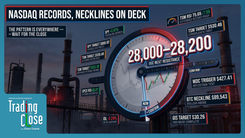
While equities are testing trendlines, the cryptocurrency markets are forming what Lawton described as "massive" bearish reversal patterns. Both Bitcoin and Ethereum are displaying classic Head and Shoulders formations, which are traditionally reliable indicators of a trend reversal from bullish to bearish.
Bitcoin's Bear Flag and Measured Move
Bitcoin recently bounced off the $73,000 level—the previous all-time high and "Liberation Day" low. While it is currently trading slightly above this support, the consolidation action resembles a bear flag.
The technical implications of the Head and Shoulders pattern are severe. Lawton outlined the "measured move"—a technical projection calculated by taking the distance from the head to the neckline and projecting it downwards from the breakdown point.
"What does technical analysis tell us? When we have a pattern, we have a measured move. And the measured move is all the way down to $35,000."
While a drop to $35,000 seems extreme, technical analysis deals in probabilities and projections. For traders looking for immediate levels, Lawton identified the previous all-time high of $69,000 as the next major support. Conversely, for those looking to short, a retrace to the neckline between $81,000 and $84,000 would offer a high-probability entry with a defined risk.
Ethereum's Downside Targets
Ethereum mirrors Bitcoin's structure with its own Head and Shoulders pattern. While the mathematical measured move points to an unlikely target of $217, Lawton focused on more immediate, actionable support levels based on market psychology and historical pivots.
- Psychological Support ($2,000): A nice, round number that retail investors naturally gravitate toward. Historical data from 2024 shows a 29% bounce occurred from this zone.
- Structural Support ($1,383): This level corresponds to the "Liberation Day" lows.
The Significance of "Liberation Day"
Throughout the analysis, Lawton referred to "Liberation Day" lows as critical reference points. This concept is vital for understanding market psychology. "Liberation Day" refers to a day of capitulation—extreme panic selling where the last of the weak hands exit the market.
"The reason why I love Liberation Day as a trader is that that was the most amount of selling, the most bearish correction that we've seen in a while… it gives us a clear level of support."
When markets revisit these levels, they often find support because the supply of sellers was previously exhausted at that price point. Whether analyzing Ethereum at $1,383 or Bitcoin at $73,000, these historical markers of maximum fear often transform into areas of maximum opportunity for the disciplined trader.
Sector Rotations: The Tech Wreck
The backdrop for today's technical setups was a broad-based liquidation in the technology sector. High-flying names like PayPal plummeted over 20% following bad earnings and a leadership shakeup, dragging the rest of the software sector down with it. Stocks like Duolingo (down 9%) and Salesforce (down 6.8%) suffered collateral damage.
This sector-wide weakness reinforces the importance of the "domino effect" in markets. When a bellwether like PayPal collapses, it forces a repricing of risk across the entire industry. However, even in a "tech wreck," opportunities exist. The divergence seen in LITE (up 13%) and the subsequent strength in memory stocks like Western Digital suggests that capital is not leaving the market entirely but is rotating into specific pockets of strength.
Conclusion: Discipline in the Face of Volatility
Today's session was a testament to the power of level-based trading. In an environment where the Nasdaq swings 3% and blue-chip stocks flush on earnings, emotional decision-making is a recipe for disaster. By waiting for Amgen to hit $330, Chipotle to hit $34.90, and AMD to hit $230.65, traders could ignore the noise and execute on high-probability setups.
As we look toward the rest of the week, with Google and other giants set to report, the technical wedges in the S&P 500 and QQQ will be the defining charts to watch. If the support trendlines hold, the bull market may have life yet. If they break, the downside targets outlined today could come into play faster than many expect.
The market rewards patience and punishes hubris. As Lawton Ho demonstrated today, the edge lies not in predicting the news, but in knowing exactly where to act when the price arrives.
Trading involves substantial risk. All content is for educational purposes only and should not be considered financial advice or recommendations to buy or sell any asset. Read full terms of service.