
Trading The Close Market Recap - 02/02/2026: S&P 500 Tests 7,000 as Nasdaq Wobbles — Bitcoin Holds $74.5K Pivot

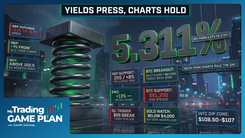
The markets opened February 2026 with a decisive test of psychological and technical boundaries. As the S&P 500 attempts to recapture the elusive 7,000 mark and Bitcoin finds footing at a critical algorithmic level, traders are navigating a landscape defined by divergence. In today’s Trading The Close, Head Trader at Verified Investing, Benjamin Pool, served as guest host and dissected the charts to reveal where the smart money is positioning itself across equities, crypto, and commodities.
The Tale of Two Indices: SPX Strength vs. NDX Fragility
A distinct divergence has emerged between the broader market and the technology sector, creating a complex environment for trend followers. The S&P 500 (SPX) continues to show resilience, attempting to reclaim the 7,000 level after briefly piercing it on January 29th.
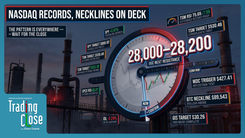
The technical structure of the SPX is defined by a long-term up-sloping trendline connecting the highs from November 2022. This trendline has acted as a ceiling on multiple occasions, rejecting price advances with mechanical precision. However, the current price action suggests a bullish bias remains intact as the index continues to print newer highs. Should the SPX successfully recapture and hold above 7,000, Benjamin Poole identified an immediate upside target of 7,219.
Conversely, the Nasdaq 100 (NDX) is painting a more cautious picture. Unlike the SPX, the tech-heavy index is making lower highs and remains trapped inside a pivot top structure. It is currently resting precariously on an up-sloping trendline.
"More often something hits the upside or the upper end of a trend line, the weaker this up-sloping trend line gets."
This technical axiom suggests that the NDX is at a critical inflection point. A break below this trendline could trigger a significant liquidation event, with a potential downside target of 24,000. For bulls to regain control, the index must clear the all-time high of 26,177. This divergence between the SPX and NDX serves as a warning: market breadth may be thinning, and traders should be wary of assuming that strength in one index guarantees stability in another.
Bitcoin and the Algorithmic Memory of Markets
The cryptocurrency markets provided a textbook example of how institutional algorithms utilize historical pivot points. Bitcoin recently found major support right below the $75,000 psychological level, bouncing precisely from a zone that has historically ignited massive rallies.
Specifically, the low pivot of $74,546 from April 2025 is the key level to watch. In the past, bounces from this zone resulted in moves of 60% to 68% to the upside. This phenomenon isn't accidental; it is a function of how automated trading systems are programmed. Ben explained:
"When you create algorithms and stuff, they look for low pivots with major pivot points, and this is where the algorithms sit, and that's why you got this solid bounce."
This "market memory" creates a self-fulfilling prophecy where liquidity rests waiting for price to return to "discount" levels. However, the recovery faces immediate headwinds. An up-sloping trendline on the weekly timeframe, which previously acted as support during consolidation, has now flipped to become resistance. This puts the ceiling for the current move around $85,000.
Traders must also prepare for the bearish invalidation of this setup. If the $74,546 shelf breaks, the next support levels are significantly lower, at $70,118, followed by $61,000, and potentially a double-bottom test at $54,747. While such targets may seem extreme to bullish investors, technical analysis requires acknowledging all potential outcomes to manage risk effectively.
Precious Metals and The "Widowmaker"
The commodities sector is exhibiting high volatility, with specific setups emerging in precious metals and energy. Silver, often moving in tandem with Gold, has shown weakness, breaking a key up-sloping trendline that had been tested five times. The failure of this trendline has turned it into resistance, with Silver recently rejecting off the underside of this level. If selling pressure continues, support targets sit at $71.43, with a deeper wash-out potential to $54.37.
Gold, meanwhile, has respected its technical boundaries more faithfully. After a run-up to nearly $5,600, it retraced to test a trendline connecting the October lows, finding a solid bounce around the $4,400 level. This area was reinforced by previous pivot tops, creating a "polarity flip" where old resistance becomes new support.
In the energy sector, Natural Gas—notoriously dubbed the "Widowmaker" for its ability to destroy trading accounts—is approaching a critical juncture.
"They call this the Widowmaker for a reason… If it does break below this level, you could be seeing sub $4 on this natural gas chart."
Current support is holding at $4.48, a level defined by significant price consolidation. A breakdown here opens the door to $3.99. However, for the patient swing trader, the high-probability long entry may require waiting for a retest of the long-term trendline around $3.00. This discipline of waiting for the "fat pitch" rather than chasing the first sign of a bounce is often what separates professional traders from amateurs.
Tech Giants: Microsoft and NVIDIA at the Brink
As earnings season continues to unfold, two of the world's most important stocks, Microsoft and NVIDIA, are testing the patience of investors. Microsoft has shown notable weakness, breaking below a key support pivot at $424.90. This breakdown signals a shift in control from buyers to sellers.
When a major support level fails, traders must zoom out to find the next liquidity zones. For Microsoft, the next significant support structure resides at $406.15. Below that lies a gap fill at $395.26. Gap fills often act as magnets for price action, as patient capital waits for these inefficiencies to be resolved before re-entering the market.
NVIDIA, the bellwether of the AI trade, is clinging to an up-sloping trendline dating back to April 2025. Trading at $184.77 in the post-market, the stock is testing the resolve of the bulls.
"Based on the amount of times that NVIDIA has hit this up-sopping trend line and failing to take out these pivot highs and more favors moved to the downside."
The repeated testing of support without making new highs is a bearish signal known as "knocking on the door." Eventually, the door tends to open. If NVIDIA breaks this trendline, support levels at $177 and $170 come into play, with a potential "scene of the crime" retrace down to $152.72.
Strategic Swing Trading: Robinhood and Uranium
Beyond the mega-caps, interesting technical setups are forming in high-beta names. Robinhood has been under immense pressure, failing to hold the $100 level. The search for a bottom leads to historical analysis of the stock's IPO era.
The high from August 2021, shortly after Robinhood's IPO, sits at $85. This level, once a ceiling of resistance, is now expected to act as a floor of support. Just below it lies a gap fill at $83.03. This confluence of technical factors makes the $83-$85 zone a high-probability area for a bounce. However, the risk profile is asymmetric; a break below this zone reveals a vacuum of support down to $66.87.
Finally, the Uranium sector serves as a cautionary tale about market euphoria. The collective Uranium chart (representing tickers like CCJ, DNN, NXE) recently experienced a "euphoria top" where price briefly exceeded a long-term trendline before failing. Benjamin observed:
"I see this all the time where euphoria enters the market or a particular stock… and then all of a sudden, euphoria dies out and [we get] this huge rejection."
This "look above and fail" pattern is a classic bearish reversal signal. The rejection has sent prices lower, with the potential to revisit support around $6,315.15. This underscores the importance of not chasing breakouts during periods of extreme sentiment, as the subsequent reversion to the mean can be swift and punishing.
Conclusion: Discipline in a Volatile Market
The overarching theme of today's market analysis is the importance of identifying and respecting key technical levels. Whether it is the $74,546 algorithmic floor in Bitcoin, the $3.00 long-term trendline in Natural Gas, or the 7,000 barrier on the SPX, these numbers are not arbitrary—they represent the collective psychology and automated decision-making of the market.
As Benjamin Pool emphasized, drawing trendlines and identifying support zones does not guarantee a profit; it provides a roadmap of probability. By knowing where the "line in the sand" is for assets like Solana ($85.16) or Platinum ($1,485), traders can define their risk and avoid emotional decision-making.
Looking ahead, the market enters a critical window with earnings volatility continuing to ripple through the indices. Traders should keep a close watch on the divergence between the Nasdaq and the S&P 500, as the resolution of this split will likely dictate the trend for the remainder of the quarter. Stay tuned for the next few sessions, as Lawton Hoe joins the broadcast to navigate what promises to be a turbulent week of earnings reactions.
Trading involves substantial risk. All content is for educational purposes only and should not be considered financial advice or recommendations to buy or sell any asset. Read full terms of service.