
Trading The Close Market Recap - 03/18/2026: Fed Hawk Shock Sends Yields Higher — Stocks & Gold Fall; Oil Rallies

The financial markets thrive on certainty, yet they are often forced to digest the exact opposite. This reality was on full display during the latest Federal Open Market Committee (FOMC) announcement, which sent shockwaves through equities, commodities, and bond markets alike. In this afternoon's Trading The Close, Pro Trader Drew Dosek at Verified Investing broke down the intricate technical reactions to Jerome Powell's latest address, revealing how algorithmic trading, geopolitical tensions, and shifting interest rate probabilities are painting a highly complex picture for investors.
For traders navigating this environment, understanding the underlying technical structures is no longer optional—it is a prerequisite for survival. Today's analysis provided a masterclass in reading the tape, identifying institutional footprints, and ignoring the emotional noise that traps retail investors.
The Macro Picture: A Hawkish Reality Check
The fundamental backdrop of today's market action was driven entirely by the Federal Reserve. Federal Reserve Chairman Jerome Powell delivered a surprisingly mixed economic outlook. On the growth front, Powell noted that GDP is pushing up to 2.4%, with potential to hit 2.3% next year. However, the optimism surrounding economic expansion was heavily overshadowed by a stark warning on inflation.
Citing the ongoing conflict in Iran, Powell conceded that inflation remains stubbornly sticky, projecting that Personal Consumption Expenditures (PCE)—the Fed’s preferred inflation gauge—will hover around 2.7% this year.
The most dramatic shift, however, occurred within the market's forward-looking rate expectations. Going into the meeting, the Fed's dot plot suggested members were collectively anticipating one rate cut this year and another next year. But as the press conference unfolded, the CME Group FedWatch tool experienced a violent repricing.
"And as you see here now, slowly but surely, they are up ticking, telling everybody, oh my gosh, guys, on the horizon, there could be a chance," Drew noted while analyzing the probability of rate hikes. "And albeit small now, these were zeros. So what's growing, there's fertilizer over here, and it is starting to increase in value. So you better watch out; rate hikes could be on the horizon."
Prior to the announcement, the market had priced in a higher probability of a rate cut arriving by December 9, 2026. Following Powell's remarks, the probabilities shifted dramatically, pricing in no rate cuts for 2026 and projecting rates to remain unchanged all the way through June 2027.
Adding to this macro uncertainty is the looming transition at the Federal Reserve. Kevin Warsh, Powell's anticipated replacement, has yet to be confirmed. While Warsh was historically viewed as more dovish prior to the Middle Eastern conflict, the current reality of rising 10-year yields and surging US oil prices makes the prospect of rate cuts increasingly difficult to justify, regardless of who sits at the helm.
Whipsaw Wednesday: Equities React to the Fed
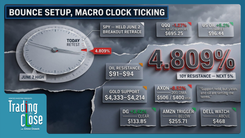
The equity markets' reaction to the FOMC data was a textbook example of algorithmic volatility. The S&P 500 closed the day down 1.4%, though it managed to avoid a worst-case technical scenario by not closing underneath the critical "Friday the 13th" candle. While closing near the lows of the day is inherently bearish, holding that specific candle preserves a shred of near-term structural integrity. Looking ahead, post-market trading showed the SPY ETF hovering near 600.10, with critical downside support waiting at 652.84.
The NASDAQ 100 experienced an even more aggressive "rug pull." After an impressive showing yesterday where price reclaimed key trend lines, the tech-heavy index violently reversed course. By closing back below its breakout levels, the NASDAQ is now testing the lower range of a massive flagpole formation. Support sits dangerously close at 24,117 points—a level that could easily be blown through—making the secondary support at 23,812 points the true line in the sand for tech bulls.
The small-cap sector fared no better. The Russell 2000 (IWM) dropped 1.61%, rejecting perfectly off the $250.25 resistance level. This rejection adds heavy conviction to a developing head and shoulders pattern, which carries a targeted measured move down to $241.78.
The intraday price action across these indices offered a profound lesson in market mechanics. When the FOMC data first hit the wire at 2:00 PM Eastern, the algorithms immediately spiked equities higher while temporarily pushing yields down.
"Remember this, the first move is usually the wrong move," Drew reminded viewers. This timeless trading axiom played out perfectly, as the initial bullish pop was aggressively sold into for the remainder of the session.
The Tale of Two Leading Indicators
To truly understand where the broader market is heading, professional traders look beneath the surface of the major indices. Today's analysis highlighted two of the most reliable leading indicators in the financial markets: the Semiconductor sector (SMH) and the Dow Jones Transportation Average (DJT).
Semiconductors at a Critical Juncture
The SMH is currently down 8% from its recent top, showing relative weakness compared to the S&P 500 (down 5%) and the NASDAQ (down 6.5%). Historically, semiconductors are the engine of the technology sector; when they lead to the downside, the broader market typically follows.
However, the SMH chart presents a fascinating near-term puzzle. Since the green candle printed on Monday, March 9th, the ETF has been forming bullish consolidation. To validate this near-term strength, price must close above the recent pivot at $407.40.
The danger lies in the larger timeframe pattern, which is a massive bear flag. If the SMH fails to break out and instead breaks its parallel support at $386.90, the technical damage would be severe. As Drew warned, if that level breaks, investors need to "watch out below," as the resulting plunge would likely drag the S&P 500 and NASDAQ down in its wake.
Transports Signal Economic Headwinds
The Dow Jones Transportation Average offers a direct look into the physical economy. Under the principles of Dow Theory, the transports must confirm the action of the industrials, as goods must be shipped for revenues to be realized.
The DJT previously triggered an inverse head and shoulders pattern with a targeted measured move of 20,505. However, after completing about 80% of that move, the index printed a glaring daily topping tail on February 11th. This candlestick pattern is a classic reversal signal, indicating that buyers have exhausted their momentum. The index is now locked in bearish consolidation, with the next major level of support sitting just under 17,000 points, aligning with an inclining trend line dating back to September 2022.
Yields and Commodities: The Flight from Safety?
The bond and commodity markets provided some of the most dramatic technical setups of the day, perfectly illustrating the inverse relationships that govern global capital flows.
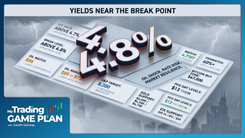
The 10-year Treasury yield, which had offered equities a brief reprieve by closing underneath a critical trend line yesterday, surged violently back above it today. After the initial algorithmic dip at 2:00 PM, the yield barreled higher, ultimately reaching 4.269%. This relentless strength in yields acts as a gravitational pull on equity valuations, particularly in the growth and tech sectors.
Precious Metals Plunge
As yields spiked and the prospect of higher-for-longer interest rates solidified, non-yielding assets like precious metals were ruthlessly sold off.
Gold suffered a devastating technical breakdown. After fighting to hold support at a parallel channel for several hours, the FOMC announcement served as the catalyst for a massive plunge. The metal fell off a cliff, slicing through support with ease. The next downside targets are clearly defined at $4,790.86, followed by deeper support at $4,620.02. Should gold attempt a dead-cat bounce, the previous support at the $4,916 parallel will now act as formidable resistance.
Silver mirrored this bearish price action, declining sharply toward the bottom range of its own bear flag consolidation. The primary downside target remains an inclining trend line at $63, though minor support may momentarily catch falling prices around the $72.50 level.
Oil's Technical Perfection
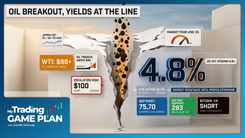
While precious metals collapsed, US Oil demonstrated the sheer power of technical analysis. Overnight, oil was making near-term lows before Asian markets aggressively stepped in, driving the price up to a key resistance level at $98.11.
"Look how technical analysis works, guys," Drew emphasized while reviewing the 10-minute chart. "When price came down, it went straight to this consolidation, caught support, and then bounced."
Oil ultimately formed a bear flag on the intraday charts, pierced the $98.11 resistance, closed below it, and is now attempting to reclaim it. If the bulls can secure a daily close above this pivot, the next resistance target sits at $103.15. Meanwhile, Natural Gas experienced a bipolar session, surging on the FOMC news to reclaim its parallel channel, though it continues to face heavy resistance in its current zone.
Crypto and Equities: Individual Setups in Focus
The macro volatility spared no asset class, creating distinct technical setups across cryptocurrencies and individual equities.
Bitcoin's Failed Breakout
Bitcoin provided a harsh lesson in the importance of confirmation. Yesterday, the cryptocurrency finally managed to close above a major descending trend line. However, technical breakouts require follow-through to be validated. Instead of pushing higher, Bitcoin suffered a massive rug pull, plunging right back down through the trend line.
This price action creates a "failed move," which often results in aggressive momentum in the opposite direction. Bitcoin is now trapped in a sideways bear flag pattern. To regain any semblance of bullish control, buyers must absorb the current selling pressure, re-attack the trend line, and secure a confirmed close above it.
Individual Equity Standouts
Despite the broader market carnage, several individual stocks presented compelling technical structures:
GEV (Up 1.71%): GEV is currently pressing against a massive trend line connecting multiple pivot highs. Trading at $886.79, the stock is on the verge of a potential breakout. If it can secure a daily close above this line, the technical target becomes the top of a long-standing parallel channel dating back to the April 2025 lows, roughly at $957. Conversely, failure here leaves the stock vulnerable to a drop toward the 50% parallel support at $810.73.
AMD (Up 1.6%): The semiconductor giant is currently trapped within a large bear flag pattern. To invalidate this bearish setup, AMD must clear two heavy resistance levels: first at $205.11, and subsequently at $218.30. If the broader market drags the stock down, a highly confluent support zone awaits between $176 and $175, which aligns closely with the 50% parallel at $177.
LAM Research (Down 0.78%): LRCX provided a textbook example of Fibonacci resistance. After a sharp decline and a subsequent double-top retest that generated a daily topping tail, the stock retraced exactly to the 61.8% Fibonacci level. It is now facing a wall of resistance at $241.40 and $243.28. Given the bearish consolidation, the path of least resistance appears to be down toward the bottom of its parallel channel at $208.
AbbVie (Down 5.2%): ABBV offered a crucial psychological lesson regarding support levels. For three days, the stock hovered dangerously close to its 50% parallel support. In technical analysis, the more a support level is tested, the weaker it becomes. Today, the floor gave out, and the stock plunged through. The next downside targets are $204.60 and $195.11. To negate this bearish breakdown, ABBV must reclaim the $219.48 level.
The Discipline of the Chart
Days like today separate the professionals from the amateurs. When Jerome Powell speaks and the algorithms take over, emotional traders are quickly separated from their capital. The initial spikes, the subsequent rug pulls, and the dramatic repricing of interest rate expectations can easily induce panic or FOMO (Fear Of Missing Out).
However, by anchoring decisions to objective technical data—whether it is the 61.8% Fibonacci retracement on LAM Research, the $250.25 resistance on the IWM, or the failed breakout on Bitcoin—traders can navigate the chaos with clarity.
The markets are currently digesting a reality where inflation remains sticky, geopolitical tensions are rising, and the highly anticipated era of rate cuts may be delayed indefinitely. In this environment, respecting the charts, waiting for confirmation, and understanding that "the first move is usually the wrong move" are the keys to long-term profitability. As the data continues to unfold, maintaining a strict, probability-based approach will be essential for capitalizing on the volatility ahead.
Trading involves substantial risk. All content is for educational purposes only and should not be considered financial advice or recommendations to buy or sell any asset. Read full terms of service.