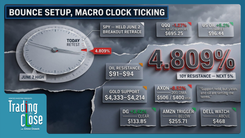

Trading The Close Market Recap - 03/19/2026: Geopolitical 2:50 PM Reversal Sparks Oil Plunge — S&P Weak, SMH & Bitcoin Key Levels

The intersection of geopolitical headlines and strict technical analysis was on full display during today's market session. For the majority of the trading day, equities were under severe pressure, grinding lower in a range-bound, sideways-to-down trajectory. However, a sudden geopolitical catalyst at 2:50 PM EST completely altered the intraday landscape. In this afternoon's Trading The Close, Pro Trader Drew Dosek at Verified Investing broke down exactly how this news impacted key technical levels across indices, commodities, and individual equities, providing a masterclass in probability-based trading.
This article expands on the critical concepts covered in today's show, offering deeper historical context and technical clarity for traders navigating this complex environment.
Geopolitics Meets Technicals: The 2:50 PM Reversal
Market sentiment shifted violently late in the afternoon following an announcement from Israel's Benjamin Netanyahu, who stated that the ongoing conflict would be ending sooner than anticipated. Crucially, the pledge to avoid attacking Iranian energy fields and the commitment to help reopen the Strait of Hormuz sent a wave of relief through global markets. Oil prices immediately plummeted, and equity investors, who had been heavily positioned for downside risk, scrambled to cover shorts and pile back into the buy side.
Despite this aggressive late-day rally, the broader market's technical damage was not fully erased. The S&P 500 still finished the day in the red, closing underneath both yesterday's candles and a critical near-term consolidation zone.
"…if we remain closed tomorrow underneath this consolidation that still will remain higher probabilities pushing this down to 652.84," noted Drew.
This 652.84 level on the S&P 500 is now the definitive line in the sand. When markets fail to reclaim consolidation zones despite highly bullish news catalysts, it often signals underlying institutional distribution. Furthermore, traders must factor in the psychological element of "weekend risk." In environments dominated by fluid geopolitical conflicts, institutional and retail investors alike are historically hesitant to hold heavy long exposure over the weekend. The fear of unexpected developments while markets are closed frequently leads to Friday afternoon selling pressure, a dynamic traders must anticipate heading into tomorrow's close.
Index Divergence: The NASDAQ, IWM, and the SMH Lifeline
While the S&P 500 struggled, the market showcased significant divergence under the surface. The NASDAQ managed to tag its first major level of support at 24,011.17 and bounced, closing with a much more constructive posture than the S&P 500. If bullish momentum continues, the NASDAQ faces a strict test at an inclining trend line resistance of 24,787.
The Russell 2000 (IWM) also displayed relative strength, finishing the day green by 0.65% after narrowly missing a measured move target of 241.78. However, it remains trapped in a consolidation pattern that historically favors downside resolution.
Perhaps the most fascinating technical drama of the day occurred in the Semiconductor ETF (SMH). For the second time recently, the SMH opened underneath a critical inclining parallel channel that dates all the way back to the April 2025 lows. And once again, it managed a miraculous recovery, rocketing back inside the parallel to close positive.
While bulls may cheer this resilience, professional technical analysis dictates caution. Support levels are like ice on a frozen pond; the more frequently they are jumped on, the weaker they become.
"…the more frequently this happens the weaker this becomes the more likely we can start breaking," Drew warned.
Traders must meticulously monitor the $387.70 level on the SMH. A definitive break and close beneath this parallel opens the trapdoor for a swift decline toward the next major support zone at $371.50.
The Intermarket Web: Yields, Oil, and Precious Metals
To truly understand today's equity movements, one must look at the bond market. The 10-year Treasury yield made new 2026 highs today, forming a textbook bear flag pattern before the 2:50 PM geopolitical announcement sent yields tumbling. This sudden drop in the cost of borrowing provided the exact fundamental oxygen needed for small-cap equities (IWM) to catch a bid, as these companies are highly sensitive to debt servicing costs.
In the commodities sector, the de-escalation news triggered massive volatility. US Oil, which had been perfectly respecting a technical resistance barrier at $98.11, dropped sharply on the Strait of Hormuz news. The fact that $98.11 held as resistance prior to the news is a testament to how technical levels often front-run or perfectly align with fundamental catalysts.
Precious metals experienced extreme pressure before the afternoon reversal. Gold pierced a vital support level at $4,620 before recovering back above it. In technical analysis, when price breaks below support, that level typically flips to resistance. Gold's ability to reclaim $4,620 is notable, but the chart remains precarious. With the daily RSI sitting at 34.18—dangerously close to the traditional oversold threshold of 30—a technical bounce is highly probable. However, any rally will immediately face formidable resistance at $4,914. Should the current support fail, the next downside target looms at $4,402.
Silver mirrored this volatility, saving itself by the end of the day but remaining vulnerable to a larger bear flag pattern. The probabilities dictate an eventual move down to tag the $63 level, though continued consolidation could lead to an attack on the upper parallel at $87.80.
Meanwhile, Natural Gas continues to form a near-term bear flag after rejecting a key parallel. With warmer months approaching and demand historically waning, the technicals align with the fundamentals, pointing toward a high-probability downside target of $2.71.
Bitcoin's Psychological Trap: The Anatomy of a Failed Move
Cryptocurrency markets provided a harsh lesson in the mechanics of failed breakouts. Earlier in the week, Bitcoin managed to close above a key resistance level, holding the breakout through Tuesday. However, the momentum evaporated, leading to a sharp reversal that is now dragging the asset back toward the lower range of its consolidation channel near $60,000.
"…whenever you have a failed move you generally have a bigger move in the opposite direction," Drew explained.
This phenomenon is rooted deeply in market psychology. When an asset breaks out, breakout traders and algorithmic momentum systems pile in, placing their stop-losses just below the breakout point. When the move fails and reverses, those trapped buyers are forced to liquidate their positions simultaneously, creating a cascading wave of sell orders that accelerates the price in the opposite direction. Bitcoin's inability to hold its breakout is a massive red flag for near-term bulls, making the $60,000 support level a critical battleground in the days ahead.
Earnings Psychology and Technical Memory: MU and AMAT
Earnings season consistently proves that market reactions are rarely about the raw numbers, but rather about positioning and technical memory. Micron Technology (MU) delivered what can only be described as a blowout quarter—beating EPS estimates by an astonishing 32% and revenue by 19.5%, accompanied by stellar forward guidance. Yet, the stock plunged 8% intraday before recovering to close down 3.78%.
Why would a stock plummet on perfect news? The answer lies in the charts. Prior to earnings, MU broke above a declining trend line, establishing a new technical floor. Professional traders knew that a post-earnings selloff would eventually seek out this support zone at $415.20. However, the market is forward-looking and highly competitive. Buyers were so eager to acquire MU shares on the dip that they "jumped the gun," stepping in at $421.11 before the stock could even touch the true support level. This illustrates how confirmed trend lines act as magnetic zones for institutional liquidity.
Applied Materials (AMAT) provided another masterclass in multi-timeframe analysis. Looking at a weekly chart dating back to 2020, AMAT broke out of a massive parallel channel, accelerated higher, and then executed a perfect retest of that exact breakout line.
"…these patterns repeat over and over again on the charts and I'm gonna show you this education, this is really what drives me on this show," Drew emphasized.
Currently, AMAT is flashing warning signs. A weekly topping tail followed by a large red candle indicates exhaustion. Zooming into the daily timeframe reveals a developing Head and Shoulders pattern—one of the most reliable reversal formations in technical analysis. The neckline of this pattern aligns with an inclining trend line at $332.20. If price breaks and closes below this trigger, it releases massive negative pressure, opening a vacuum that could pull the stock all the way down to a glaring gap fill at $246.92.
Historical Confluence: The Power of Long-Term Charts
The true edge in trading often comes from zooming out. General Electric (GE) is currently trading within an inclining parallel channel established in May 2024. After tagging the top of this channel, price has retreated to the 50% midline. But the real magic of this chart is found on the monthly timeframe, where a horizontal trend line connects perfectly to a massive pivot high from the year 2000.
When technical levels from over two decades ago align with current price action, they carry immense psychological weight. With GE's daily RSI currently sitting at an oversold 31.99, the stock is primed for a technical bounce to retest resistance at $306.54. Conservative traders, however, should exercise patience. Waiting for a potential break of the current 50% parallel could offer a much safer entry at the lower support level of $276.24.
Similarly, a viewer-requested analysis of C.H. Robinson (CHRW) highlighted the importance of volume footprints. After printing a daily topping tail on February 3rd, the stock experienced brutal selling on February 12th, accompanied by a massive, anomalous volume spike.
Volume is the ultimate lie detector in the stock market. That massive red volume candle represents thousands of trapped buyers who are now underwater. When the price eventually bounces back toward that level, those trapped buyers eagerly sell to break even, creating an invisible ceiling of supply. CHRW has currently found support near the 50% area of its parallel at $166.75. For bears to take control, they must crack this $166.75 floor, which would expose the next major support at $143.96. Conversely, bulls must conquer the declining trend line at $185.87 to shift the probabilities back in their favor.
Conclusion: Discipline Over Emotion
Today's market action was a perfect encapsulation of why emotional trading destroys capital, while probability-based technical analysis preserves and grows it. When the 2:50 PM geopolitical news hit, emotional traders chased the headlines. Professional traders, however, simply looked at their charts to see how the news interacted with predefined levels of support and resistance.
Whether it is respecting the S&P 500's resistance at 652.84, waiting patiently for SMH to prove its $387.70 support, or understanding the volume dynamics trapping buyers in CHRW, the path to consistent profitability relies on letting the charts dictate your actions.
As we head into the end of the week, traders must remain hyper-vigilant of weekend risk and geopolitical headlines. But more importantly, they must remain loyal to their technical levels. The market will always provide news to react to, but the charts will always provide the truth of how institutional money is actually positioning. By mapping out these levels in advance, traders can strip the emotion from their execution and operate with the cold, calculated precision required to succeed in modern markets.
Trading involves substantial risk. All content is for educational purposes only and should not be considered financial advice or recommendations to buy or sell any asset. Read full terms of service.