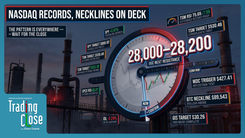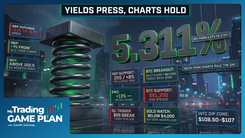

Trading The Close Market Recap - 03/17/2026: FOMC Looming — Oil vs. Yields, S&P Moving-Average Warning & Bitcoin Breakout

The financial markets often operate in a state of deceptive calm right before a major macroeconomic event. Today's session perfectly encapsulated this phenomenon. While all major indices finished in the green, the price action was notably muted, reflecting a market holding its collective breath. With the Federal Open Market Committee (FOMC) meeting looming tomorrow, traders and investors are positioning themselves for potential volatility.
In this afternoon's Trading The Close, Pro Trader Drew Dosek at Verified Investing broke down the critical technical levels, intermarket relationships, and individual stock setups that savvy market participants need to monitor. While a rate cut is entirely off the table for tomorrow's meeting, the real danger lies in the rhetoric.
"However, guys, be paying attention and on standby in case Jerome Powell starts floating the idea on potential rate hikes," warned Drew. "I know there's a zero percent chance right now in the CM Fed watch tool for that happening. But if there's any sort of mention of that, watch out. That could lead to fireworks here in the markets."
This article expands on the key technical and macroeconomic themes discussed in today's show, providing the depth and historical context needed to navigate these treacherous market waters.
The Macroeconomic Tug-of-War: Yields vs. Oil
To understand today's positive drift in the equities market, one must look beyond the stock charts and examine the bond and commodity markets. A fascinating dynamic is currently playing out between the 10-year Treasury yield and U.S. Oil, creating what Pro Trader Drew accurately described as a macroeconomic battleground.
"US oil and the ten-year yield guys are really like the tug of war for what's going on in the markets today," he explained. "Because, guys, when oil is going up, that's going to put inflationary pressures on everything."
Oil is a globally traded commodity, highly sensitive to geopolitical tensions. Today, U.S. Oil pushed up 1.75%, currently sitting at $95.91. When energy costs rise, profit margins across virtually every sector get squeezed, and inflationary fears are reignited. This typically forces bond yields higher as investors demand more compensation for inflation risk.
However, the 10-year yield actually provided a sigh of relief today, slipping underneath a declining trend line that dates back to January 15, 2025. This cooling off in yields is precisely what allowed the major indices to stay afloat and finish in the green.
Looking ahead for oil, resistance looms at $98.11, with a major secondary ceiling at $103.15. Interestingly, a recent surge to $102.44 may have weakened that upper resistance level. In technical analysis, when price approaches a major resistance zone but falls just short, it often clears out the early sellers. If oil surges again, that $103.15 level might break much easier than anticipated, which would undoubtedly send shockwaves through the equity markets.
S&P 500 and the Warning of Moving Averages
While the S&P 500 managed a modest 0.26% gain today, closing within yesterday's price range, the underlying technical structure is flashing warning signs. The daily simple moving averages (SMAs) are telling a story of a trend that is losing its structural integrity.
For a healthy, sustained uptrend, technical analysts look for "proper spacing" between moving averages—specifically, the 20-day SMA riding comfortably above the 50-day SMA, which in turn sits above the 200-day SMA. This alignment indicates strong momentum across short, medium, and long-term timeframes.
Currently, the S&P 500 is violating this principle. The yellow 20-day moving average has crossed underneath the blue 50-day moving average.
"Whenever we have these moving averages cross over each other, it is indicating that the markets at least potentially may be making a top," Drew noted.
To understand the gravity of this signal, we only need to look back to March 2025, the last time this specific crossover occurred right before a significant market decline. While fake-outs can happen, these moving averages act as the market's "training wheels," guiding our eyes to the true underlying trend. If selling pressure resumes, the ultimate magnet for the S&P 500 is the 200-day moving average, currently sitting way down at 659.41. Traders should watch closely to see if price rallies to retest the broken trend line only to face aggressive selling pressure as it meets the declining 20-day SMA.
Meanwhile, the tech-heavy Nasdaq (NDX) showed more resilience, pushing through two trend lines to close slightly positive, though still within yesterday's range. The next major test for the NDX is the 50% parallel resistance at 24,992 points.
Sector Divergence: Semiconductors, Small Caps, and Airlines
The broader market's muted action masked some significant moves and technical setups beneath the surface across various sectors.
The Semiconductor index (SMH) led the day, up 0.75%, but remains trapped within yesterday's trading range. It faces strict technical boundaries with resistance at $407.40 and near-term minor support at the bottom of its parallel channel at $387.09.
Conversely, the small-cap Russell 2000 (IWM) is painting a much more concerning picture. Despite a 0.45% gain today, the index was cleanly rejected by a previous support level that has now flipped to resistance. This is textbook technical behavior in a downtrend. The overarching pattern on the IWM is a massive head and shoulders formation. Based on the measured move of this pattern, the downside target remains firmly at 241.78. If the 10-year yield reverses its recent cooling trend and begins to spike again, it will likely be the catalyst that flushes the IWM down to this target.
In the transportation sector, Delta Airlines provided a masterclass in how fundamental news interacts with technical levels. Despite the recent surge in oil prices—which usually crushes airline stocks—Delta announced that consumer demand is vastly outweighing increased fuel costs. This fundamental catalyst sparked a 6.56% rally.
However, price action respects technicals regardless of the news. Delta opened inside a long-term inclining parallel channel, surged higher, and violently tagged a declining trend line which acted as absolute resistance. The 10-minute chart revealed a massive topping tail right at this intersection. This suggests near-term bearish consolidation, potentially pulling the stock back to $64.00 before it can muster the strength to re-attack the trend line. If it breaks through, targets sit at $65.84 and $68.33. Crucially, Delta must close higher to confirm it is back inside the parallel channel; otherwise, today's move is nothing more than a bull trap.
Commodities and the Crypto Breakout
The precious metals complex continues to look heavy. Gold printed a sideways doji candle, failing to break down but showing no bullish momentum. A daily close under $5,088.52 would shift the probabilities dramatically to the downside, opening the trapdoor to the next major support at $4,865.00.
Silver is exhibiting even more weakness. It remains trapped in a clear bear flag pattern, suffering multiple rejections at parallel resistance levels. The technical structure strongly implies a coming flush down to the $63.00 range, where an inclining trend line dating back to August 2025 should finally provide solid support. Natural gas (Natgas) is similarly weak, drifting at the lower end of yesterday's range, targeting a drop to $2.71 once geopolitical tensions ease.
In stark contrast to the heavy metals, Bitcoin has finally achieved a milestone that crypto bulls have been waiting weeks for: a daily close above its key resistance level. Currently trading at $74,685, the digital asset is on the verge of a major breakout.
However, technical trading requires confirmation. Bitcoin needs to push up and close above $74,914 today to confirm the breakout and trap the bears. If it achieves this, the probabilities shift heavily in favor of continued upside. The conservative target for this move sits at the low pivot of $80,500, with the ultimate bullish target reaching up to $84,000 on the longer-term trend line.
Extreme Equities: FOMO, Earnings, and Failed Breakouts
Individual equities provided some of the most dramatic price action of the day, offering vital lessons in market psychology, overextension, and technical discipline.
Western Digital (WDC) exploded higher by 9.64%, closing at $313.81. To put this into perspective, this stock was trading at a mere $30.47 in April of last year. While today's move negated a recent daily topping tail—a near-term bullish signal—traders must be hyper-aware of the broader context.
WDC is hurtling toward the top of a massive parallel channel, with major resistance looming between $340 and $345. Furthermore, the daily Relative Strength Index (RSI) is currently at 65.21. If price pushes into that $340-$345 resistance zone, the RSI will easily cross the 70 threshold, indicating severely overbought conditions. Vertical moves of this magnitude always attract aggressive profit-taking at key technical boundaries. Chasing this stock here is a low-probability gamble.
On the other end of the spectrum, Tencent Music Entertainment (TME) suffered a devastating 24% collapse following its earnings report. Despite showing 15% year-over-year revenue growth, investors panicked over a shrinking pool of free subscription members, fearing a cap on future growth.
From a technical standpoint, the damage was catastrophic. TME broke a massive, long-term inclining trend line dating back to October 2022. The stock plummeted from recent highs of $26.52, slicing through support until it finally caught a bid at $11.38. The daily RSI has plunged to an extremely oversold 29.35.
When long-term trend lines break so violently, the market has a habit of returning to the "scene of the crime."
"When price action breaks trend lines, especially long term ones, you know what it likes to do, but it likes to go back up and retest that trend line where it broke," Drew explained.
This sets up a high-probability swing trade scenario. If support holds at $11.38, TME could see a relief bounce back to the $13.38 or $14.00 range to retest the underside of that broken trend line. If selling pressure continues, traders should look for deeper support entries at $10.00 or $9.41. Because this is a Chinese equity subject to geopolitical and tariff risks, position sizing must be kept strictly conservative.
Finally, Broadcom (AVGO) demonstrated the dangers of a failed breakout. Down 1.11% today, AVGO tried to break higher but was violently rejected, pulling price back down to an inclining support trend line at $317.21. Failed breakouts often lead to fast moves in the opposite direction. If $317.21 breaks, the stock will likely flush to $300, then $295.30. If those parallel supports fail, the trapdoor opens down to $276.36. After six straight days of selling, a bounce is due, but the structural damage is evident.
The Psychology of Capitulation Volume
One of the most powerful tools in a technical trader's arsenal is volume analysis, particularly when looking for market bottoms. In response to a viewer request, Pro Trader Drew analyzed MicroStrategy (MSTR), which has been in a brutal downtrend since November of last year.
However, a shift is occurring. Switching to the weekly chart reveals a massive volume spike right at the recent lows.
"Whenever you have a major volume spike near the bottom of charts. That usually implies investors are picking it up," Drew pointed out.
This is the textbook definition of capitulation. It represents the moment when the last remaining weak hands throw in the towel and sell their shares in a panic, only for massive institutional buyers to step in and absorb that liquidity. Drew compared this directly to a recent bottom in UnitedHealth Group (UNH), where an identical volume spike preceded a massive reversal and sustained uptrend.
While MSTR still has significant work to do—facing minor resistance at $173 and major overhead supply at $187—the volume footprint suggests the worst of the bleeding may be over. Volume is the one thing institutions cannot hide, and learning to read these capitulation spikes is essential for finding high-probability reversal trades.
Conclusion: Discipline in the Face of Uncertainty
As we head into tomorrow's highly anticipated FOMC meeting, the market is a complex web of conflicting signals. We have equities holding near highs while moving averages flash warning signs. We have oil threatening to reignite inflation while bond yields temporarily cool off. We have massive breakouts in crypto and devastating breakdowns in individual tech names.
Navigating this environment requires removing emotion from the equation and relying strictly on technical levels and probabilities. Whether it's waiting for WDC to hit overbought resistance, looking for a capitulation bounce in TME, or watching the S&P 500 interact with its moving averages, the key is patience.
Professional trading isn't about guessing what Jerome Powell will say tomorrow; it's about knowing exactly how you will react when price reaches your predefined levels. By studying the charts, respecting the volume, and managing risk through proper position sizing, traders can find consistent profitability regardless of the macroeconomic noise. Stay disciplined, trust the technicals, and let the probabilities work in your favor.
Trading involves substantial risk. All content is for educational purposes only and should not be considered financial advice or recommendations to buy or sell any asset. Read full terms of service.