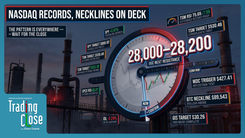

Trading The Close Market Recap - 11/25/2025: Small-Cap Surge (IWM), Google Breakout & Oklo Breakdown

In a market driven by shifting narratives and holiday-thinned volume, technical analysis provides a crucial roadmap for navigating the price action. In this afternoon's Trading The Close show, Pro Trader Drew Dosek of Verified Investing dissected the charts, revealing a market of divergences. From the explosive rally in small caps to major breakdowns in individual names, the key to identifying opportunity lies in understanding price patterns, key levels, and the repetitive nature of market behavior.
The Small-Cap Resurgence
While the broader indices have seen a healthy rebound, the Russell 2000 small-cap index (IWM) has staged what can only be described as a "killer rebound," outperforming its large-cap peers. This relative strength isn't random; it's rooted in a key fundamental expectation. As Drew noted, the potential for the Federal Reserve to cut interest rates in December is a powerful catalyst for this sector. Small-cap companies, which often rely more heavily on borrowing to fund operations and growth, are disproportionately sensitive to the cost of capital. The prospect of "cheaper money" has sent investors flocking back into these names.
However, this powerful three-day surge has now run into its first significant obstacle. The IWM is currently testing a resistance zone defined by a period of choppy, sideways consolidation from a few weeks ago. Such areas of prior congestion often act as speed bumps for strong trends, as they represent a price level where a large volume of shares previously changed hands, creating a supply and demand equilibrium. It is logical to anticipate a period of consolidation or a slight pullback as the market digests the recent gains.
Should the IWM manage to break through this area, the next major resistance level is a significant one: the all-time highs. A move of that magnitude would likely involve price attempting to re-enter its long-term parallel channel, with a technical target around 256.08. For now, however, Drew suggests that probabilities favor a cooling-off period after such a tremendous advance.
The Market's Memory: When Charts Repeat Themselves
One of the most powerful concepts in technical analysis is the idea that price patterns are not random but are reflections of market psychology that tend to repeat over time. Drew highlighted this phenomenon in several markets today, offering a masterclass in how to use the market's memory to anticipate future moves.
"Charts often like to repeat themselves," Drew explained. "They like to do almost exactly what they've just done."
Nowhere is this clearer than in the chart of US Oil. A couple of weeks ago, Drew pointed out a pattern of three distinct wicks at the bottom of the daily candles, indicating that every time price dipped to that level, buyers stepped in aggressively to push it back up. This was a clear sign of buying pressure building beneath the surface. Now, the chart has done it again, printing another series of three wicks at a key support level.
"Whenever you get to that number three I start paying attention," Drew emphasized. This repetition is a powerful confirmation that a significant level of demand exists. It tells traders that sellers have tried and failed three times to push the price lower, and the buyers are in control at this price zone. This pattern suggests oil could be coiling for a move higher, with an initial target being the high of the November 12th candle at $61.06. That area will likely present stiff resistance, as it also coincides with a declining trendline that has capped previous rallies.
This same principle applies to Natural Gas, but in the opposite direction. After a massive, extended move upward, the commodity has been consolidating. This price action creates a potential scenario for a sharp reversal. Just as a big move up can beget another, it can also precede a big move down. If Natural Gas breaks its current support zone, the next logical target would be down at $4.02, effectively giving back a substantial portion of its recent gains.
Decoding Post-Earnings Volatility
Earnings season provides some of the most volatile and opportunity-rich periods in the market, and this week was no exception. The reactions of Symbiotic (SYM) and Zoom (ZM) offer perfect case studies in how to apply technical analysis to navigate these wild swings.
Symbiotic delivered a spectacular earnings report, beating earnings-per-share estimates by over 800% and revenue by 2.39%. The market's reaction was equally spectacular, with the stock gapping up and closing higher by an incredible 39.36%. While impressive, such parabolic moves are often followed by profit-taking. The key is to identify where that selling pressure might emerge.
The daily chart provides the clues. The long wick on the top of today's candle shows that some profit-taking already began. Furthermore, the price is rapidly approaching the top of a well-defined parallel channel that has contained its entire rally since April. This channel resistance sits right at $81.30, which also aligns almost perfectly with a gap fill level at $81.83. This confluence of two powerful technical factors creates a high-probability zone for significant resistance, where traders who are long might consider taking profits and aggressive traders might look for a potential short setup.
Zoom also beat earnings expectations but its price action told a different story. The stock floated higher for most of the day before profit-takers stepped in with force. The reversal didn't happen at a random level; it occurred precisely where multiple technical resistance factors converged. Drew's analysis revealed a parallel channel whose 50% median line acted as resistance, and this level was reinforced by a separate trendline connecting previous pivot highs. This is a textbook example of how a stock can have a positive fundamental catalyst but still be turned away by technical ceilings.
A Tale of Two Breakouts: Google vs. Meta
The technology sector continues to be a major market driver, and the recent price action in Google (GOOGL) and Meta (META) illustrates two very different stages of a trend.
Google is in full-blown breakout mode, fueled by positive news surrounding its Gemini 3 AI developments. The stock has not only made brand new all-time highs but has also broken out of a parallel channel that had neatly defined its trend since the end of 2024. When a stock enters uncharted territory like this, how does one find the next target?
Drew demonstrated a sophisticated technique: adjusting the existing parallel channel. By dragging the channel upwards so that its 50% median line aligns with previous areas of support and resistance, a new, valid channel can be established. This adjusted channel projects a new potential resistance level for Google near the $347 to $350 mark. This provides a logical target for long positions and a potential area where the rally could pause or reverse.
Meta, on the other hand, is in the early stages of a recovery. After a significant decline, the stock has rallied for three days, pushing up 3.78% today directly into its first major test of resistance at $637.63. How the stock reacts here will be telling. A rejection could send it back down to test support around $600, while a break through could signal the start of a "Santa Claus rally" with the next major target being the 50% retracement level near the $700 mark.
Anatomy of a Breakdown: A Technical Deep Dive on Oklo
In a viewer request, Drew analyzed the chart of Oklo (OKLO), which provided a textbook example of a classic bearish pattern. The stock has recently broken down below a long-term inclining parallel channel and, just today, confirmed its position below that channel by failing to reclaim it. This is the first major red flag.
The second, and more ominous, sign is the clear formation of a Head and Shoulders pattern. This classic topping pattern consists of a left shoulder, a higher peak (the head), and a lower peak (the right shoulder), all resting on a common support level known as the "neckline." A break below the neckline triggers the pattern and projects a measured move downward.
On Oklo's chart, the pattern has already triggered. The break of the neckline projects a staggering downside target all the way down at $37.09. A common behavior after a neckline break is for the price to stage a relief rally to "retest" the broken trendline from below. This potential bounce, perhaps to the $96-$99 range, would offer a lower-risk entry for a short position, as a stop can be placed just above the trendline. If price were to reclaim the trendline, the bearish thesis would be negated. For now, however, the technicals are painting a decidedly bearish picture for Oklo.
Key Levels Across the Board
Rounding out the market overview, several other key assets are at critical inflection points.
- Bitcoin: After a solid 10% bounce off the $80,000 level, Bitcoin is now approaching its next major challenge: the 50% median line of its parallel channel, located around $91,878. This level, which coincides with prior consolidation and a large red candle, is expected to be a "stiff test."
- Gold: The yellow metal is in a precarious position. It continues to trade within the lower 50% of its near-term parallel channel. As long as it remains in this lower half, the probabilities favor an eventual breakdown. Resistance for tomorrow sits at $4,172.94.
- Silver: While still technically in an uptrend, silver is showing signs of weakness. It is testing its inclining trendline for what will be the fifth time. As Drew warned, "every time it hits the trend line that trend line gets weaker." The bulls need to see price accelerate away from this line soon, or a break down towards the next support at $46.79 becomes increasingly likely.
Conclusion: Navigating a Market of Contrasts
This week's market action underscores the importance of a disciplined, technical approach. We are seeing a market of contrasts: explosive strength in small caps, measured breakouts in mega-cap leaders like Google, bearish breakdowns in names like Oklo, and assets like oil and silver testing critical support levels.
By understanding how to read chart patterns, identify multi-factor support and resistance zones, and recognize the market's tendency to repeat itself, traders can gain a significant edge. The roadmap is laid out on the charts; the key is to have the discipline to follow it, manage risk, and execute when high-probability opportunities present themselves. As we head into the holiday-shortened week, these technical levels will be more important than ever in guiding trading decisions.
Trading involves substantial risk. All content is for educational purposes only and should not be considered financial advice or recommendations to buy or sell any asset. Read full terms of service.