
Trading The Close Market Recap - 12/08/2025: Fed Week Low-Volume Drift — Sleeper Hold, Carvana Rally & WBD Takeover Risk

The markets have returned from the weekend, but the typical Monday buzz is conspicuously absent. Instead, traders were met with light volume and a slow drift lower, a clear sign of a market holding its breath. With a pivotal FOMC meeting looming on Wednesday, the stage is set for a week where patience will be paramount. In this afternoon's Trading The Close show, Pro Trader Drew Dosek of Verified Investing dissected the muted price action, highlighting key technical patterns and specific stock setups that are providing clues amid the quiet.
Today's article will expand on these critical insights, exploring the implications of low-volume trading ahead of a major catalyst, decoding the proprietary "Sleeper Hold" pattern, and analyzing the powerful lessons offered by stocks like Carvana and Warner Bros. Discovery.
The Quiet Before the Catalyst: Low Volume and the FOMC
Monday’s trading session was a textbook example of a market in a holding pattern. The S&P 500, represented by the SPY ETF, traded a mere 53 million shares—a stark illustration of institutional players waiting on the sidelines. This behavior is common ahead of significant events like the Federal Open Market Committee (FOMC) meeting, where pronouncements on interest rates and economic policy can shift market sentiment in an instant.
As Pro Trader Drew noted, this week's meeting is particularly significant. "We've got an 89% chance of a Fed rate cut, so it's all but guaranteed that we will have a rate cut this coming meeting. The real question is, what's the dialogue going to be? What's Jerome Powell going to say?"
This is the central question preoccupying the market. While a rate cut is largely priced in, the forward-looking statements from the Federal Reserve Chair will be scrutinized for clues about the future pace of cuts, inflation expectations, and the overall health of the economy. This uncertainty is the primary reason for the current lack of conviction. Institutions, which drive market volume, are hesitant to place large bets until they have more clarity.
Historically, the period following the final FOMC meeting of the year is when institutional "window dressing" and portfolio rebalancing for the year-end kicks into high gear. This often brings a surge of volume and volatility. The current low-volume drift, therefore, can be seen as the quiet before a potential storm of activity. Traders should be wary of drawing strong directional conclusions from price action on such thin volume, as moves can be easily reversed once the big players re-engage post-FOMC.
Decoding the "Sleeper Hold" in a Low-Conviction Market
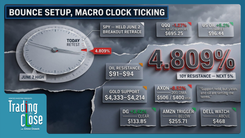
Amid the quiet drift, specific technical patterns are emerging that offer potential roadmaps for the market's next move. On the S&P 500 chart, Drew identified a "Sleeper Hold" setup—a proprietary pattern taught in his Mastering the Overnight Trade course. This pattern, characterized by a sharp upward move followed by sideways consolidation near the highs, often signals an impending move lower.
The semiconductor sector provides an even clearer illustration of this dynamic. The SMH ETF shows a "double sleeper hold pattern," a more exaggerated version of the setup, pushing directly into a previous double-top resistance area. Meanwhile, the SOXX, another semiconductor ETF, printed a distinct daily topping tail on Friday, reinforcing the bearish thesis.
However, trading these patterns in the current environment requires nuance. As Drew explained, the lack of volume complicates the picture. "Which side are the institutions on? They're on the side with heavy volume, all right? So usually follow the volume, usually stay in profits. And light volume is telling me there's not a lot of conviction pushing us back up to all-time highs."
This is a critical point. While the patterns suggest a pullback is likely, the low volume indicates that there isn't heavy institutional selling pressure yet. This can lead to choppy, indecisive price action at the top. The psychology of a bull market, especially in a hot sector like AI-driven semiconductors, also plays a role. "It takes a lot of effort to kill a bull. We've been programmed to buy the dip for so long, right?" This ingrained behavior means that initial dips are often met with buying pressure, leading to multiple tests of a top before a decisive rollover occurs. For traders, this means recognizing reversal signals while also respecting that tops are a process, not a single point in time.
The Index Inclusion Effect: A Case Study in Carvana
While the broader market was subdued, Carvana (CVNA) provided a masterclass in event-driven trading. The stock surged over 12% on Monday following the late Friday announcement that it would be included in the S&P 500 index. This phenomenon, often called the "index inclusion effect," is driven by pure market mechanics.
As Drew explained, when a stock is added to a major index like the S&P 500, all the ETFs and index funds that track that benchmark are required to buy the stock to rebalance their holdings. This creates a wave of "forced buying" that is not based on the company's fundamentals but on regulatory and structural requirements. This mechanical buying pressure is what fueled Carvana's powerful gap-up and rally.
However, savvy traders know that these moves can create exceptional opportunities on the other side of the trade. Drew identified a key resistance zone for a potential short trade. "I suspect both of those levels will have profit takers. If we get up to the five hundred dollar level, that would be a great shorting opportunity… That zone should be above four seventy to five hundred. A great area considering this march up that's occurred on Carvana to short."
The rationale here is based on the concept of exhaustion. The forced buying is temporary. Once the index funds have completed their purchases, the artificial bid is removed from the market. A stock that has experienced a parabolic, news-driven rally becomes vulnerable to a sharp reversal as early investors and profit-takers begin to sell into the elevated prices. The top of the parallel channel near the psychological $500 level represents a logical zone where this selling pressure could overwhelm the last of the forced buying, creating a high-probability short setup.
Navigating Takeover Bids: A Lesson in Risk Management from WBD
Another stock making headlines is Warner Bros. Discovery (WBD), which has become the subject of a potential bidding war. Netflix has reportedly offered to acquire the company for $27.75 per share, while Paramount has countered with a hostile offer of $30.00 per share. For many retail investors, this scenario seems like a can't-miss opportunity to buy the stock and ride it up to the takeover price.
However, Pro Trader Drew offered a crucial piece of professional advice that could save investors from a common and costly mistake. "These are hypothetical situations that usually drag in retail investors… the answer is no, because the deal is not done yet… A lot of cases not taking a trade will help save you money. And that's what I'm giving you is a little tidbit of info. Whenever you hear these buyouts, sit back. The company getting bought out. Don't even trade it."
This is a profound lesson in risk management. Takeover deals are fraught with uncertainty. They must clear regulatory hurdles, secure financing, and survive shareholder votes. Any of these steps can cause a deal to fall apart, often sending the target company's stock price plummeting. The perceived "arbitrage" opportunity is not risk-free; it is a bet on the successful completion of the deal.
Instead of gambling on the target company, Drew pointed out where the real opportunity lies: in the acquiring companies. The stocks of Netflix and Paramount will experience volatility based on the market's perception of the deal's value and strategic fit. These are the charts where traders can find actionable long or short setups based on technical analysis, as opposed to speculating on a binary, news-driven outcome in WBD.
Individual Setups to Watch
Beyond the major themes, several individual charts present compelling technical pictures:
- Tesla (TSLA): After a 3.39% drop, Tesla pulled back from a key resistance level. However, Drew noted that the larger bullish structure—an inverse head and shoulders pattern with a measured move target of $512.97—remains intact. The key for bulls is for support at $385.95 to hold. This makes Tesla a major outlier among mega-caps, with a clearly defined bullish pattern still in play.
- Bitcoin (BTC): The crypto giant continues to chop around the 50% area of its parallel channel, currently near $92,754. Drew pointed out that history often repeats itself on charts. The last time Bitcoin consolidated around this level, it took about two months to resolve. We are currently one month into this consolidation phase, suggesting more sideways action could be in store before a decisive break.
- Natural Gas (NG): After a massive "rug pull" that sent prices tumbling, Natural Gas closed precisely on a critical inclining trendline that has been tested three times. In technical analysis, a third touch of a significant trendline often produces a strong bounce. A break below tomorrow's value of $4.70 would negate this potential bounce and open the door to lower support levels.
Conclusion: Waiting for Conviction
This Monday's session served as a powerful reminder that trading is often a waiting game. With the market holding its breath for the FOMC, conviction is low, and price action can be misleading. The key takeaway from today's Trading The Close is the importance of aligning your strategy with the market's current state.
In a low-volume environment, it's wise to reduce position size, be skeptical of breakouts, and pay close attention to multi-factor technical signals that can cut through the noise. The lessons from Carvana and WBD highlight the difference between chasing news-driven hype and trading structured, high-probability setups. While bearish patterns like the "Sleeper Hold" are forming on major indices, the lack of institutional volume suggests that patience is required before committing heavily to a directional bias. The real moves will likely begin after Wednesday when the Fed provides the catalyst the market is waiting for. Until then, the disciplined trader watches, plans, and waits for conviction to return.
Trading involves substantial risk. All content is for educational purposes only and should not be considered financial advice or recommendations to buy or sell any asset. Read full terms of service.