
S&P 500 Head and Shoulders Breakdown, Oil Spike Risk, and Geopolitical Market Impact
Markets are entering a period of heightened uncertainty as military action against Iran introduces sharp new variables across equities, energy, and safe-haven assets. The interplay between geopolitical risk and technical chart structure is creating a high-stakes setup that traders and investors cannot afford to ignore.
This analysis examines the S&P 500's deteriorating chart structure, the near-term trajectory for crude oil, and the macro implications of potential disruptions to global energy supply — all through the lens of price action and probability-based risk management.
S&P 500: Head and Shoulders Pattern at a Critical Juncture
The Parallel Channel That Has Guided the Bear Case
Since at least last October, a long-term parallel channel on the S&P 500 has served as a consistent warning signal. The upper boundary of this channel — established by connecting the COVID-era lows to the Liberation Day sell-off lows and projecting upward — has acted as a reliable ceiling, capping meaningful upside and limiting risk/reward for bullish positions.
This structural context matters because it frames the current distribution pattern playing out near the highs. The rounded top formation that has developed is a classic sign of institutional distribution — large players systematically reducing exposure into retail demand from participants who assume the market can only move higher. That assumption has historically been a dangerous one.
The Neckline Break That Could Trigger the Next Leg Down
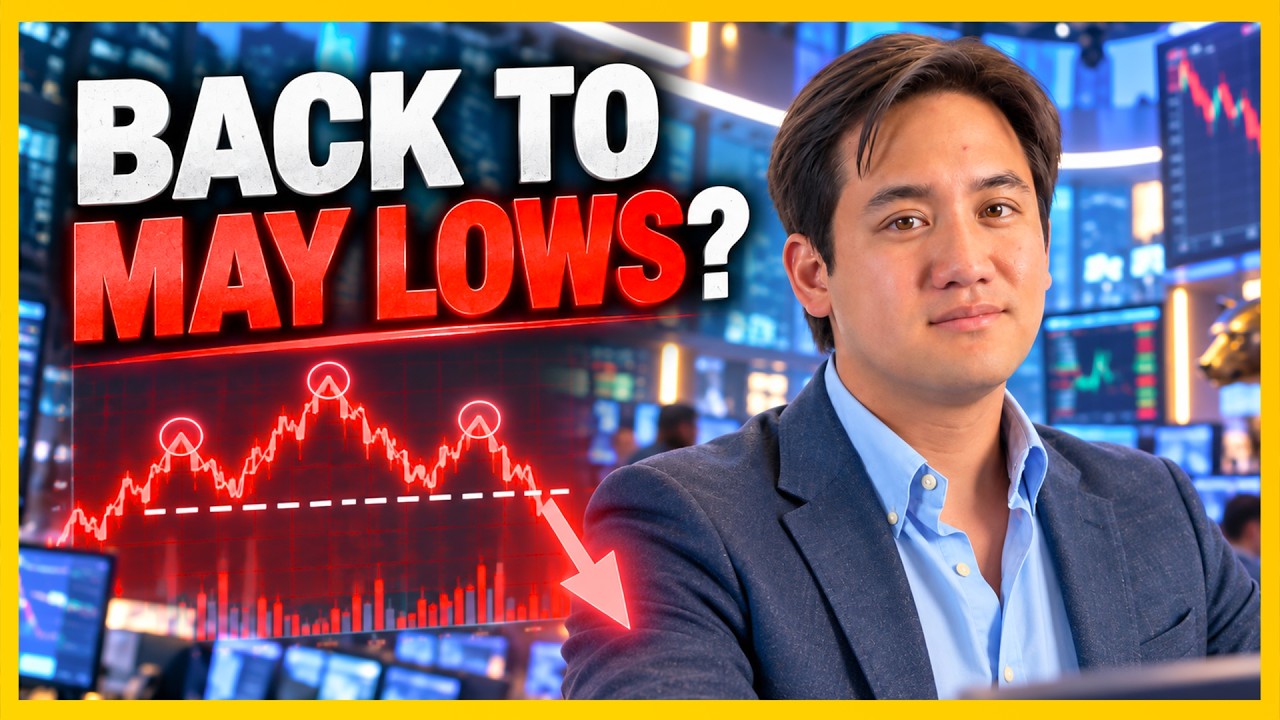
The more immediate technical concern is a head and shoulders pattern that has formed since January, with the neckline sitting around the 6,790–6,790 zone on the S&P 500. This level has repeatedly acted as support, but with futures expected to open sharply lower, the probability of a breakdown increases materially.
Should the S&P 500 post a daily close below this neckline, the measured move target derived from the pattern — calculated from the head high to the neckline — projects a further decline of approximately 3% from the breakpoint, or roughly 4.3% from Friday's close. That near-term target aligns with a cluster of prior pivot lows that should provide at least a temporary bounce.
The sequence of events anticipated is as follows: a neckline break triggers an initial decline to that support cluster, a brief bounce follows, and then the market resumes its downtrend toward the primary first-half target.
First-Half Target: 6,100
The longer-term downside objective remains 6,100 on the S&P 500 — a level that has been the focal point of the bearish thesis since the beginning of the year. Reaching that zone would likely produce a more durable bounce, potentially lasting weeks to months, rather than the brief one-to-three-day recoveries that have characterized recent price action. Even so, new all-time highs are not considered a realistic probability from that level in the near term.
To the upside, meaningful resistance sits at the parallel channel trend line near 7,100. Until the index can break and hold above that level, the risk/reward calculus continues to favor the downside.
Crude Oil: Near-Term Spike, Longer-Term Reversal
A 20% Rally Sets the Stage
Crude oil had already advanced approximately 20% from its January 7th low heading into this weekend's military action. The breakout from the beginning of the year was a high-conviction call, and price has followed through accordingly. The geopolitical catalyst now in play raises the probability of an additional sharp gap higher when futures open Sunday night.
The key structural risk centers on the Strait of Hormuz, through which roughly 20% of the world's oil supply transits. Any disruption to that chokepoint would add a significant risk premium to crude prices beyond what is already being priced in.
Resistance and a Potential Short Setup
From a technical standpoint, upside resistance on oil is identified in the $77–$80 per barrel range, defined by prior pivot highs. At those levels, a short-term counter-trend trade becomes worth considering — not as a high-conviction directional bet, but as a measured, scaled-entry position that acknowledges the inherent uncertainty around where a geopolitically-driven spike terminates.
The rationale is straightforward: these types of geopolitical risk premiums tend to be sharp but short-lived. The administrative and political incentive structure also points toward a quick resolution rather than a protracted conflict.
The Macro Calculus: Near-Term Pain, Midterm Relief
There is a plausible macro thesis worth examining. A near-term spike in oil prices will add inflationary pressure in the short run. However, if the military action results in a government transition in Iran more favorable to Western interests, Iranian oil could re-enter global markets without sanctions-related restrictions, potentially driving crude prices back toward the $50 range by the fall. That scenario would produce lower gas prices heading into the November midterm elections — a politically significant outcome.
This framework carries meaningful tail risk. If the conflict is not resolved quickly or a regime change does not materialize, the inflationary and economic damage from sustained high oil prices becomes a far more serious problem.
Bond Markets and Safe-Haven Flows
The decline in the 10-year Treasury yield heading into this event is consistent with two simultaneous dynamics: a slowing domestic economy already being telegraphed by bond markets, and what appears to be informed positioning by institutional participants who anticipated military action and moved capital into U.S. Treasuries ahead of time.
Despite ongoing concerns around U.S. fiscal sustainability and the national debt burden, Treasuries continue to function as the default safe-haven asset in risk-off environments. Gold is also expected to gap higher overnight. Silver presents a more nuanced case — while it carries safe-haven characteristics, its industrial demand exposure makes it more sensitive to economic slowdown risk, which higher oil prices could accelerate.
Key Takeaways: Process Over Prediction
The technical picture for U.S. equities has been consistently negative since the beginning of the year, even as consensus analyst targets were repeatedly revised higher. The charts have provided a more reliable guide. The present setup does not change that underlying structure — it adds a geopolitical accelerant to a market that was already under distribution pressure.
The priority framework in this environment is risk/reward discipline: recognizing that upside in equities is capped by well-defined resistance, that oil's near-term spike creates a defined trading opportunity in both directions, and that the durability of any market move will depend heavily on how quickly the geopolitical situation resolves. Conditional thinking — responding to what the price action confirms rather than predicting outcomes with certainty — remains the appropriate posture.
This article is intended for informational and educational purposes only and does not constitute financial advice. All trading involves risk. Past performance is not indicative of future results. Trading involves substantial risk. All content is for educational purposes only and should not be considered financial advice or recommendations to buy or sell any asset.
Trading involves substantial risk. All content is for educational purposes only and should not be considered financial advice or recommendations to buy or sell any asset. Read full terms of service.