
Trouble Brewing? Stagflation and the Supreme Court Tariff Ruling
Markets absorbed a volatile combination of inputs — worse-than-expected GDP and inflation data, followed swiftly by a Supreme Court ruling that declared broad tariffs illegal. The result was a sharp intraday reversal: an early gap lower gave way to a modest rally as traders reassessed the inflation picture in light of the tariff decision.
This analysis breaks down what the economic data means for the macro backdrop, how the major indices are positioned technically, and what key levels investors should be watching across the S&P 500, NASDAQ, Dow Jones, and several high-profile individual stocks.
A Stagflationary Signal From the Data
The morning's economic releases presented a challenging picture. GDP came in at 1.4%, well below the consensus forecast of 2.8%. While part of that weakness can be attributed to the Q4 government shutdown, the result still fell short even with that factor priced into estimates.
More notable was the inflation data. Both the month-over-month and year-over-year PCE readings came in hotter than expected — an important distinction from the more widely cited CPI figure.
It's worth understanding why PCE carries more weight in this context. The Consumer Price Index allocates roughly 30% of its weighting to housing and rent. As those categories moderate, they pull the headline CPI figure lower, potentially creating a misleading impression of broader disinflation. PCE, by contrast, draws from a wider range of expenditure categories, making it a more comprehensive gauge of actual consumer price pressure. The latest PCE reading shows inflation holding near 3% — a level inconsistent with the Federal Reserve's 2% target.
The combination of slowing growth and persistent inflation raises the specter of stagflation. Historically, stagflation is among the most difficult macroeconomic environments for equities: it reduces the probability of accommodative Fed policy while simultaneously pressuring corporate revenues and consumer spending. Rate cuts become less likely, not more, and the typical market playbooks lose their reliability.
The Supreme Court Tariff Ruling: Relief Valve or Distraction?
The market's recovery from its early lows was driven not by improving fundamentals, but by the Supreme Court's ruling that broad tariffs are illegal. The market reaction was immediate and positive — and the logic is straightforward: tariffs function as a tax on imported goods, and their removal or reduction is inherently disinflationary.
If tariffs are scaled back or eliminated, the argument is that inflationary pressure from trade costs begins to ease, potentially bringing the PCE trajectory closer to target over the coming months. That narrative was enough to offset the initial shock of the hot inflation print, at least for the short term.
That said, the tariff ruling does not resolve the underlying growth slowdown. GDP weakness, softening labor market data from JOLTS and challenger job cut reports, and accelerating AI-driven workforce reductions at major technology firms — including Microsoft, Meta, and Amazon — represent structural headwinds that persist regardless of trade policy. The bounce, in this view, addresses one side of the stagflation equation while leaving the other intact.
S&P 500: Head-and-Shoulders Pattern Intact, Neckline Is the Trigger
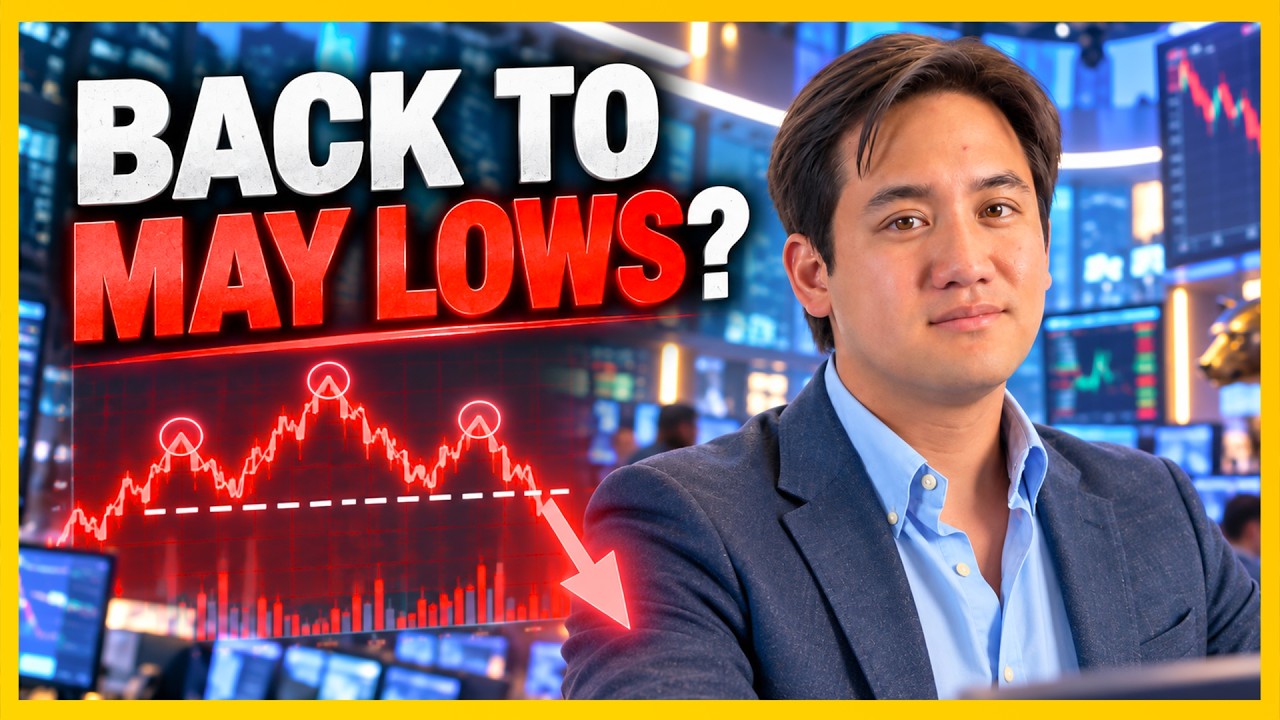
The S&P 500 continues to develop a textbook head-and-shoulders formation on the chart. As of this analysis, the pattern has not yet triggered — the neckline remains intact. That distinction matters: a bearish pattern only becomes actionable when price breaks and closes below its neckline. Until that occurs, the formation is a warning, not a confirmed signal.
The head-and-shoulders target is calculated by measuring the vertical distance from the peak of the head down to the neckline, then projecting that same distance downward from the breakout point. That calculation puts the initial downside target in the 6,550–6,560 range on the S&P 500 — a level that also aligns with prior structural support, adding technical confluence to the target.
Beyond that initial level, a broader trend line analysis identifies 6,100 as the next significant target. Based on current market conditions and the trajectory of the macro data, that level could potentially be reached by mid-year.
The broader structure on the S&P reflects a market that formed a narrowing wedge, broke to the downside, retraced, and now appears to be rounding out a top ahead of a more definitive breakdown.
NASDAQ: Major Support Already Broken
The NASDAQ composite tells a similar story, though arguably in a more advanced stage. The index has already broken major support — a development that puts it ahead of the S&P in terms of technical deterioration. A gap fill level was reached in recent sessions, and the current bounce following the tariff news is expected to be temporary. The pattern points back toward lower levels, consistent with the broader market structure analysis.
Dow Jones: Watching the 49,300 Trigger Level
The Dow Jones Industrial Average is currently testing a longer-term trend line that has transitioned from support to resistance. The index repeatedly bounced off this level when it acted as support, broke below it during the broad tariff-driven selloff, and has since been making multiple attempts to reclaim it — each of which has failed.
The key trigger to watch is a daily close below approximately 49,300. A confirmed break below that level would open the door to a corrective move toward the 46,000 area — representing a potential decline of 3,000 to 4,000 points from current levels. Until that break occurs, the setup remains conditional, but the repeated failure to reclaim the trend line is technically meaningful.
Individual Stocks: Critical Support Levels Across Big Tech
Several major technology stocks are currently sitting at or near key technical support levels. How they respond to those levels will help define the near-term market environment.
Microsoft
Microsoft is currently testing support, and a near-term bounce is a reasonable expectation from this level. However, if the support level fails to hold, the downside risk becomes substantially larger. A clean break below current support would warrant a reassessment of the near-term bullish case and could trigger a more significant decline.
Meta
Meta is seeing a positive session following the tariff news, but a longer-term trend line is now the critical level to monitor. A break below that trend line would represent a meaningful technical deterioration and could initiate a larger corrective move in the stock.
Amazon
Amazon is also testing a key support zone and catching a bounce in the current session. If that support fails, the next meaningful level lower could represent 10–20% additional downside from current prices.
NVIDIA
NVIDIA is holding for now, but the key technical level is near the $172 area. A confirmed breakdown below that level would open a path toward $150, representing the next significant support zone in the stock's structure.
Coordinated Data Release: Noteworthy Timing
One aspect of today's session worth noting is the timing of information flow. The PCE and GDP data — both worse than expected — were released in the morning and immediately weighed on markets. The Supreme Court tariff ruling followed shortly after, effectively providing a counternarrative that arrested the selloff.
The tariff ruling has been pending for months. The fact that it was released on the same morning as the hotter inflation data raises questions about the coordination of information flow. Whether intentional or coincidental, the sequence had a clear market impact: the inflation data was largely discounted by investors who pivoted to the forward-looking implications of reduced tariff pressure.
Market Outlook: Structural Risks Remain
The intraday bounce following the Supreme Court ruling does not change the underlying technical or macro setup. The S&P 500 head-and-shoulders pattern remains intact and untriggered. The NASDAQ has already broken major support. The Dow is being pressured by a trend line that has flipped from support to resistance.
The fundamental backdrop — slowing GDP, persistent PCE inflation, softening labor market conditions, and AI-driven job reductions in the technology sector — continues to suggest downside risk for equities. The near-term relief from the tariff ruling addresses inflation optics but does not resolve the growth side of the equation.
Key levels to monitor: S&P 500 neckline support (head-and-shoulders trigger), Dow at 49,300, NVIDIA at $172, and broader support zones across Microsoft, Meta, and Amazon. How price responds at these levels will define the next significant directional move.
Discipline and risk awareness remain the appropriate posture as these setups resolve.
This article is intended for informational and educational purposes only and does not constitute financial advice. All trading involves risk. Past performance is not indicative of future results. Trading involves substantial risk. All content is for educational purposes only and should not be considered financial advice or recommendations to buy or sell any asset.
Trading involves substantial risk. All content is for educational purposes only and should not be considered financial advice or recommendations to buy or sell any asset. Read full terms of service.