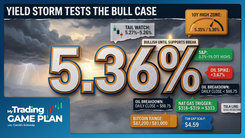

My Trading Game Plan Revealed - 03/30/2026: Oil Topping Tail Sparks S&P Relief Rally, Bitcoin Strength and High-Probability Trades

The global markets are currently navigating a complex web of geopolitical tensions, shifting energy dynamics, and underlying macroeconomic fragility. As oil prices experience a slight pullback amidst ongoing Middle Eastern conflicts, equities have caught a temporary bid. In this morning's My Trading Game Plan, Gareth Soloway, Chief Market Strategist at VerifiedInvesting.com, provided a masterclass on separating media-driven narratives from pure technical realities.
By stripping away the emotion and focusing strictly on the charts, savvy investors can identify high-probability setups across equities, commodities, and cryptocurrencies. Today's analysis dives deep into the critical divergence between near-term technical bounces and long-term economic gravity, offering a strategic roadmap for the weeks and months ahead.
The Oil Narrative vs. Technical Reality
One of the most glaring disconnects in today's market is the mainstream narrative surrounding crude oil versus what the price action is actually dictating. Over the weekend, geopolitical tensions—specifically concerns regarding the straits and broader US-Iran conflicts—dominated the headlines. This has led to rampant speculation on major financial networks.
"In fact, even on CNBC today, I heard multiple pundits and analysts talking about, oh, the case for $200 oil is there," Gareth noted. "The charts, they don't show it. They absolutely right now don't show it."
When analyzing the daily chart for oil, a massive bearish reversal signal has emerged in the form of a "topping tail." In technical analysis, a topping tail occurs when buyers aggressively push the price up during a session, only for sellers to step in and drive the price all the way back down near the open by the close. This leaves a long upper wick, signaling a severe rejection of higher prices and a sudden shift in momentum. Following this topping tail, oil has begun forming a bearish flag pattern, which traditionally resolves with a continuation to the downside.
Unless oil manages to take out the $120 per barrel resistance level—a scenario Gareth assigns only a 10% probability—the high-probability setup points lower. The near-term target sits in the $70 per barrel range over the next month or two. Furthermore, if the broader economy slows as anticipated, we could see oil prices plummet to sub $50 per barrel by the end of the year.
This technical setup in oil is the exact catalyst providing the S&P 500 with its current relief rally. However, investors must understand the difference between a short-term technical bounce and a long-term structural bull market.
S&P 500: The Duality of Timeframes
A hallmark of professional trading is the ability to hold two seemingly contradictory outlooks based on different timeframes. Currently, the S&P 500 presents a perfect example of this duality.
"The first thing to make clear is that in the near term, I am bullish on the markets," Gareth explained. "You can be bullish near term and still bearish mid term or long term. And that's really where I'm at."
The S&P 500 is currently staging a technical bounce, fueled by the slight pullback in oil and an oversold condition. This relief rally could yield a 5% to 6% upside move. Historically, these are the exact types of rallies that lure retail investors back into a false sense of security, prompting premature calls for new all-time highs.
However, the longer-term technical structure remains ominous. The S&P 500 is operating within a massive parallel channel that has dictated every major high and low for the past five to six years. The index is currently approaching the midpoint of this parallel channel, a level that historically has "teeth" and acts as formidable resistance.
If the market pushes up to kiss this midpoint, currently sitting around the 6,100 level, it will likely serve as the launching pad for the next major leg down. The downside targets are sobering: a return to the high pivot from last year, with a year-end target plunging to the 5,500 to 5,600 level.
The Macro Underbelly
This bearish long-term technical view is heavily supported by deteriorating macroeconomic fundamentals. Even if oil returns to $70 per barrel, it does not fix the structural rot beneath the surface of the US economy.
Before the recent spike in energy prices, the economy was already flashing severe warning signs. Auto loan defaults are rising to levels reminiscent of the 2008-2009 financial crisis. Credit card delinquencies are surging in tandem. The housing market is beginning to roll over, and a private credit crisis is quietly brewing in the background. Furthermore, recent labor market revisions reveal that the economy has essentially created zero net new jobs over the past few years. Add to this the fact that PPI (Producer Price Index) inflation data was already surging prior to the oil spike, and the fundamental case for a year-end market decline to 5,500 becomes incredibly robust.
Yields Acting as Shadow Rate Hikes
A critical component of the current market dynamic is the behavior of the 10-year Treasury yield. The recent massive spike in the 10-year yield is a primary source of anxiety for equities.
This upward move in yields is effectively doing the Federal Reserve's job for them. The recent surge is the mathematical equivalent of a 60 basis point rate hike by the Fed. When yields rise this aggressively, borrowing costs for consumers and corporations skyrocket, which inherently chokes off economic growth.
However, as the US economy continues to weaken under the weight of these shadow rate hikes and consumer debt burdens, yields are expected to eventually pull back. This anticipated drop in yields is contributing to the near-term bullish bounce in the stock market, but it ultimately signals a slowing economy rather than a healthy one.
High-Probability Equity Setups
Despite the looming macro risks, a trader's job is to extract capital from the markets by identifying high-probability, asymmetric risk-to-reward setups. For the first time since the beginning of the year, Gareth noted that his portfolio is currently more long than short, driven by extreme oversold conditions in specific individual names.
NewScale Power Corporation (SMR): The Geopolitical Energy Play
NewScale Power Corporation (SMR) presents one of the most compelling "two-factor" trade setups in the current market. The stock has been absolutely decimated, falling 82% from its October highs without a meaningful bounce.
Technically, SMR hit a major pivot support level on Friday, which perfectly aligned with a down-sloping trend line. When two major technical indicators converge at the exact same price point, it dramatically increases the probability of a successful trade.
Beyond the chart, the macro thesis for SMR is profound. The current geopolitical conflict disrupting global oil supplies is serving as a wake-up call for nations worldwide. Countries are realizing that relying heavily on oil leaves them vulnerable to catastrophic economic disruptions caused by isolated regional conflicts. This realization will inevitably drive massive global demand for energy diversification, specifically toward small nuclear reactors.
With the stock deeply oversold, Gareth is targeting a relief rally back to the $14 to $15 range. This represents a massive 40% to 50% upside swing trade from current levels, offering an exceptional risk-to-reward ratio.
Microsoft (MSFT): Buying the Fear in Big Tech
Microsoft, widely considered one of the greatest American companies, has suffered a brutal string of consecutive down days. The stock is currently down 36% from its highs, making it the most oversold it has been on a daily basis in 10 to 15 years.
On Friday, the stock slammed into a critical pivot and double-bottom support level. When a mega-cap tech titan reaches historical extremes in oversold conditions and hits major technical support, a swing trade bounce becomes highly probable. The initial "low lift" target for this bounce is $384, with secondary and tertiary targets sitting at $392 and $412, respectively.
Meta (META): Navigating the "Tobacco Moment"
Meta is currently grappling with severe negative sentiment, with many analysts comparing its current regulatory and social scrutiny regarding children's usage to the tobacco industry's reckoning. While the psychological fear is palpable, the technicals suggest the selling is overdone.
Meta has aggressively pivoted its business model toward AI and data centers, front-running many of these social media headwinds. Technically, the stock is primed for a bounce. The initial upside target sits at $583, representing roughly 10% upside, with a highly probable gap fill target resting above at $595.
Precious Metals and Commodities: Respecting the Levels
The commodities market requires strict discipline and an unwavering respect for technical levels. As Gareth frequently reminds his viewers: "You respect the resistance or support level until it's broken."
Gold and Silver
Gold recently hit a major support level and printed a long-tail candle, indicating that buyers aggressively rushed in to defend the price. This near-term bullish price action suggests gold is likely heading back to $4,650. However, the longer-term macro view remains bearish. If gold eventually breaks the $4,300 to $4,400 support zone, it opens the trapdoor for a decline to $3,900, before eventually reaching a generational accumulation zone between $3,450 and $3,500.
Silver is displaying a similar technical posture. The metal successfully pierced and held a critical pivot low between $66 and $64. This successful defense of support sets the stage for a potential bounce as high as $82 per ounce.
However, silver traders must remember the lessons of history. Gareth pointed out that the exact same bearish "topping tail" pattern currently forming in oil previously formed in silver when it topped out at $120 per ounce. Following that topping tail, silver collapsed by 50%, plummeting to $60 per ounce. If silver's broader downtrend resumes, the long-term downside target sits in the $49 to $54 zone.
Natural Gas
Natural gas remains trapped in a tightening technical wedge. After hitting the high end of resistance on Friday, it was swiftly rejected. The asset is compressing and will be forced to make a directional decision by the first week of April.
"The charts will tell me. I can't impose my views on the charts," Gareth stated, emphasizing the need for objective analysis. If natural gas breaks down from this wedge, the target is $2.70. Conversely, an upside breakout could trigger a short squeeze toward $4.30, though the probabilities currently lean toward the former.
Bitcoin's Striking Relative Strength
In a market environment where almost every major asset class has struggled, Bitcoin is flashing incredible relative strength. Since February, gold, silver, and the broader stock market are all net negative. Bitcoin, however, remains the only multi-trillion dollar asset that is net positive over that same timeframe.
From a technical perspective, Bitcoin recently printed a massive wide-range reversal green candle. Crucially, the price has yet to close below the bottom of that candle, which sits around $62,750. As long as Bitcoin maintains daily closes above $62,750, the bulls remain in firm control of the price action.
Bitcoin is currently bouncing back toward the $68,000 level. If the S&P 500 manages to execute its projected 5% near-term relief rally, Bitcoin will likely act as a high-beta beneficiary. In that scenario, Bitcoin is primed to retest $76,000, with a strong probability of reaching the $80,000 to $85,000 targets. Recognizing this setup, Gareth noted he had nibbled on additional Bitcoin exposure below $66,000, systematically building a position to unload into those higher targets.
Conclusion: Discipline Over Narrative
Today's market landscape perfectly illustrates why relying on media narratives is a recipe for catastrophic losses. While television pundits scream for $200 oil, the charts quietly signal a high-probability drop to $70. While the crowd panics over Meta's "tobacco moment" or Microsoft's relentless selling, the technicals reveal generational oversold conditions ripe for profitable swing trades.
Trading is not about predicting the future with absolute certainty; it is about identifying asymmetrical risk-to-reward setups and executing them with emotionless precision. By respecting support and resistance levels, understanding the interplay between different timeframes, and ignoring the noise of the crowd, investors can navigate this treacherous macroeconomic environment with confidence.
(Note: Verified Investing is expanding its educational footprint. Be sure to look out for the launch of our new YouTube channel, Verified Pro Traders, which will feature deep-dive, asset-specific technical analysis videos from Gareth and the rest of the trading team, focusing heavily on commodities, the dollar, and crypto.)
Trading involves substantial risk. All content is for educational purposes only and should not be considered financial advice or recommendations to buy or sell any asset. Read full terms of service.