
My Trading Game Plan Revealed - 03/31/2026: S&P 500 Nasdaq Relief Rally, Oil Shock, Bitcoin and Chip Stocks Key Levels

The financial markets are currently navigating a complex web of geopolitical tensions, macroeconomic shifts, and intense technical battles. Following a sharp sell-off that saw the Nasdaq drop 15% and the S&P 500 fall 10% from their highs, we are finally seeing signs of life. The catalyst? Whispers from the White House regarding a potential willingness to de-escalate ongoing conflicts, even if the critical Strait of Hormuz remain closed.
In this morning's My Trading Game Plan show, Gareth Soloway, Chief Market Strategist at VerifiedInvesting.com, broke down exactly how technical analysis predicted this bounce and where the markets are likely heading next. For traders willing to tune out the emotional noise of social media and mainstream news, the charts are providing a clear, probability-based roadmap.
The S&P 500 and Nasdaq: Navigating the Bounce
The recent market action perfectly illustrates why relying on technical levels trumps trading on headlines. While retail investors panicked over geopolitical fears, the charts were quietly signaling that a bounce was imminent.
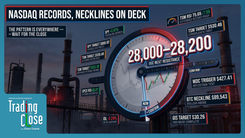
Looking at the S&P 500 (ES futures), the market staged a dramatic reversal. After falling steadily, futures caught a bid and surged higher. However, this rally is now approaching critical resistance. Gareth identified a key line in the sand for the ES futures at 6,470. If the market can push through this level, it opens the door for another leg up.
For those trading the SPY or watching the cash index, the equivalent resistance zone sits right at the opening highs of the previous session, specifically around 6,425, extending up to a zone between 6,425 and 6,450.
But why did this bounce happen in the first place? The answer lies in the longer-term daily chart and the power of parallel channels. The S&P 500 recently tagged the midpoint of a massive, multi-year channel. This specific trendline has historically dictated major market turning points, including the COVID low, the 2022 bear market lows, the liberation sell-off low, and the bull market highs of late 2025 and early 2026.
When an index drops 10% and hits a historical channel midpoint, the probabilities heavily favor a bounce. As Gareth explained regarding his own trading strategy:
"I played the probabilities. I shut my emotion off and just focused on the charts."
For traders looking to accumulate, Gareth noted a massive buy zone between 6300 down to 6100. This 150 to 200-point range offers a high-probability area for scaling into long positions, backed by major support from the highs of 2024 and early 2025.
Meanwhile, the Nasdaq, which suffered a steeper 15% decline, pierced its own parallel channel support before bouncing. If the tech-heavy index continues its relief rally, traders should watch for heavy resistance at 22,100, with a secondary level at 22,200. These prior pivot lows will now act as a ceiling, requiring significant buying volume to break through.
The Macro Picture: Oil Shocks and Yield Dynamics
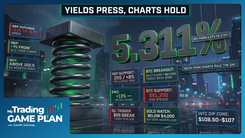
You cannot trade the current market without understanding the intricate dance between oil prices, inflation, and Treasury yields. The closure of the Strait of Hormuz has created a massive supply shock, driving fears that oil could skyrocket. Yet, despite the panic, the 10-year Treasury yield is actually falling.
To the untrained eye, falling yields might seem like a purely bullish signal—a sign that the pressure of high interest rates is easing. However, the reality is far more nuanced. Falling yields in the face of an oil shock suggest that the bond market is pricing in severe economic weakness.
Gareth predicts that within six to 18 months, interest rates will fall below 4%. This isn't because inflation will miraculously disappear; in the near term, the oil shock will likely push inflation higher. Rather, the broader economy is weakening. As consumers pull back on spending, demand destruction will naturally drag prices down over the long run.
This brings us to crude oil itself, which was down roughly $1.70 on the session. Despite the geopolitical panic, oil has formed a classic "topping tail" on the charts—a bearish reversal candlestick pattern that occurs when buyers push the price to a new high, only for sellers to aggressively step in and drive it back down by the close.
Even if oil experiences a dead-cat bounce, the technicals suggest it could rally all the way up to $110 or $111 and still remain within a bearish pattern. This perfectly aligns with a classic market adage that Gareth reminded viewers of:
"The best cure for high oil prices is high oil prices."
High prices inevitably destroy consumer demand. Once demand evaporates, supply catches up, and prices crater. It is a self-correcting cycle that technical traders can track through chart patterns long before the fundamental data is released.
Semiconductor Volatility: Nvidia, MRVL, and Micron
The semiconductor sector remains a hotbed of volatility and opportunity, particularly with the news of Nvidia making a $2 billion investment in MRVL (Marvel).
MRVL experienced a significant pop on the news, but day traders need to be cautious about chasing the headline. The charts reveal a critical pivot high at $100.80. Combined with a down-sloping trendline in the same vicinity, there is a massive wall of resistance sitting just above the $100 mark.
Nvidia itself is providing a masterclass in technical breakdown and resistance testing. For months, Nvidia had been bouncing off a long-term support trendline. However, Gareth applied his famous "door theory" to the stock: the more times a level is tested (or a door is rammed), the weaker it becomes, until it finally breaks.
Nvidia finally broke that door down. While the stock is bouncing with the broader market today, the old support line now becomes new resistance. Traders should watch the $177 to $178 level closely. If Nvidia rallies into that zone, it will likely face intense selling pressure from trapped buyers looking to exit at breakeven.
Other chip names are offering precise, multi-factor setups. Sandisk, which was trading near $800 just a week ago, has been in freefall, dropping to $575. For aggressive day traders, a further flush down to $540 presents a compelling bounce opportunity based on parallel channel support. However, due to the stock being ridiculously overbought on larger timeframes, this is strictly a day trade, not a swing trade.
Micron is also presenting clear levels. Day traders can look for a gap fill around $311. For swing traders, the ultimate buy zone sits much lower at $260. This $260 level is a "multi-factor" setup—it aligns with prior pivot highs and perfectly matches the 50% Fibonacci retracement drawn from the April lows to the recent highs. When multiple technical indicators converge at a single price point, the probability of a successful trade increases exponentially.
Commodities at a Crossroads: Natural Gas, Gold, and Silver
The commodities market is presenting a mix of tight consolidations and complex multi-timeframe trends.
Natural gas is currently trapped within a very tight technical wedge. Overnight, the price dropped to test the low end of the wedge before reversing to attack the high end. Wedges are compression patterns; they represent a build-up of energy that eventually results in an explosive breakout or breakdown. Traders should keep natural gas on their radar, waiting for a confirmed break of the wedge before committing capital.
Precious metals are offering a fascinating divergence between short-term bounces and mid-term bearishness. Gareth recently flipped short-term bullish on gold after it successfully held a long-term trendline. The immediate upside targets for this bounce are $46.50, followed by $48.75.
However, traders must not confuse a short-term bounce with a macro trend change. Gareth remains mid-term bearish on gold and silver. For gold, the critical support zone to watch is $4,400 to $4,300. If that floor gives way, the technicals point to a severe drop down to $3,900, and eventually a longer-term target of $3,450 to $3,500.
Silver is following a similar trajectory. While the short-term bullish call is currently playing out beautifully, the metal will eventually face overhead resistance. Once this relief rally exhausts itself, the mid-term downside target for silver remains $49 to $54. Understanding these different timeframes is crucial; you can be bullish for the next week while remaining fiercely bearish for the next quarter.
Bitcoin's Line in the Sand
While traditional equities bounced, Bitcoin has remained relatively flat to positive, quietly digesting its recent moves. The cryptocurrency had a strong showing yesterday, rallying while the rest of the market bled, but today it is simply holding its ground.
The key to Bitcoin's current chart is a massive green reversal candle that recently printed. To be valid, a bullish engulfing or reversal candle needs to be large and must swallow 75% to 80% of the previous red selling candle. Bitcoin achieved exactly this, shifting the near-term momentum back to the bulls.
Looking overhead, the immediate hurdle is the $75,000 to $76,000 level. If Bitcoin can chew through that resistance, the chart opens up for a swift move toward $80,000 to $85,000.
However, risk management is paramount. The bottom of that massive green reversal candle serves as the ultimate line in the sand. If Bitcoin suffers a daily close below the $62,700 to $62,800 level, the bullish thesis is invalidated. A break below that support would likely trigger a test of recent lows and a breakdown below the psychological $60,000 level. As long as the price remains above that line, a neutral-to-bullish stance is mathematically justified.
The Psychology of Probabilities
Perhaps the most valuable takeaway from today's analysis isn't a specific price target, but rather the psychological framework required to extract money from the markets consistently.
When the markets were dropping yesterday, social media and mainstream news were flooded with panic. Analysts were calling for $200 oil and predicting total economic collapse. This is the "survival mind" taking over—an emotional state that forces amateur investors to sell at the exact moment they should be buying.
Professional traders view this panic differently. Extreme fear is one of the greatest contrarian indicators available. When the crowd is terrified, the charts often reveal that assets are hitting major, historical support levels.
Trading is not about being right 100% of the time; it is about operating like a casino rather than a gambler. Casinos don't win every hand of blackjack, but they have a mathematical edge that guarantees profitability over thousands of hands.
"I'm at 80%, right? 80%. I'll take it to the bank on [being] the casino versus the gambler."
Achieving an 80% win rate requires intense discipline. It means waiting for multi-factor setups, like Micron's 50% Fibonacci retracement aligning with prior pivots. It means respecting lines in the sand, like Bitcoin's $62,700 support, and taking losses quickly when the probabilities shift against you. Most importantly, it means ignoring the hype, the fear, and the narratives, and trusting the math.
A Game Plan Built on Logic
As we navigate the remainder of this trading week, the roadmap is clear. The S&P 500 and Nasdaq are executing a highly anticipated relief rally, but they are fast approaching rigid technical resistance at 6,470 and 22,100, respectively. Oil's topping tail suggests that the geopolitical panic may be fully priced in, while falling Treasury yields quietly warn of underlying economic fragility.
Whether you are day trading the volatility in semiconductor stocks like MRVL and SNDK, or positioning for swing trades in gold and Bitcoin, the rules of engagement remain the same. Let the emotional investors chase the headlines. For those armed with technical analysis, the charts will continue to provide the highest probability setups in the market. Stay disciplined, respect your levels, and always let logic dictate your trades.
Trading involves substantial risk. All content is for educational purposes only and should not be considered financial advice or recommendations to buy or sell any asset. Read full terms of service.