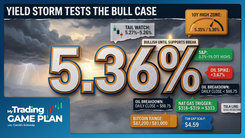

My Trading Game Plan Revealed - 04/23/2026: S&P 500, Oil Rally, AI Capex Fears and Crypto Bear Flag

Global markets are navigating a complex web of geopolitical flashpoints, massive corporate earnings reports, and shifting macroeconomic data. Overnight, tensions escalated sharply as Iran seized two vessels in the Strait of Hormuz, prompting a swift response from the President, who ordered that any ship laying mines in the strait would be fired upon. This fluid, high-stakes situation caused oil to spike and equity futures to whipsaw violently. Yet, amidst the headline noise, the charts are quietly mapping out the true probabilities for the weeks ahead.
In this morning's My Trading Game Plan show, Gareth Soloway, Chief Market Strategist at VerifiedInvesting.com, stripped away the emotional reactions to these global events and focused purely on the technical data. From critical resistance levels on the S&P 500 to the massive capital expenditure fears driving tech earnings, today's analysis provides a masterclass in probability-based trading.
Geopolitics vs. Earnings: The S&P 500's True Driver
When news broke about the Strait of Hormuz, the S&P 500 futures experienced a sudden drop. However, context is everything in trading. As Gareth pointed out, a 20-point drop on an index trading over 7,000 is mathematically insignificant. While social media and financial news networks amplify these intraday swings, the broader market structure remains remarkably resilient.
"Everything going on in the Middle East is secondary," Gareth explained, noting that while the geopolitical situation is undeniably serious on a human level, the stock market views it as a temporary distraction. The true drivers of the S&P 500's multiple are corporate earnings and the strength of the U.S. consumer. As long as earnings show real strength, institutional investors will continue to bid up equities.
From a technical perspective, the S&P 500 is currently contending with a massive parallel channel that has kept the market in check—both to the upside and downside—since 2020. Last Friday, the index tagged the exact upper trendline of this channel. The market is now potentially forming a bull flag consolidation just below this resistance, though traders must remain vigilant for a potential bull trap.
What makes the current market structure so historically anomalous is the nature of the recent recovery. Historically, vertical "V-bottom" recoveries occur after massive, systemic sell-offs—such as the 25% to 30% drops witnessed during the COVID-19 crash. In those scenarios, a rapid 10% bounce is a natural rubber-band effect. However, the S&P 500 recently experienced a relatively measly 9% correction, only to rip 13% to 14% higher in a vertical straight line directly to new all-time highs. This type of price action is unprecedented and highlights the relentless buying pressure currently underpinning the market.
Oil's Technical Warning and the 10-Year Yield
The geopolitical tensions in the Middle East have naturally put oil in the spotlight, but the chart was already signaling a significant move before the headlines hit. Oil has formed a classic technical pattern that suggests a near-term surge back above the $100 mark, potentially reaching as high as $104 to $105.
This setup is what Gareth refers to as a "retrace to the scene of the crime." The pattern consists of a topping tail, an inside bar, a breakdown, and a subsequent bear flag forming inside a parallel channel. Human psychology dictates that after a breakdown from a key level, the asset will often rally back to test the "underbelly" of that previous support—the scene of the crime—before resuming its downward trajectory. If oil executes this move toward $104 or $105, it could introduce near-term headwinds for the S&P 500, as rising energy costs act as a tax on the consumer and pressure corporate margins.
Simultaneously, the U.S. 10-year Treasury yield is flashing its own warning signs. The yield chart is currently forming a slightly bullish down-sloping parallel pattern following a massive move upward. If inflation data continues to run hot, this pattern could break out to the upside, sending interest rates higher.
This technical setup is further complicated by the looming macroeconomic and political landscape. The market is closely watching to see if Kevin Warsh will be confirmed as the next Fed Chair, or if Jerome Powell will serve out his term. If Warsh takes the helm, the critical question becomes whether he will cut rates to appease political pressures, or hold firm if inflation remains too high—a decision that will dictate the trajectory of the 10-year yield for years to come.
The Capex Conundrum: Tesla and the AI Arms Race
Earnings season is in full swing, and the reactions are revealing deep-seated anxieties among investors regarding the Artificial Intelligence arms race. Tesla's earnings report provided a perfect case study in market psychology. Initially, the stock popped beautifully on decent numbers. However, the rally evaporated the moment Elon Musk began discussing the company's massive capital expenditure (capex) plans.
The market is becoming increasingly skittish about the astronomical sums being poured into AI and infrastructure. With tech behemoths like Microsoft and Meta spending an eye-watering $150 billion to $200 billion a year, investors are demanding to know when—or if—these companies will see a tangible return on investment. Are these companies spending to innovate, or are they simply burning cash because they have no choice but to keep pace with their rivals?
For Tesla, this capex fear drove the stock lower. From a trading perspective, Gareth identified two critical support levels. The first is a pivot low at $337. However, a more compelling technical setup exists just below $350, where an up-sloping connector line drawn from the 2025 pivot low to the 2026 low intersects with price action. If broader market weakness drags Tesla down an additional $25, this $350 zone becomes a prime area to watch for a high-probability trade.
Software vs. Semiconductors: Diverging Paths
The divergence between software and semiconductor stocks was on full display during this morning's earnings reactions. ServiceNow (NOW), a major software player, was absolutely slammed following its report. While the company's earnings were decent, forward guidance revealed margin compression and ignited fears that AI could eventually commoditize or replace traditional software services for free.
What makes ServiceNow particularly dangerous for swing traders is its relative weakness. While the S&P 500 has been making new all-time highs, ServiceNow has been grinding out lower lows and lower highs. If the broader market experiences a standard 5% pullback, a stock that is already hovering near multi-year lows is highly vulnerable to a severe breakdown. For day traders, Gareth noted a potential bounce level around $83. However, swing traders should exercise extreme patience and wait for the major 2022/2023 pivot lows between $69, $70, and $71 before considering a longer-term position.
IBM suffered a similar fate, dropping sharply on its earnings. The stock hit its initial $230 pivot low in overnight trading, shifting the next day-trade target to a major technical level at $223.25. For swing traders, the ultimate line in the sand sits at a $200 pierce, which aligns with a massive pivot high from 2023 and early 2024.
Conversely, the semiconductor sector continues to show staggering relative strength. Texas Instruments reported stellar earnings, gapping up approximately 10% and helping the SOXS potentially power toward its 17th consecutive up day. However, vertical moves create precise shorting opportunities for disciplined traders. Gareth identified a massive trendline connecting multiple pivot lows and previous "scene of the crime" retracements. This line points to a high-probability short opportunity on Texas Instruments in the $261 to $262 range.
Commodities and Crypto: Bearish Flags Waving
While the equity markets battle at all-time highs, the commodity and cryptocurrency sectors are painting a decidedly more bearish technical picture.
Gold has lost its recent volatility and is currently forming a bearish inside bar pattern following a down move. Despite the stock market's sharp rally, gold has decoupled and failed to catch a bid, suggesting that lower prices are on the horizon.
Silver's chart is even more alarming. After perfectly tagging Gareth's major resistance level at $82 a week ago, the metal was rejected sharply and is now forming a "horrendous bear flag." Technical probabilities suggest this pattern will resolve to the downside, ultimately targeting the $50 level in the longer term.
In the cryptocurrency space, Bitcoin recently surged to $79,500, coming within a hair of Gareth's $80,000 low-end target. While the near-term momentum could easily push Bitcoin to pierce $80,000 or even test $85,000, the macro technical structure remains ominous. The current price action appears to be forming a massive bear flag top on the larger timeframes. Once this near-term bullishness exhausts itself, the overarching bearish pattern is highly likely to play out, sending Bitcoin back down into the $50,000 range.
The Psychology of the "Lion in the Brush"
Perhaps the most valuable takeaway from today's market analysis is the mindset required to trade these volatile events successfully. When a stock like LRCX reports earnings and opens perfectly flat, amateur traders often force a trade out of boredom. Professional traders do the exact opposite.
"Be that lion in the brush that's ready to pounce," Gareth advised. Traders require volatility and vertical extension—either to the upside or downside—to find an edge. If a stock doesn't move, you simply sit on your hands, preserve your capital, and wait for a setup that meets your strict mathematical criteria.
This discipline is rooted in a deep understanding of probabilities. Trading is not about predicting the future with absolute certainty; it is about executing a proven system over a large sample size.
"Can I win 700 trades out of a thousand? OK, still have 300 losses out of a thousand, but 700 winners, and that's how I build that real wealth," Gareth explained.
A 70% win rate is exceptional in the trading world, but it still requires the mental fortitude to accept 300 losses without abandoning your strategy. By relying on chart data, historical pattern repetition, and strict risk management, investors can tune out the geopolitical noise, ignore the social media hype, and operate like a casino—letting the mathematical edge play out over time.
Conclusion: Navigating the Noise with Chart Logic
As we progress through this chaotic earnings season, the contrast between narrative and price action has never been starker. Geopolitical headlines regarding the Strait of Hormuz will continue to cause intraday whipsaws, and CEOs will continue to spin their massive AI capex spending as necessary innovations.
However, the charts do not lie. Whether it's the S&P 500 testing its multi-year parallel channel, oil retracing to the scene of the crime at $104, or silver breaking down from its $82 resistance, the technical levels provide a clear, emotionless roadmap for what is likely to happen next.
By embracing the patience of the "lion in the brush," waiting for multi-factor technical alignments, and accepting the probabilistic nature of the markets, traders can protect their capital and capitalize on the precise levels where the math is heavily stacked in their favor.
Trading involves substantial risk. All content is for educational purposes only and should not be considered financial advice or recommendations to buy or sell any asset. Read full terms of service.