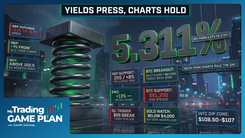

Trading The Close Market Recap - 04/22/2026: Risk-On Rebound, Semiconductor Euphoria & Market Divergences

The markets have once again demonstrated their remarkable ability to absorb geopolitical news and translate it into aggressive price action. Following the announcement of a ceasefire extension, the fear that had briefly gripped market participants evaporated, replaced by a fierce "risk-on" appetite that sent capital flooding back into memory stocks and artificial intelligence plays.
In the latest Trading The Close, Pro Trader Drew Dosek at Verified Investing broke down the complex technical dynamics driving this renewed euphoria. While the headline indices paint a picture of unbridled optimism, a deeper look under the hood reveals critical divergences, extreme overbought conditions, and technical structures that demand a trader's utmost caution and discipline.
The S&P 500 and NASDAQ: Momentum vs. Exhaustion
The broader market's response to the geopolitical de-escalation was swift and decisive. As Drew noted, "the markets just started pushing right back up and then we started getting back into risk on mode." This surge has pushed the S&P 500 right back to the top of its inclining parallel channel, completely negating the brief breakdown we witnessed earlier in the week.
What stands out most prominently on the charts is the emergence of a "three-bar surge" on the weekly timeframe for both the S&P 500 and the NASDAQ. In technical analysis, a three-bar surge of this magnitude is exceptionally rare. It represents a period of intense, uninterrupted buying pressure. However, historically, these formations often serve as precursors to near-term exhaustion.
Interestingly, there is a slight divergence between the visual price action and the momentum oscillators. While the weekly charts look parabolic, the S&P 500's weekly RSI sits at 64.06, and the NASDAQ's weekly RSI registers at 65.28. Neither has officially crossed the 70 threshold that traditionally marks overbought territory—a level the S&P 500 hasn't breached since September.
This creates a complex scenario for traders. The price action suggests we are moving too fast and need to cool off, but the weekly RSI indicates there could technically be room for further upside before a mathematical extreme is reached. If the NASDAQ can maintain its current trajectory and hold its breakout above its inclining trend line, the next major technical destination sits at 28,500.
Market Internals: The IWM and Transportation Divergence
While mega-cap tech and semiconductors drive the headline indices higher, the internal health of the broader market tells a different story. The Russell 2000 (IWM), which tracks small-cap stocks, is actively struggling against significant technical headwinds.
Unlike its tech-heavy peers, the IWM's daily RSI is deeply overbought at 70.3. More importantly, it is battling a formidable double resistance zone. Price action is currently pinned against the previous neckline of a played-out head and shoulders pattern, which perfectly intersects with a trend line connecting the November 2024 pivot to the January 2026 peak. Given these overbought conditions and structural barriers, the probabilities heavily favor a pullback to retest support at 268.44.
Perhaps the most fascinating internal dynamic discussed in the show revolves around the Dow Jones Transportation Average. Recently, this index had been marching steadily higher, leading many to assume the underlying economy was firing on all cylinders. However, Drew peeled back the layers to reveal a massive distortion caused by a single stock: CAR.
The Dow Jones Transportation Average is a price-weighted index, meaning stocks with higher share prices carry more influence over the index's movement than stocks with lower share prices, regardless of market capitalization. CAR recently experienced an epic short squeeze, rocketing up 330% in a single month. Because its share price soared well over $100, it artificially dragged the entire Transportation Average higher.
When the squeeze inevitably broke, CAR plummeted 37% in a single session, closing at $443.94 and printing a nasty reversal candle. As Drew brilliantly pointed out regarding the predictability of these volatile events: "even with a ridiculous short squeeze, look at that push up and rejection with one candle above the parallel… very neat how technical analysis works, even when it seems like there's just utter nonsense and chaos going on on the charts."
Semiconductor Euphoria and the Danger of "Air Pockets"
The semiconductor sector, tracked by the SMH ETF, continues to act as the market's primary leading indicator. After surpassing a critical trend line over the last three trading days, it finally confirmed the breakout, establishing new support at $465.09. Fueled by post-market earnings reactions, the SMH pushed even higher, testing the upper range of its parallel channel at $481.22.
This sector-wide strength has translated into breathtaking, all-time highs for memory and storage stocks, though the technical structures of these rallies warrant intense scrutiny.
SanDisk (SNDK) has staged a miraculous recovery, nearly doubling from its March 30 low of $560 to close at $978. While the momentum is undeniable, the hourly timeframe reveals bearish divergence and extreme overbought conditions. If the rally continues to squeeze, the top of its current parallel channel sits at $1,065, which would likely serve as a massive rejection zone.
Western Digital (WDC) presents an even more precarious technical setup. Following a textbook weekly bull flag breakout that originated back at 180, the stock has been relentlessly grinding higher. Its measured move target sits at $418.28, and its weekly RSI is flashing warning signs at 81.69.
However, Pro Trader Drew highlighted a critical structural flaw in WDC's current advance: it is diagonally inclining without putting in healthy, sideways consolidation. When a stock grinds upward at a steep diagonal angle without building structural support bases, it creates a massive "air pocket" underneath the price action.
"Eventually the song stops playing and the stocks do find gravity," Drew warned. When the inevitable selling begins, stocks with air pockets tend to fall rapidly because there is no historical price memory to act as support. It is worth noting that during WDC's previous consolidation phase, it pulled back over 20% while still maintaining its broader bullish posture. Traders must respect the trend, but chasing these vertically extended charts carries immense risk.
Micron (MU) rounds out the memory sector's dominance, having broken through a key inclining trend line at $482.70. If this breakout confirms, the ultimate bullish target rests at the top of its parallel channel at $537.84.
Commodities and Crypto: Critical Inflection Points
Away from the equity markets, commodities and cryptocurrencies are navigating their own pivotal technical levels.
The precious metals complex is showing signs of near-term exhaustion. Gold has broken its hourly inclining trend line that originated from the March 26 pivot. To confirm a larger trend reversal, bears need to force a daily close beneath the recent Tuesday low, which would open the trapdoor for a decline down to major support at $4,588. Silver, meanwhile, continues to show relative strength, remaining tightly bookended between support at $75.33 and resistance at $84.18. A failure to hold $75.33 would shift the target down to the next inclining trend line at $67.13.
In the energy sector, US Oil is demonstrating the fractal nature of technical analysis, proving that patterns play out identically on both daily and hourly timeframes. After multiple failed attempts and necessary consolidation, oil finally broke through resistance at $91.05. It is now trapped in an intraday range between $91.05 support and $95.25 resistance, with larger macro levels looming at $97.32 above and $88.46 below. Natural Gas remains trapped in a tight inside bar, requiring a decisive break above $2.90 or below $2.82 to dictate its next directional move, with downside targets resting at $2.71 and $2.41.
Bitcoin finds itself at a massive macro crossroads. The cryptocurrency has successfully held its near-term "line in the sand," setting up a potential push toward the November 21 low pivot at $80,500, followed by a critical inclining trend line near $85,000.
However, the broader structural outlook remains highly cautionary. Bitcoin has carved out a massive head and shoulders pattern on the larger timeframes. The $85,000 level represents the ultimate proving ground. If price action rejects heavily at $85,000, it validates the bearish thesis and triggers a measured move downward. Conversely, a strong breakout above this level would negate the head and shoulders pattern entirely, forcing a dramatic shift in market probabilities back to the bullish side.
Earnings Season: Breakouts and Breakdowns
The post-market session provided a masterclass in how different technical setups react to earnings catalysts.
Tesla (TSLA) executed a textbook technical maneuver leading into its report. After breaking out of a declining trend line, the stock pulled back to retest that exact line as support—a classic entry signal for astute technicians. The earnings print sent the stock soaring over $400 before settling near $387, with its next major resistance level waiting at $426.26.
Texas Instruments (TXN) delivered an even more historic breakout. The stock surged from a $236 close to $254.39 in after-hours trading, violently breaking out of a massive, multi-year parallel channel that dates all the way back to the COVID-19 lows of March 2020. The key for TXN will be whether it can hold this breakout; a close back under $250 would trap the price action back within the historical parallel.
Conversely, IBM highlighted the unforgiving nature of technical weakness. Unable to catch the tech sector's tailwind, the stock broke lower on earnings, retesting lows at $230. The technical stair-steps down are clearly defined: support rests at $225.17, followed by the low pivot at $220. If those levels fail to hold, IBM faces the very real prospect of a sub-$200 valuation.
The Foundation of Trading Success
The stark contrast between the euphoric, air-pocket rallies in memory stocks and the precise, level-to-level technical rejections seen in assets like CAR and IBM highlights a fundamental truth about the markets: structure must always precede speculation.
As Drew emphasized when discussing the newly launched Trader's Core educational program, the vast majority of market participants operate on hope, headlines, and hype. They chase vertical charts out of FOMO (Fear Of Missing Out) and hold onto losing positions because they lack a defined framework for risk.
True professional trading is not about guessing the news or predicting the future; it is about identifying high-probability patterns, understanding where the mathematical edge lies, and executing with emotionless precision. Whether you are navigating a 330% short squeeze, a multi-year parallel channel breakout, or a massive head and shoulders pattern, the charts will always provide the roadmap. The only question is whether you have built the foundation necessary to read it.
Trading involves substantial risk. All content is for educational purposes only and should not be considered financial advice or recommendations to buy or sell any asset. Read full terms of service.