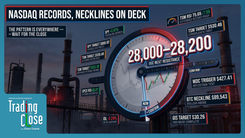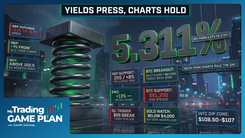

Trading The Close Market Recap - 02/26/2026: NVIDIA Earnings Spark Volatile Sell-Off, Semiconductors Slump; Nasdaq Eyes 24,660

In today's Trading The Close show, Pro Trader Drew Dosek at Verified Investing broke down one of the most volatile and psychologically testing trading sessions of the year. After waiting with bated breath for NVIDIA’s earnings, the market reaction offered a masterclass in the difference between fundamental news and technical price action. While the headline numbers were stellar, the market’s response sent shockwaves through the semiconductor sector, testing the resolve of bulls and bears alike.
As we look toward tomorrow’s pre-market PPI data release at 8:30 AM, understanding the technical damage—and the surprising intraday recoveries—is essential for navigating the rest of the week.
The NVIDIA Paradox: When Good News Becomes a Sell Signal
The anticipation surrounding NVIDIA’s earnings was palpable, and fundamentally, the company delivered. They reported a double beat on earnings per share and revenue, coupled with fantastic guidance. However, the market’s reaction serves as a stark reminder that price action dictates profit, not headlines.
As Drew noted during the broadcast: "Every investor in NVIDIA nearly was jamming that sell button today, making the pressure stress out the semiconductors today, hitting that area of support."
Technically, NVIDIA triggered a specific bearish setup known as a "failed move." The stock had previously attempted to break back into a parallel channel. By failing to hold that level and reversing sharply, it confirmed a rejection. In technical analysis, failed moves often lead to fast, aggressive moves in the opposite direction because traders who positioned for the breakout are forced to liquidate rapidly.
The stock found temporary support at an inclining trend line, tagging $180.22. However, this level was tested recently on February 5th. The more frequently a support level is tested in a short period, the weaker it becomes, much like a hammer hitting a floorboard repeatedly. If this level gives way, the door opens for a move to the next support zone just under $170.
This price action has broader implications. NVIDIA has essentially been "dead money" since August of last year, trapped in a range. A decisive break below the $170 level would signal a significant deviation from this consolidation, potentially dragging the broader indices down with it given the stock's massive weighting.
Sympathy Stress: Broadcom (AVGO) and SMH
The selling pressure in NVIDIA naturally bled into the broader semiconductor sector. The SMH (Semiconductor ETF), which had just made new all-time highs yesterday, faced a "kerplunk" moment, dropping back down. The critical level to watch for the SMH tomorrow is $410.84.
Broadcom (AVGO) also felt the heat, leading the way down early in the session with a 6% decline while NVIDIA was down 5%. However, AVGO demonstrated resilience, forming a beautiful 10-minute bottoming tail and rallying back to close at $321. Should the sector weakness continue, AVGO has support at $295, followed by a major parallel channel support at $290.
A Tale of Two Indices: S&P 500 Resilience vs. Nasdaq Heaviness
Today’s session highlighted a divergence in strength between the S&P 500 and the tech-heavy Nasdaq. While the S&P 500 finished down nearly half a percent, the intraday price action told a story of recovery.
The day began with a nasty fall—seven straight 10-minute candles down. However, the S&P 500 managed to stage a relief bounce and, from 1:00 PM onwards, formed a bull flag consolidation. By the closing bell, the index had rallied back up, suggesting that the market is trying to consolidate in this range rather than capitulate.
The Nasdaq, however, bears the scars of the tech sell-off more visibly. While it also rallied from its lows, it did not finish as strongly as the S&P 500. The chart reveals a larger time frame bear flag, which is a continuation pattern that favors the downside.
Drew issued a specific warning regarding the Nasdaq's levels: "The area where I start getting folks on the warning track is right here, 24,660 points. Be mindful of that… this will be the starting point where everything will start to look a little bit more murky."
Traders should monitor this 24,660 level closely. A breach here could signal that the bearish flag is activating, potentially leading to a retest of lower levels. Conversely, immediate resistance stands at 25,486.
Crypto Markets: Bullish Consolidation Continues
While equities dealt with earnings volatility, the cryptocurrency markets remained relatively calm, engaging in healthy consolidation.
Bitcoin's Sideways churn
Bitcoin moved sideways, posting a minor 0.89% loss. In the context of the previous day's green candle, this is constructive price action. The cryptocurrency is essentially digesting recent gains. The technical outlook remains bullish as long as this consolidation holds, with the next major resistance target sitting between $75,000 and $76,000.
Ethereum's Catch-Up Trade
Ethereum is showing a similar, albeit slightly lagging, setup. Yesterday’s move tagged a precise resistance level at $2,147.80. This price point acts as the "line in the sand" for the bears. However, the near-term structure is a bull flag, mirroring Bitcoin.
If the bullish scenario plays out, Ethereum has significant room to run, with a primary upside target of nearly $2,800. Conversely, downside risk is defined by the inclining parallel channel at $1,761, with deeper support at $1,351. Given the correlation, if Bitcoin breaks higher, expect Ethereum to follow suit with potentially higher percentage gains as it plays catch-up.
Earnings Roulette: Analyzing the Aftermath
Earnings season continues to provide high-volatility opportunities for disciplined traders. Today’s recap covered a spectrum of outcomes, from massive beats to disappointing guidance.
The "Robot" Approach to Zoom (ZM)
Zoom Video Communications illustrated the danger of holding through earnings with weak guidance. Despite a revenue beat, the stock sold off more than 14% intraday, dipping below $74.
However, panic selling often creates opportunity. The daily RSI on Zoom dropped to $30.15, signaling oversold conditions. While the stock closed near $75, further weakness could present a swing trade opportunity. The key is discipline.
"If support levels get hit, operate like a robot. You can enter these trades at that point, anticipating a bounce," Drew advised. The level to watch is $71.30. A tag of this level could trigger a technical bounce back toward the $78 range.
The Breakout: JM Smucker (SJM)
On the bullish side, JM Smucker delivered a double beat ($4.65 EPS) and gapped up significantly. Technically, this move is significant because it broke a declining trend line that had been suppressing price since January 2024. The stock moved from $94 to near $120. While the move is extended, a pullback to the breakout point would offer a high-probability entry for a move toward resistance at $125.78.
Quantum Leaps: IonQ and Righetti
The quantum computing sector caught fire today, led by IonQ’s staggering 480% earnings per share beat. The stock jumped 21.7%, running right into near-term resistance. If momentum carries it through, the next target is $55.37.
This move triggered a sympathy play in Rigetti Computing (RGTI), which rose 5.73%. Sympathy plays are common in hot sectors, but traders must be cautious. Rigetti faces resistance at $19.48 and $22.46. Furthermore, a bearish Head and Shoulders pattern remains on the chart with a measured move down to $13.27. Until that pattern is invalidated, the risk remains.
Relative Strength and The Power of Moving Averages
Amidst the sea of red in tech, two stocks stood out for their relative strength: Spotify (SPOT) and GoDaddy (GDDY).
Spotify surged 6.99%, ignoring the broader market weakness. It is currently challenging a critical resistance level at $506.47. This level coincides with a declining parallel channel, making it a formidable barrier. A clean break here opens the door to $550.
Educational Spotlight: The Death Cross
During the recap, Drew used these charts to provide a vital lesson on Simple Moving Averages (SMAs). He highlighted the "Death Cross"—a bearish signal where the 50-day moving average crosses below the 200-day moving average.
Using GoDaddy as a case study, Drew showed how a previous Death Cross signaled the end of a bullish run, leading to a massive decline. "This was another death cross scenario where even if price was rallying up, you could say, guys, this could be your time to get out of the stock," he explained.
When moving averages invert (with the 200 on top, 50 in the middle, and 20 on the bottom), every rally faces layered resistance. For a stock to recover, it must chew through these dynamic resistance levels one by one. This is why "cheap" stocks in downtrends often stay cheap—they are fighting the weight of overhead supply represented by these averages.
GoDaddy, despite the historical warning, showed strength today with an 8.95% move. It put in a bottoming tail at $73.06 and is now approaching resistance between $87 and $92.
Conclusion: Discipline in a Volatile Market
Today’s market action reinforces the necessity of technical discipline. Whether it was avoiding the trap of chasing NVIDIA’s headline news or identifying the precise bottom in CrowdStrike (which hit the $385 target predicted on Monday’s show), success comes from trusting the levels.
As we head into tomorrow, all eyes will be on the PPI data at 8:30 AM. Inflation data has the power to override technical setups in the short term, so caution is warranted. However, by focusing on the charts—watching the $180.22 support on NVIDIA, the 24,660 warning track on the Nasdaq, and the consolidation patterns in crypto—traders can navigate the volatility with a probability-based edge.
Remember, trading is a marathon, not a sprint. It’s about preserving capital during the murky times so you can capitalize when the setups align perfectly. Stay tuned for the morning updates, and keep your charts ready.
Trading involves substantial risk. All content is for educational purposes only and should not be considered financial advice or recommendations to buy or sell any asset. Read full terms of service.