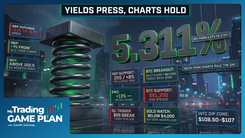

My Trading Game Plan Revealed - 02/26/2026: S&P 500 Rounded Top, Nvidia Non-Reaction Signals Shift to Software Value, and Crypto Breakouts

The markets opened this morning to a complex mix of economic data and earnings reactions that paint a picture of a financial landscape in transition. With Initial Jobless Claims coming in at 212,000—slightly better than the estimated 217,000—the labor market remains in what Gareth Soloway describes as a "gray area." It is neither robustly growing nor dramatically contracting, creating a neutral ground that leaves investors searching for clearer signals.
Against this backdrop of economic ambiguity, the spotlight turned to the tech sector, specifically Nvidia's earnings and the subsequent market reaction. In this morning's My Trading Game Plan show, Gareth Soloway, Chief Market Strategist at Verified Investing, dissected the charts to separate narrative from reality, revealing critical levels for the S&P 500, opportunities in beaten-down software stocks, and a strategic approach to the cryptocurrency and commodities markets.
The S&P 500: Anatomy of a Rounded Top
The S&P 500 has staged a recovery over the last few sessions, but a deeper look at the technical structure reveals a potentially precarious position. The index is currently barely positive, showing fractional gains that suggest a lack of conviction following the initial earnings euphoria.
The daily chart reveals a massive parallel channel dating back to 2020. The upper bound of this channel has acted as a ceiling for the market, and the recent price action near these highs has formed a specific and concerning pattern: a rounded top.
“What's created after we tagged that high… is essentially a rounded top. And rounded tops are formed when it's at the high of a chart. It's usually formed by retail being extra bullish, so they're usually levering up… while institutions are spreading that narrative and essentially saying, hey, we're going to use this as exit liquidity.”
This distribution pattern—where institutional money sells into retail buying strength—often precedes a trend reversal. While the market churns sideways, moving "up a little, down a little," the underlying transfer of ownership from smart money to retail investors weakens the foundation of the rally.
The "Brick Wall" Resistance
Despite the bearish formation, technical analysis always allows for probabilities rather than certainties. Is it possible for the S&P 500 to rally to new all-time highs? Technically, yes. The upper trend line of the long-term parallel channel sits just under 7,100.
However, this level represents a formidable "brick wall" of resistance. For the market to break through this level would require a significant shift in momentum that the current probability models do not favor. Furthermore, the market remains below a secondary trend line stemming from April, adding another layer of bearish confirmation.
For traders, this setup demands a separation of emotion from execution. As Gareth noted, many market participants are "fair weather friends," turning bullish on a few up days and panicking on down days. The disciplined trader looks at the rounded top and the resistance levels and recognizes that the probabilities currently favor a rollover rather than a sustained breakout.
Nvidia and the Bear Market Signal
Perhaps the most telling signal in today's market comes not from a chart pattern, but from a lack of reaction. Nvidia, the bellwether of the AI revolution, reported great earnings and provided strong guidance. In a raging bull market, such news would typically send the stock soaring.
Instead, Nvidia is trading around $97, barely holding onto fractional gains after surging initially.
“When you have great earnings and great guidance, and your stock does not react the way most people would think, that's a bear market signal. It tells you the mindset, the psychology of investors or institutional money.”
This muted reaction suggests that the good news was already fully priced in—and potentially overpriced. When the market refuses to go up on good news, it indicates exhaustion. Investors should view this non-reaction as a warning sign for the broader semiconductor sector and the high-flying momentum names that have led the market rally.
Hunting for Value: The Software Sector Opportunity
While the high-flying semi stocks show signs of exhaustion, a different narrative is unfolding in the beaten-down software sector. Gareth highlighted a specific strategy of identifying quality companies that have been aggressively sold off going into earnings, creating a "worst-case scenario" pricing model.
Workday (WDAY): The PE Ratio Disconnect
Workday serves as a prime example of this strategy. leading into earnings, the stock had fallen approximately 40% since January, trading down to the $116-$118 range. At these levels, the fundamental valuation became compelling. With earnings of roughly $10 per share ($2.50 times four quarters), the stock was trading at a Price-to-Earnings (PE) ratio of roughly 11.8.
For a growth software company, a PE ratio under 12 is historically low. This valuation floor, combined with extreme bearish sentiment, meant that even a "light" guidance report was enough to trigger a relief rally. The stock went green following the report, validating the thesis that the selling had been overdone.
The Trade Desk (TTD): A Potential Turnaround
Applying this same logic to current opportunities, Gareth identified The Trade Desk (TTD) as a stock to watch closely. The chart damage here is severe:
- January 5th: Trading around $40.
- Current Price: Trading at $21.55.
- Decline: Down nearly 50% in under two months.
Similar to Workday, TTD beat on earnings and revenue but offered weak guidance. However, the stock is now trading at a valuation that may already account for this weakness. With projected earnings of over $2.00 per share this year, the stock is trading at a PE ratio of approximately 10. Gareth pointed out,
“That is for a software stock that is insanely low… worst case probably didn't come true. This might be one that turns around today… I could see this thing trading back to $30 to $35 within a month or two, which, again, is basically 50% upside based on current levels.”
While technical targets on falling knives can be tricky, the risk-reward ratio at $21.55 heavily favors the upside, potentially offering a move back toward the $30-$35 range as value investors step in.
The Short Side: Lamentum and the Memory Chip Narrative
On the opposite end of the spectrum from the value plays in software is the short setup in Lamentum (LIT). The daily chart posted a "strong topping tail" yesterday—a candlestick pattern that often signals a reversal after a meteoric rise.
The fundamental thesis for shorting the memory chip sector challenges the prevailing narrative of perpetual shortage. While the current narrative suggests an endless demand for memory chips due to data centers, Gareth warns that this ignores the reality of competition and production capacity, particularly from China.
“If you think that companies in China aren't going to start pounding out memory chips to start filling these amazing margins and prices that they're getting, you're crazy… There's no memory chip that's really elite. There's nothing proprietary about those, and so they can be mass-produced.”
History suggests that high margins in commoditized tech hardware attract massive competition, leading to a supply glut. We saw this with solar panels, and we are likely to see it with memory chips.
The technical target for the Lamentum short is the gap fill at $500. Furthermore, the broader sector—including names like Sandisk, Western Digital (WDC), and Seagate (STX)—could face 50% to 75% downside by year-end as the supply-demand dynamics shift and the scarcity narrative crumbles.
Crypto Markets: Consolidation and Breakouts
The cryptocurrency markets continue to offer some of the most dynamic trading opportunities, though patience is currently required for the flagship asset.
Bitcoin's Breakout Level
Bitcoin has staged a solid recovery but has technically not yet confirmed a breakout. The key level to watch is $69,000. A daily close above this threshold would confirm the bullish structure and open the door for a move to the next major target zone of $80,000 to $85,000.
Until that close occurs, Bitcoin remains in a consolidation phase. However, the broader crypto ecosystem is showing signs of life, particularly in the altcoin market.
The Altcoin Explosion: Polkadot
The potential in altcoins was on full display yesterday with Polkadot, which surged 50% in a single session. This move highlights the importance of active money management.
“Did I sell my Polkadot yesterday? You better darn believe it… What I did really yesterday was unload half positions, half of our position to take profits, and then we can let the rest run.”
This strategy—selling into strength to lock in gains while keeping a "runner" position—allows traders to benefit from further upside while protecting their capital. If the asset retraces, the exited portion can be added back; if it continues to soar, the remaining position captures that value.
Commodities: The "Widowmaker" and Patience in Oil
The commodities complex is presenting a mix of wait-and-see setups and high-risk entries.
Natural Gas (UNG): Dipping a Toe
Natural gas is notoriously volatile, earning it the nickname "The Widowmaker" among traders. Today, the United States Natural Gas Fund (UNG) gapped lower, presenting a potential entry point for the disciplined trader.
Gareth initiated a "starter position" today—described as "dipping a toe in the water." This approach is crucial when dealing with volatile assets. By starting small, a trader gets "skin in the game" without exposing the portfolio to catastrophic risk if the asset continues to slide. The strategy involves scaling in slowly as the chart develops.
Oil and Precious Metals
- Crude Oil: After exiting a profitable trade near the highs, the strategy is now to wait. The geopolitical situation with Iran remains a variable that introduces gambling-like risk. The prudent move is to wait for a technical pullback to the $60-$61 level before re-entering the long side.
- Silver: The metal is pulling back after failing to break resistance. The chart remains range-bound, and rejection at these levels was the higher probability outcome.
- Gold: Gold is showing slightly more strength than silver but remains stuck in a chop zone. Major resistance looms overhead at approximately $5,400.
Conclusion: The Probability Mindset
The overarching theme of today's analysis is the reliance on probabilities over narratives. Whether it is the S&P 500's rounded top, the disconnect in Nvidia's pricing, or the valuation gaps in software stocks, the charts provide a mathematical framework for decision-making.
Gareth likens successful trading to playing a rigged game in a casino—but rigged in your favor.
“If I'm playing in a casino and I know there's a game where I can win 70% of the time, I'm playing that game every single time, knowing that I'll lose three times out of 10. I'll just keep playing it, keep playing it over and over again.”
This mindset shifts the focus from the outcome of any single trade to the consistency of the process. By ignoring the hype, analyzing the risk-reward ratios (such as the 10-to-1 potential in beaten-down software), and respecting the technical "brick walls," investors can navigate the gray areas of the economy with clarity and confidence. The market may be emotional, but your game plan should be entirely logical.
Trading involves substantial risk. All content is for educational purposes only and should not be considered financial advice or recommendations to buy or sell any asset. Read full terms of service.