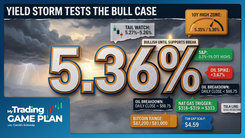

My Trading Game Plan Revealed - 04/02/2026: S&P 500 at 50% Fibonacci, Oil Spike Fuels Weekend Risk

The financial markets are currently navigating a complex web of geopolitical uncertainty, macroeconomic crosscurrents, and intense technical volatility. Following a highly anticipated presidential speech that failed to provide clarity on the ongoing Middle East conflict and the reopening of critical shipping straits, S&P 500 futures took a sharp 1.5% dive overnight. As traders prepare for a prolonged three-day holiday weekend, fear of the unknown is driving retail investors to the sidelines.
However, where the masses see panic, professional traders see opportunity. In this morning’s My Trading Game Plan show, Gareth Soloway, Chief Market Strategist at VerifiedInvesting.com, broke down the exact technical levels, intermarket divergences, and contrarian psychological setups that savvy investors must monitor. As Gareth frequently reminds his viewers, "Logic and charts beat hype and narratives every time."
Here is a deep dive into the critical technical levels and strategic game plan heading into this crucial holiday weekend.
The S&P 500: Fibonacci Precision and Critical Pivot Points
The broader market has been on a wild ride this week. Prior to the overnight drop, the S&P 500 had staged a monumental two-day rally, surging nearly 5% off its recent lows, while the tech-heavy NASDAQ climbed approximately 6%. However, the lack of definitive geopolitical news triggered immediate profit-taking.
From a technical perspective, this pullback is not just random price action; it is a textbook retracement. As the S&P 500 futures opened the regular session near 6,500, it represented an exact 50% Fibonacci retracement of the entire 5% upward move.
The precision of these technical levels is a testament to the algorithmic and institutional forces driving the market. A 50% pullback is a standard resting point for an asset after a massive directional surge. However, Gareth noted that the 61.8% Fibonacci level is often the most reliable zone for a bounce. If the S&P 500 continues to slide, the 61.8% retracement sits around 6,425. As long as the index holds this zone, the bullish thesis for a continuation of the rally remains highly probable.
But what happens if the market breaks down?
"The best traders are going to look at all angles," Gareth explained, highlighting the danger of retail bias where investors ignore bearish signals on their long positions. If the S&P 500 breaks below its recent low pivot at 6,315, the technical damage would open the trapdoor for a drop down to the 6,100 level. While a 200-point drop sounds severe, it represents roughly a 3% decline—a manageable move that would ultimately set up the next major buying opportunity.
Oil's Bearish Parallel and the Weekend Catalyst
The primary catalyst for the current market anxiety is the price of crude oil. WTI crude futures surged to $113 a barrel following the president's speech, acting as a massive headwind for equities. The longer oil stays elevated, the more it acts as a regressive tax on the consumer, threatening to choke off economic growth.
Despite the frightening headlines, the technical chart for WTI crude tells a fascinating story. Oil is currently trading within a defined bearish parallel channel, having recently topped out with a massive tail at $120. Just this morning, oil perfectly tagged the upper trendline of this parallel channel before immediately seeing a slight rejection. This formation is known as a bearish inside bar pattern.
Beyond the charts, there is a massive geopolitical catalyst looming: the three-day weekend. With traditional equity markets closed on Friday, the market will be offline for three and a half days.
"This president likes to do things when the market is closed," Gareth hypothesized, pointing out the high probability of weekend military action to reopen the straits. "I'm a true believer that the president is smart enough to know the damage it's doing to the US economy, pushing up inflation enormously, and also the midterm elections in November."
If military action successfully reopens the shipping lanes over the weekend, oil could experience a violent gap down by Monday morning. This creates a unique contrarian setup. While retail traders are dumping stocks out of fear of holding over a long weekend, the technical and geopolitical probabilities suggest that a resolution could spark a massive relief rally in equities and a sharp decline in energy prices next week.
The Bond Market's Warning: Yields Diverging from Oil
One of the most sophisticated observations from today's analysis was the divergence between crude oil and the 10-year Treasury yield. Typically, spiking oil prices stoke inflation fears, which in turn drives bond yields higher. However, despite oil pushing to $113, the 10-year yield is actually lower than it was late last week.
Why is this intermarket divergence happening? The bond market, often considered the "smart money" of the financial system, is looking past the immediate inflationary shock of oil and pricing in the subsequent economic destruction.
When energy costs spike this aggressively, it destroys consumer discretionary spending. The bond market is signaling that the economic damage has already been done, and this will inevitably slow the economy down, dragging it toward a recession. In a recessionary environment, demand collapses, which could eventually lead to deflation by the end of the year. Consequently, yields are pulling back in anticipation of this broader economic slowdown. Recognizing these subtle divergences is what separates professional market strategists from amateur chart readers.
Precious Metals and Crypto: The Risk-Off Reality
The commodity and cryptocurrency markets are also providing critical clues about global liquidity and risk appetite.
Gold, traditionally viewed as a safe-haven asset, is actually falling sharply alongside the equity markets today. This correlation is a major red flag for precious metal bulls. When gold falls during a "risk-off" day in the broader market, it indicates that the asset is being held by "weak hands"—speculators who bought it as a momentum trade rather than a true safe haven.
Because of this dynamic, Gareth maintains a negative midterm bias on gold. The charts suggest that this current pattern will eventually break down, with initial downside targets at $3,900, and a deeper, more attractive buy zone at $3,500. Silver is facing a similarly precarious technical setup. The metal must hold the critical support zone between $66 and $64 per ounce. If that floor gives way, the charts point to a severe flush down to the $50 level.
Natural gas is presenting its own unique puzzle. Despite the massive geopolitical premium in crude oil, natural gas is completely ignoring the rally, hovering weakly within a tight wedge pattern. If this wedge breaks to the downside, natural gas could plummet to $2.70, a stark reminder that not all energy assets trade in tandem.
Meanwhile, Bitcoin is taking a beating today, dropping back to the $66,000 level amid the broader market sell-off. However, zooming out reveals a critical new trendline connecting the high pivots from January, March, and early April. This has formed a massive wedge pattern. While today's price action is painful for crypto bulls, Bitcoin remains the only major asset to hold neutral-to-higher ground since February, showing relative strength compared to the stock market, gold, and silver. The resolution of this wedge will dictate Bitcoin's next macro directional move.
Strategic Equity Setups: Gap Fills and Defensive Rotations
In a volatile market, stock picking becomes an exercise in precision and patience. During the massive two-day rally earlier this week, Gareth executed classic swing trading discipline by unloading several long positions and taking profits into the strength. Now, with the market pulling back, he is looking to re-add exposure at discounted levels.
Several specific setups and sectors are presenting high-probability opportunities:
Tesla's Gap Fill: Tesla is experiencing a severe pre-market drop, but this panic selling is creating a highly defined day-trading opportunity. The stock has a massive gap fill sitting exactly at $356. In technical analysis, unfilled gaps act like magnets for price action. When a stock violently sells off into a historical gap fill, it often triggers algorithmic buying, creating a high-probability bounce trade for nimble day traders.
Defensive Rotations: With recessionary fears creeping into the bond market, defensive stocks are showing relative strength. Nike is presenting an intriguing setup; the company has already "kitchen-sinked" its bad news regarding China during its recent earnings report, and the stock is sitting on massive higher-timeframe support. Similarly, consumer staple giants like ConAgra and Kraft Heinz are prime candidates for capital rotation as investors seek safety in companies that produce essential, everyday goods.
Buying the Dip on High-Beta Growth: For traders looking to capitalize on a potential S&P 500 bounce from the 50% or 61.8% Fibonacci levels, high-beta names offer the most upside torque. Gareth is actively monitoring pullbacks in OKLO, IonQ, Microsoft, and Meta. Furthermore, after taking 10% profits off the lows in Righetti yesterday, the current market weakness provides a perfect opportunity to re-accumulate shares at a better cost basis.
The Psychology of Contrarian Trading
Perhaps the most valuable takeaway from today's market analysis is the psychological framework required to trade effectively during periods of high anxiety.
Going into a three-day weekend with an active geopolitical crisis and oil at $113 is terrifying for the average retail investor. The natural human emotion is fear—the urge to sell everything, go to cash, and hide until the storm passes. But markets are designed to transfer wealth from the emotional majority to the disciplined minority.
By utilizing technical analysis, traders can remove emotion from the equation. While the crowd panics over the headlines, a professional trader looks at the S&P 500 hitting a perfect 50% Fibonacci retracement at 6,500 and sees a calculated, probability-based entry point. They look at oil hitting the top of a bearish parallel channel and see a limited upside risk for energy prices. They look at the 3-day weekend not as a liability, but as a potential catalyst for a bullish resolution.
This logic-based, no-nonsense approach to the markets is clearly resonating with the public. During today's broadcast, Verified Investing officially crossed the 100,000 subscriber milestone on YouTube, while simultaneously launching the new "Verified Investing Extra" channel to provide even more deep-dive interviews and earnings analysis. This growth is a testament to a growing movement of retail investors who are tired of social media hype and mainstream financial narratives, choosing instead to empower themselves with pure chart reading and probability mathematics.
Conclusion: Discipline in the Face of Uncertainty
As we head into this extended holiday weekend, the financial markets are sitting at a critical technical and geopolitical crossroads. The S&P 500 is testing vital Fibonacci support zones, oil is testing the upper bounds of its bearish channel, and the bond market is quietly warning of future economic deceleration.
For traders, the game plan is clear: respect the levels. If the S&P 500 holds the 6,425 to 6,500 zone, the dip-buying strategy remains intact. If the 6315 pivot breaks, be prepared to wait for the 6,100 level. Monitor the $356 gap fill on Tesla, watch for the breakdown in gold toward $3,900, and keep a close eye on the news wire for any weekend developments regarding the shipping straits.
By stripping away the emotion, ignoring the sensationalized headlines, and trusting the historical probabilities of technical analysis, investors can navigate this volatility with confidence. The market will always present challenges, but for those armed with the right game plan, volatility is simply the engine of opportunity.
Trading involves substantial risk. All content is for educational purposes only and should not be considered financial advice or recommendations to buy or sell any asset. Read full terms of service.