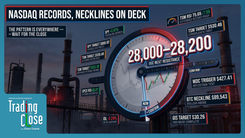

My Trading Game Plan Revealed - 04/08/2026: S&P 500 Hits 6,800 Resistance, Oil Scarcity Risks, and Bitcoin Breakout

The financial markets have delivered a massive relief rally, executing a textbook technical bounce that caught many retail investors off guard but played out exactly according to the charts. Just a week ago, when fear was pervasive and the masses were panic-selling, the technical signals pointed to a rare, high-probability buying opportunity. In this morning's My Trading Game Plan show, Gareth Soloway, Chief Market Strategist at VerifiedInvesting.com, broke down the mechanics of this exact market reversal, the geopolitical catalysts at play, and the critical resistance levels where smart money is now taking profits.
This environment perfectly illustrates why logic and chart reading must always supersede hype and emotional narratives. As we navigate a complex web of international ceasefires, shifting commodity prices, and major technical inflection points, understanding the underlying mechanics of these moves is essential for any serious investor.
The S&P 500: Hitting Epic Resistance at 6,800
A week ago, amidst a sea of market pessimism, Gareth announced he was buying the S&P 500 with both hands. The target was precise, and today, the market opened right at that exact destination: 6,800.
This wasn't a guess; it was a calculated projection based on the midpoint of a long-term parallel channel. Historically, the midpoint of these channels acts as a powerful pivot point. We saw this dynamic play out going into the sell-off in April of 2025, where the index rested at this exact midline before making its next directional move.
The S&P 500 has now completed a staggering 7.5% move off its recent lows, hitting the exact trigger level identified for this relief rally. However, reaching this target requires a dramatic shift in strategy.
"I do think the markets will top out within a day or two and start to revert back to the downside," Gareth noted, explaining his decision to begin aggressively unloading long positions.
When an index hits what can only be described as "epic resistance" at 6,800, the probability of a continued, uninterrupted breakout drops significantly. The market is currently over-extended on a short-term basis, fueled by relief rather than fundamental economic improvement. While the index might overshoot by 20 or 30 points—a mere rounding error in today's volatile environment—the technical reality suggests that gravity is about to reassert itself.
The Geopolitical Chessboard: Ceasefires and Market Psychology
The catalyst for this immediate market surge was the announcement of a two-week ceasefire deal between the U.S. and Iran. However, peeling back the layers of this agreement reveals a highly fragile situation driven more by domestic political pressure than lasting diplomatic resolution.
When comparing the proposed frameworks, the disconnect is glaring. Iran's submitted 10-point plan includes non-starters for long-term peace: the continued enrichment of uranium, the removal of terrorist designations, the complete withdrawal of military personnel from the region, and essentially handing Iran control of the Strait of Hormuz. The two sides are miles apart.
So why was the deal made? The answer lies in political psychology and the calendar. With the November midterms rapidly approaching, the current administration was backed into a corner. Inflation is surging, and the economic optics of a new conflict are politically devastating. Because inflation typically takes three to six months to cycle out of the economic system, immediate action was required to suppress energy prices and stabilize the stock market.
This two-week band-aid provides temporary relief, but it guarantees that the markets will remain on a knife's edge as the clock ticks down on the ceasefire.
The Unforeseen Consequence: Oil's Scarcity Mindset
The most critical macroeconomic takeaway from today's analysis involves the unforeseen consequences of this geopolitical disruption on the global energy markets. While oil collapsed on the ceasefire news, currently trading at $92.40 per barrel, the long-term picture is deeply concerning for global inflation.
From a technical perspective, oil recently printed a massive "topping tail" on the daily chart. A topping tail is a classic bearish reversal signal, indicating that buyers pushed the price to a new high, but sellers aggressively took control and forced the price to close near its lows. "As long as the price of oil does not close above the high of that topping tail, it is a bearish signal," Gareth explained. Oil tested its max upside resistance line three days in a row and was violently rejected each time.
While a drop into the $80s—or perhaps even as low as $80—is technically probable if a longer-term deal is struck, we are unlikely to see a return to the $60 per barrel levels we enjoyed just this past February.
Why? Because the world has just experienced a profound psychological shock.
"Countries are now in a mindset that they cannot risk being caught with their proverbial pants down if another disruption occurs," Gareth warned. We are about to witness the macroeconomic equivalent of the COVID-19 toilet paper panic. Nations realize that if a single country without nuclear weapons can disrupt the entire world's energy supply, the risk profile of global trade has fundamentally changed.
As oil approaches $80, countries will aggressively hoard the commodity to fill their strategic reserves. This artificial, panic-driven demand will create a floor under oil prices. If oil remains sticky at $80, long-term inflation is going up, not down. The only true cure for these elevated prices will be severe demand destruction brought on by a major recession, which technicals suggest could arrive later this year or early 2027.
Sector Divergences: Tech, Airlines, and the Russell 2000
As the broader market hits resistance, individual sectors and stocks are presenting highly specific technical setups that require surgical precision.
The Russell 2000's Trend Line Test
The small-cap Russell 2000 index has staged a violent retracement, rallying all the way up to a major descending trend line. Just yesterday, this exact move was mapped out as the primary upside target. Now that the index has reached this line, it transitions from a target to a formidable resistance barrier. A rejection here is highly probable within the next week or two, if not within the next 24 to 48 hours.
Delta Airlines and the Cost of Fuel
Delta Airlines provided a fascinating case study in earnings reactions. The company reported generally positive earnings, but the underlying data revealed the brutal reality of the energy crisis: Delta will have to spend an extra $1 billion on jet fuel costs. Despite this massive headwind, the stock rallied, largely because the market had already priced in the fuel issue, and the overnight drop in oil provided a psychological tailwind.
However, from a trading perspective, Delta is now pushing into a pristine double top formation at $76.40. For active day traders, this presents a compelling, high-probability shorting opportunity against a clearly defined technical level.
Google and the Semiconductor Hedge
In the tech sector, Google has experienced a massive surge but is now colliding with a critical pivot low resistance level right around $321. Previous support often flips to become new resistance, making this a prime zone to look for short setups.
Furthermore, with the semiconductor sector ripping higher today, contrarian opportunities are emerging. By utilizing inverse ETFs like SOXS (a triple-leveraged short semiconductor ETF), traders can begin to nibble on short positions, hedging against a tech sector that is rapidly becoming overextended into major resistance zones.
Precious Metals and Natural Gas: Shifting Correlations
The commodity space outside of oil is also flashing important technical signals.
Gold has enjoyed a spectacular run, kissing the underbelly of its next major resistance level at $4,875. Interestingly, gold has temporarily lost its status as a pure safe-haven asset and has been trading in tandem with the broader stock market. Because it is moving with equities, the impending top in the S&P 500 suggests that gold is also forming a bearish pattern and will likely head lower as the broader market pulls back.
Silver, while up an impressive 6% today, has not yet reached its ultimate resistance zone. The charts indicate that silver still has room to run toward the $80 to $82 level before it encounters the same heavy selling pressure that is currently capping gold.
Natural gas presents a different picture. Down 3.5% as it follows oil's general trajectory, natural gas never experienced the massive geopolitical premium that crude oil did, meaning it has less room to fall. The asset is currently breaking down from a wedge pattern, but downside appears limited. A drop to the $2.70 level would represent a highly attractive buy zone where smart money will likely begin accumulating long positions.
Bitcoin: The Breakout is Confirmed
In the cryptocurrency markets, patience and technical confirmation have paid off. After testing major resistance, Bitcoin officially confirmed its breakout yesterday.
"Game on, baby. Game on," Gareth noted regarding the crypto leader's technical posture.
The immediate short-term upside target for Bitcoin is the key pivot zone between $75,000 and $76,000. This is the ultimate proving ground for the current rally. If Bitcoin can successfully digest supply at this level and push through, the technical doors swing wide open for a run to $80,000, with a best-case scenario target sitting at $85,000.
The Psychology of Trading: Escaping the Social Media Scourge
The wild market swings of the past two weeks highlight the most important variable in investing: human psychology. When the S&P 500 was bottoming, social media was flooded with apocalyptic narratives. Today, as the market hits epic resistance at 6,800, those same platforms are pushing unbridled greed and FOMO (Fear Of Missing Out).
"The charts will set you free from that. Shut out the nonsense, focus on the chart," Gareth advised.
Social media has become a scourge for retail investors, weaponizing fear and greed to influence people into doing the exact wrong thing at the exact wrong time. Buying at the highs and panic-selling at the lows is a direct result of trading based on narratives rather than logic.
No trader is perfect, and no chart pattern works 100% of the time. However, by mastering technical analysis, you can elevate your win rate to 80%. At an 80% probability, you possess a mathematical edge that surpasses even the most profitable casinos in the world. You don't need to catch the exact bottom or sell the exact top; you simply need to scale in at high-probability support zones and systematically take profits at predefined resistance levels.
This is why mastering trading psychology is so vital. With Gareth's highly anticipated psychology course releasing in just one week, investors will soon have access to the mental frameworks required to detach from emotion, ignore the mainstream media noise, and execute trades with cold, calculating logic.
Conclusion: Discipline at the Highs
As we digest this massive market rally, the game plan is clear: discipline must prevail. The S&P 500 has hit its 6,800 target. The Russell 2000 has tagged its trend line. Oil is masking a long-term inflation crisis behind a temporary geopolitical band-aid.
Now is not the time to be swept up in the euphoria of green screens. It is the time to act like the smart money—unloading longs into strength, respecting epic resistance levels, and patiently preparing for the market's next inevitable rotation. By trusting the charts and shutting out the noise, you position yourself not just to survive the volatility, but to consistently profit from it.
Trading involves substantial risk. All content is for educational purposes only and should not be considered financial advice or recommendations to buy or sell any asset. Read full terms of service.