
My Trading Game Plan Revealed - 04/09/2026: Oil Geopolitics Fuel Market Moves, S&P 500 6,800 Test, Semiconductors Lead, Bitcoin Bull Flag

The global markets are currently navigating a complex web of geopolitical tensions, shifting sector leadership, and critical technical inflection points. As traders look for clarity amidst the noise, understanding the underlying mechanics of price action is more crucial than ever.
In this morning's My Trading Game Plan show, Gareth Soloway, Chief Market Strategist at VerifiedInvesting.com, provided a masterclass on how macroeconomic shocks, specifically in the energy sector, are dictating equity flows. He also revealed precise technical levels across indices, tech giants, commodities, and cryptocurrencies that savvy investors must monitor.
This article expands on the critical themes discussed in today's show, offering deeper context into the technical setups and psychological discipline required to extract consistent profits from the current market environment.
The Macro Picture: Oil's Geopolitical Premium and Inflationary Ripple Effects
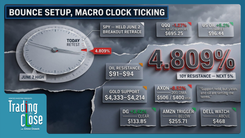
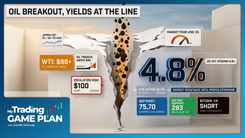
The broader market's slight pullback today can be directly attributed to the creeping strength of crude oil. As Gareth noted, oil successfully held its parallel channel low yesterday, confirming it as a formidable level of technical support. Currently, oil is chopping within a defined $90 to $100 range, acting as a real-time barometer for geopolitical anxiety.
The catalyst driving this price action is the looming two-week deadline for a ceasefire agreement. The resolution—or failure—of this deadline will dictate oil's next major directional move.
"As we get closer to that two-week deadline for the ceasefire to either be extended or obviously we go back to fighting, then you will see oil starting to uptick more and more," Gareth explained.
If a long-term deal is secured, keeping crucial waterways like the Strait of Hormuz open, oil is technically primed to break its parallel channel to the downside, targeting a significant drop to $75 to $80 a barrel. Conversely, if negotiations collapse, a rapid spike back to $110 is highly probable.
However, even the "bullish" scenario of oil dropping to $80/bbl presents a stark macroeconomic reality. In January and February, oil averaged just $60 a barrel. An $80 price tag still represents a massive 30% increase from earlier this year. This mathematical reality guarantees that inflation will remain sticky.
Historically, energy shocks filter through the economy in stages. They first appear in the Producer Price Index (PPI) as wholesale and manufacturing costs rise. Over the subsequent months, these costs are passed onto the consumer, elevating the Consumer Price Index (CPI). Because of this delayed pass-through effect, we are likely facing an extended period of elevated inflation for at least the next three to six months.
Furthermore, these geopolitical shocks have triggered a profound psychological shift among global governments. Recognizing the vulnerability of their supply chains, countries are now actively stockpiling energy, general commodities, and physical assets. As Gareth astutely observed, the world is witnessing "what one country can do to the entire world, sending shockwaves through the system."
Looking further out, Gareth's long-term forecast for oil into 2027 is a drop to $50 a barrel. While consumers might celebrate cheaper gas, a drop to $50 would signal a severe macroeconomic contraction. It implies that the cumulative stress of inflation, geopolitical shocks, and potential AI-driven job displacement has finally triggered a deep recession, resulting in massive demand destruction.
S&P 500 Technicals: The 6,800 Wall and Future Trajectories
The S&P 500 futures (ES) are currently trading slightly negative, reacting inversely to the uptick in oil. This price action perfectly aligns with the technical roadmap laid out in previous sessions.
A week ago, Gareth accurately predicted a market rally, identifying 6,800 as a massive technical wall where the S&P 500 would likely stall. This 6,800 level represents the "underbelly" of previous support. It is a confluence of multiple pivot lows that, once broken, initiated the market's recent freefall—a drop reminiscent of the aggressive tariff-driven selloff seen in April 2025.
Yesterday, the index tagged this exact trend line and stopped on a dime, validating the precision of technical analysis. If oil continues to drift sideways to slightly higher, and anxiety over the Strait of Hormuz builds, the S&P 500 is likely to fade back down to its recent gap fill.
The market's fate hinges on the geopolitical outcome. A ceasefire deal could propel the S&P 500 to retest the 6,800 level and potentially push higher toward a descending trend line connecting recent high pivots. If no deal is reached, the market faces a high-probability collapse back to the recent double bottom.
Zooming out to the macro-technical picture, Gareth warned that regardless of near-term bounces, the S&P 500 is eventually headed toward the lower band of its macro parallel channel by early next year. While parallel channels and up-sloping trend lines can provide support for extended periods, they eventually break. A breakdown of these macro structures could usher in the darker phases of the 100-year debt cycle as we approach 2028 and 2029.
Sector Divergence: Semiconductor Strength vs. Software's Debt Bomb
One of the most revealing dynamics in yesterday's robust market rally was the stark divergence between semiconductor stocks and software companies. While the broader market rallied over 2%, the participation was heavily skewed.
Semiconductor ETFs like the SOXX surged to new all-time highs, and the SMH came within striking distance of its own record peaks. Conversely, major software players like Oracle and Microsoft gapped up at the open but closed flat, failing to hold their gains.
This divergence is a massive tell from "smart money." It indicates that as soon as the immediate panic regarding the US, Iran, and the Strait of Hormuz subsided, institutional focus immediately pivoted to the private credit markets and the looming "debt bomb" within the software sector.
Companies have poured astronomical sums into AI infrastructure. The market is now aggressively questioning the Return on Investment (ROI) of these expenditures. If software companies cannot monetize their massive AI investments, the debt accumulated to fund these projects becomes a systemic risk.
For traders looking at Microsoft, a significant drop from current levels would target the low pivot from April 2025, which would serve as a double bottom and a high-probability bounce level.
Precision Setups in Tech
While swing trades in the tech sector require patience right now, day traders have clear levels to attack:
- Meta: Unlike its software peers, Meta showed incredible relative strength. However, for day traders, Gareth identified a mammoth resistance zone at $637 to $638. This level represents a confluence of a gap fill and a major pivot high. Reaching this zone would require a $16 to $17 move up from pre-market levels, making it an ideal, high-probability exhaustion short for day traders.
- Sandisk: The memory chip maker has seen incredible momentum, but a rising parallel trend line presents a massive shorting opportunity at $855 to $860. The historical precedent is clear: the last time Sandisk tagged this specific trend line, the stock suffered a brutal rejection, plummeting from $725 down to $545.
- Lumentum (LITE): Another memory chip player exhibiting a similar technical setup. A parallel channel connecting multiple pivot lows and highs points to major resistance around the $940 level.
As Gareth emphasized, successful day trading is akin to playing chess. You must look four steps ahead, identify the levels where the probabilities of a reversal are 80% or higher, and wait patiently for the price to come to you.
Precious Metals and Energy: Navigating Inside Bars and Data Center Demand
The precious metals complex is currently flashing cautionary technical signals. Gold experienced a strong pop yesterday, kissing critical resistance at $4,875 per ounce before backing off.
The primary concern for gold bulls is the formation of a daily "inside bar" following a downward move. In technical analysis, an inside bar consolidation pattern following a drop is a classic continuation setup. It suggests that the market is simply pausing to catch its breath before initiating the next leg lower.
As long as gold remains at or below the $4,875 to $4,900 resistance zone, this bearish pattern remains valid. The chart dictates that the next major leg down targets $3,900. Interestingly, projecting the current down-sloping trend lines forward reveals a massive confluence of technical support arriving in late April or early May right at this level. While gold could ultimately fall to $3,500 in a worst-case liquidity event, the $3,900 level presents a premier swing trade bounce opportunity.
Silver is exhibiting a nearly identical inside bar consolidation pattern, signaling a likely move lower. However, Gareth noted that silver becomes a highly attractive long-term buy around the $50 level. Similar to gold, silver's trend lines point to a major technical confluence arriving in mid-May.
Natural Gas and the AI Infrastructure Narrative
Natural gas presents one of the most fascinating fundamental and technical setups in the commodity space. The asset recently broke a key trend line, though it has not yet confirmed the breakdown with a subsequent lower close.
Gareth is eyeing the $2.71 level as a potential buy zone, driven by a unique fundamental catalyst: the insatiable energy demands of AI data centers.
Across the country, particularly in states reliant on hydropower like Oregon, Washington, and California, the massive electricity consumption of data centers is causing utility rates to skyrocket for everyday consumers. As the political landscape becomes increasingly hostile toward data centers due to these surging public utility bills, tech companies may be forced to pivot. If natural gas prices drop low enough, these data centers may begin buying natural gas directly to burn for their own independent energy generation. This structural shift in demand could serve as the ultimate fundamental floor for natural gas prices.
Bitcoin's Breakout and the Search for a Bull Flag
In the cryptocurrency space, Bitcoin successfully confirmed its recent breakout. Because Bitcoin trades 24/7, it was able to react immediately to the geopolitical ceasefire news, popping aggressively while traditional equity markets were closed.
Following this pop, Bitcoin is currently pausing. What technical traders want to see now is the formation of a "bull flag"—a healthy period of sideways, low-volatility chop over a few days that digests the recent gains before launching the next leg higher.
If this bullish consolidation plays out, Bitcoin's first major resistance sits around $75,000. A successful navigation through that level opens the door for a run to the November low pivot, targeting a pierce of the $80,000 mark.
The Psychology of Consistency: Position Sizing and Humility
Perhaps the most valuable takeaway from today's My Trading Game Plan was Gareth's commentary on the psychology of trading. Technical analysis provides the edge, but emotional discipline dictates whether a trader actually keeps their profits.
After a string of highly successful swing trades at Verified Investing, Gareth took a moment to remind viewers of the ultimate truth of the markets: there is no certainty, only probabilities.
"A real trader is never super cocky because the market always, the second we get a little cocky, the market slams us down and says, nope, we're in charge," Gareth warned.
This humility is what separates career professionals from boom-and-bust amateurs. When retail traders hit a hot streak, the psychological temptation is to increase position sizes—to "put all their chips in" on the next trade. This gambler's mentality is the fastest route to a blown-up account.
Professional trading requires keeping position sizes strictly equal, regardless of how confident you feel or how many consecutive trades you've won. By maintaining uniform position sizing, you ensure that the inevitable losing trade—which is a mathematical certainty in a probability-based business—does not wipe out the progress of your winning streak.
Conclusion: Discipline in a Headline-Driven Market
As we move through the rest of the week, the markets remain highly sensitive to geopolitical headlines, energy prices, and shifting sector narratives. The divergence between semiconductors and software proves that beneath the surface of index rallies, institutional money is aggressively repositioning based on fundamental realities like debt and ROI.
By focusing on clearly defined technical levels—like the S&P 500's 6,800 wall, Meta's $637 to $638 resistance, or gold's $4,875 ceiling—traders can filter out the emotional noise of the news cycle.
The setups are clear, the levels are defined, and the probabilities are calculated. The only remaining variable is the discipline of the trader. By maintaining equal position sizes, refusing to chase FOMO, and waiting patiently for price action to reach high-probability confluence zones, investors can navigate this complex environment with the clinical precision of a professional.
Trading involves substantial risk. All content is for educational purposes only and should not be considered financial advice or recommendations to buy or sell any asset. Read full terms of service.