
My Trading Game Plan Revealed - 04/10/2026: Semiconductors Top, Oil Inflation Risks and Software Pairs Trade

The financial markets are a complex ecosystem driven by a constant tug-of-war between raw data and human psychology. This morning, traders were greeted with highly anticipated Consumer Price Index (CPI) data, geopolitical developments, and extreme technical extensions across multiple asset classes. In today’s Friday edition of the My Trading Game Plan show, Gareth Soloway, Chief Market Strategist at VerifiedInvesting.com, provided a masterclass in separating emotional market reactions from logic-based technical realities.
From a potential multi-year top in semiconductors to a strategic pairs trade in the software sector, today's analysis offers a comprehensive roadmap for navigating current market extremes.
The Psychology of False Confidence and the S&P 500
The trading day kicked off with a critical inflation reading. The CPI data came in at 0.9%, which initially sparked a bullish reaction in the pre-market. To the untrained eye, a market rally on this data might seem logical since it slightly beat the consensus expectation of 1%. However, peeling back the layers reveals a much darker macroeconomic reality.
A 0.9% monthly CPI reading translates to an annualized inflation rate of 9.9%, or up to 10.8% depending on compounding metrics. These are horrendous inflation figures by any historical standard. The market's initial upward thrust was quickly met with selling pressure as smarter institutional money recognized the severity of the underlying data.
Beyond the CPI, the broader market psychology is currently being heavily influenced by geopolitical events, specifically hopes for peace in the Middle East. With oil pulling back from its $120 top and trading below $100, investors are rushing into equities. Gareth drew a fascinating historical parallel to this behavior:
"I think the market has lulled people into this false sense of confidence. There are so many differences in the underlying economy right now than there were a year ago. It's much, much worse many times over, and I think we're going to see a big reversal."
A year ago, a similar psychological trigger occurred when tariffs were backed off. The market rallied relentlessly from April to October before eventually topping out. Today, retail investors are experiencing FOMO (Fear Of Missing Out), assuming a similar uninterrupted rally is imminent.
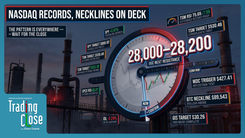
Technically, the S&P 500 is trading into a major resistance zone right around 6,800. This level represents the underbelly of previous market consolidation. Furthermore, the index has staged an incredible 8% rally in a straight line over just seven days. Going into a two-day weekend with the Strait of Hormuz still effectively closed and geopolitical tensions simmering, the risk of holding long positions is heavily skewed. Institutional money rarely takes unnecessary weekend risk after an 8% vertical move, making profit-taking and a negative close highly probable.
Oil's Ascending Channel and the Inflation Floor
The energy sector remains the linchpin for the broader macroeconomic picture, particularly regarding inflation. Oil is currently trading flat, stuck within a clearly defined parallel up-sloping, or ascending, channel. Earlier in the week, this technical formation provided a major short signal when price hit the top of the channel, resulting in a sharp drop to the lower range.
The next directional move in oil hinges on two primary factors: the potential reopening of the Strait of Hormuz and the elongation of the current two-week ceasefire. If a permanent ceasefire materializes, oil could easily drop to $80 or even $75 a barrel. However, traders expecting a return to cheap energy may be sorely disappointed due to global strategic reserves.
As Gareth astutely pointed out, countries worldwide are circling the energy markets like sharks. Having depleted their strategic reserves and been caught off guard by extended supply chain disruptions, governments—including the US—will likely step in as aggressive buyers if oil drops into the $70 to $80 range. This massive institutional buying will create an artificial floor under the price of oil.
This floor has dire implications for the inflation fight:
"The longer it stays above the $60 a barrel level where it was earlier this year in January and February, that is going to continue to seep in to various products."
Sustained oil prices above $60 inevitably bleed into the broader economy. It affects the cost of plastics, agricultural operations, and global shipping. Truckers and farmers are forced to pass these elevated costs onto the consumer. Consequently, inflation is likely to remain north of 5%, and potentially above 6%, for the remainder of the year, with the very real possibility of elevated inflation extending deep into 2027.
Semiconductors: The Anatomy of a Multi-Year Top
Perhaps the most compelling analysis from today's show centered on the semiconductor sector (tracked via the SMH ETF). Gareth laid out a multi-factor technical case suggesting that semiconductors are putting in a multi-year cycle top right now.
The first technical factor is a concept known as the "triple tap." Looking at the trend line on the semiconductor chart, we can observe a distinct pattern of distribution. The first time the asset hit this trend line, it resulted in a shallow 5% to 10% dip. The second hit produced a slightly deeper pullback. Today, the sector is gapping up into its third hit—the triple tap.
"This is something that, again, these are little institutional secrets I'm revealing to you guys, these type of signals… The triple tap, notice the first pullback was the shallowest, second deeper, and the third one is the mega one. That's the big kahuna, if you will."
To prove the historical validity of this pattern, Gareth referenced Bitcoin's previous market cycle, which exhibited the exact same triple tap behavior right before entering a brutal, multi-year bear market.
But the technical evidence for a semiconductor top doesn't end there. By zooming out to the weekly and monthly charts, a stunning mathematical symmetry reveals itself. Between 2020 and the highs of 2021, the SMH reached a maximum extension of exactly 103% above its 200-period weekly moving average before suffering a massive reversion to the mean.
Today, if the SMH gaps up to the target zone of $436 to $437—which perfectly aligns with the triple tap trend line—it will once again be exactly 103% above its 200-period weekly moving average. Furthermore, this exact same extension aligns perfectly with the 50-period moving average on the monthly chart.
When you combine the triple tap trend line, the 103% weekly moving average extension, the monthly moving average extension, and the broader macroeconomic headwinds, you get a 5-factor technical setup. While nothing in trading is 100% certain, stacking these probabilities gives a trader an 80% to 85% chance that a major, multi-year top is being formed.
The Pairs Trade: Pivoting to Software
Professional trading isn't just about identifying what to short; it's about finding relative value and hedging your exposure. While Gareth is heavily bearish on semiconductors, he is simultaneously identifying high-probability long setups in the software sector. This creates a pseudo-pairs trade: shorting the overextended hardware/semiconductor names while going long on beaten-down software stocks.
"There's always a long trade somewhere in the market. You just have to look for it, and there's always short trades."
Several top-tier software companies have experienced severe pullbacks, bringing them into prime technical buy zones:
- CRM (Salesforce): After collapsing over the last two days, CRM has fallen directly into a major gap fill and a prior pivot high. This confluence of support makes it a prime candidate for a technical bounce.
- ServiceNow: This stock has suffered an incredible drop but is now approaching a major support zone. Currently trading around $88, the stock has a massive floor between $86 and $87. This tight proximity allows traders to define their risk clearly.
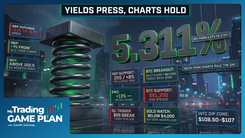
- Oracle: Oracle has already filled one gap and has established huge support via a double bottom. There is another gap below at $128, which is only $6 to $8 away from current levels, providing a clear worst-case scenario accumulation zone.
These are not buy-and-hold forever recommendations; they are calculated swing trades. The objective is to capture a 10% or greater move over a two to four-week period as capital rotates out of overextended semiconductors and back into oversold software names.
Bitcoin and Precious Metals: Key Inflection Points
The cryptocurrency and precious metals markets are also flashing critical technical signals that demand attention.
Bitcoin has recently triggered a short-term breakout, creeping up above the $72,000 mark. However, it is rapidly approaching its ultimate proving ground: a major pivot top resistance zone between $75,000 and $76,000. This is the highest point Bitcoin reached prior to its last significant dip.
If Bitcoin can successfully break and close through the $75,000 to $76,000 barrier, the technical path is clear for a rapid blast up to the $80,000 to $85,000 range. Conversely, if it faces rejection at this pivot top, traders should expect a swift retracement back down to the underlying trend line, or potentially even new relative lows.
In the precious metals complex, both gold and silver are exhibiting bearish consolidation patterns. Gold is inching up today but faces major overhead resistance within a net bearish sideways consolidation pattern. Silver's chart is arguably even more bearish due to its flatter consolidation structure. While both metals could see short-term upward blips to test their respective resistance levels, the near-term trend points lower. For silver, the critical line in the sand is $82; as long as the price remains below $82/oz, the chart favors a secondary wave of selling.
Natural Gas: The Forgotten Energy Play
While the world fixates on crude oil, natural gas has quietly become the forgotten energy play, presenting a unique swing trading opportunity. Gareth recently initiated a starter position based on a compelling technical and fundamental thesis.
Technically, natural gas has tagged a double bottom and is trading within a defined wedge pattern, signaling a potential upside breakout. Fundamentally, the thesis is tied directly to the price of oil.
The broader market assumes that once geopolitical tensions ease, oil will immediately revert to $60 a barrel. However, as established earlier, institutional and governmental buying will likely keep oil elevated in the $80 to $85 range for the next four to five months.
If oil remains stubbornly expensive, corporations and utility providers will increasingly look for cost-effective alternatives. Natural gas becomes highly favored in this environment due to its massive cost benefit relative to $80+ oil. This rising demand should drive natural gas prices higher in the near term.
Traders must exercise discipline here. The goal isn't to hold out for a massive run to $4, but rather to capture a reliable 10% to 20% swing trade and move on. Because natural gas can be highly volatile, utilizing a starter position is key. If the asset dips, secondary support levels are clearly defined for additional accumulation, specifically around the $2.60 area, with ultimate major support resting at $2.35.
Conclusion: The Discipline of Probabilities
Today's market environment perfectly illustrates why narratives and hype are dangerous, and why logic and charts must dictate trading decisions. The mainstream narrative sees a 0.9% CPI and hopes for Middle East peace as a reason to blindly buy equities. The technical reality shows an S&P 500 stretched 8% in a straight line into major resistance ahead of a risky weekend.
By focusing on multi-factor technical setups—like the 103% moving average extension and triple tap on semiconductors—traders can elevate their win rates by aligning with institutional money rather than fighting it. Whether it's taking a calculated pairs trade in software, waiting for Bitcoin to prove itself at $76,000, or methodically scaling into natural gas at defined support levels like $2.60 and $2.35, success in the markets requires patience, discipline, and a strict adherence to probabilities.
Trading involves substantial risk. All content is for educational purposes only and should not be considered financial advice or recommendations to buy or sell any asset. Read full terms of service.