
My Trading Game Plan Revealed - 04/30/2026: Fed Stability, Mega-Cap Earnings, NASDAQ Near 25,000 and Key Technical Levels

The intersection of macro policy, mega-cap earnings, and precise technical levels has created a complex web for traders to navigate this week. Following a highly anticipated Federal Reserve decision and a slew of major corporate earnings, the markets are exhibiting extreme volatility, driven by shifting narratives and underlying inflation pressures. In this morning's My Trading Game Plan show, Gareth Soloway, Chief Market Strategist at VerifiedInvesting.com, broke down the critical technical setups and intermarket relationships that are dictating price action across equities, commodities, and cryptocurrencies.
By stripping away the emotion and focusing purely on the charts, traders can identify high-probability setups amidst the noise. Today's analysis dives deep into the Fed's structural dynamics, the reality of corporate capital expenditures, and the historical precedents that could signal the next major market top.
The Federal Reserve: Independence and Inflation
Yesterday's Federal Reserve decision provided crucial insights into the future of monetary policy. While Jerome Powell announced no interest rate change, the structural dynamics of the Fed's leadership took center stage. Powell will remain on the Board of Governors, retaining his voting power even when Kevin Warsh is confirmed as the new Chairman of the Federal Reserve.
"And again, what that does, in my humble opinion, is it actually solidifies the Fed a little bit more in the market's eyes as being independent, not able to be pushed quite as much," Gareth explained.
This is a vital concept for investors to grasp. The Federal Reserve operates on a consensus-driven voting system; the Chairman does not wield universal, unilateral control over interest rates. By keeping Powell on the board, the institution maintains a layer of continuity and independence. In an environment where inflation is continuing to rise, market participants view this structural stability as a net positive. It reassures investors that the Fed will likely remain data-dependent rather than bowing to external political or economic pressures.
Mega-Cap Earnings: The CapEx Reality Check
The after-hours trading session was dominated by mega-cap technology earnings, which presented a mixed but generally positive picture. Alphabet (Google) pushed sharply higher, Amazon inched up, and Microsoft edged slightly lower. However, Meta took a severe beating, getting crushed on the back of higher-than-anticipated capital expenditures (CapEx).
While the headline narrative might suggest that these tech giants are aggressively expanding their infrastructure, the underlying reality of this spending tells a different story about inflation's impact on corporate growth.
"So it's not like they're spending more to buy more, they're just spending more to buy the same amount," Gareth noted.
This distinction is absolutely critical for fundamental and technical traders alike. If a company is increasing its CapEx simply to keep pace with the rising costs of products and hardware, it indicates that actual demand and physical expansion are not necessarily growing at the rate the dollar amounts suggest. This margin compression is exactly why Meta saw its stock plummet from its highs, dropping to $605 before bouncing back to the $615 level.
For day traders, Meta has left a compelling technical magnet below. There is a significant gap fill sitting at $575. While it is unlikely to hit that level in a single session without a broader market shock, it remains a premier day-trading level to keep on the radar if selling pressure accelerates.
The S&P 500, Oil, and Intermarket Dynamics
To understand the broader market's direction, we must look at the intricate dance between equity futures and commodity prices. Overnight, S&P futures initially pushed higher on the back of tech earnings. However, a sudden spike in WTI crude oil to $111 sent equity futures tumbling. As morning approached, oil faded from its highs, euphoria returned to the stock market, and equities rallied back toward the highs of the day.
This inverse relationship is a textbook example of intermarket analysis. Oil's rejection at $111 was not random; it occurred precisely at a major technical resistance level—the underbelly of a parallel channel.
When an asset breaks down from an up-sloping parallel channel, it often forms a larger bear flag. The subsequent rally back to the breakdown point—what technicians call returning to the "scene of the crime"—typically results in a rejection and further downside. By recognizing this pattern in oil, traders could accurately anticipate the relief rally in the S&P 500.
The S&P daily chart continues to hammer against its own parallel resistance. Traders must exercise patience here; a simple pierce above a trend line does not confirm a breakout. Professional traders wait for subsequent daily closes to validate the move and avoid the devastating fake-outs that frequently trap retail investors.
The NASDAQ's March to 25,000: A Historical Echo
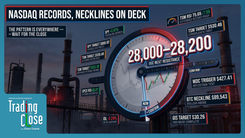
One of the most fascinating technical setups currently unfolding is the NASDAQ's approach toward the massive psychological barrier of 25,000. Recently, the index pulled back after getting within roughly 117 points of this milestone. However, historical market behavior suggests that major round numbers act as powerful magnets, and they are rarely abandoned without a true test or pierce.
Gareth drew a brilliant parallel to the dot-com bubble to contextualize this setup:
"Remember, in the dot-com era, we pierced 5,000, which was the top. Now, we actually pierced by about 150 points, which would equate at 25,000 to about a 750-point pierce."
This historical precedent is vital. Markets are driven by human psychology, and round numbers trigger intense emotional reactions—both FOMO (Fear Of Missing Out) on the way up, and panic on the reversal. A pierce of 25,000, potentially driven by upcoming catalysts like Apple's earnings, could range anywhere from 100 points to a massive 750-point overshoot. The ultimate question is whether this euphoric surge will dictate a larger, macro top for the markets.
Precision Technical Setups: Finding the "Gems"
While the broader indices test macro levels, individual stocks are presenting highly specific, multi-factor technical setups for both day and swing traders.
Alphabet and Amazon: Trend Line Resistance
Alphabet has staged a very solid move to the upside, but it is approaching a critical juncture. By connecting the historical high pivots on the chart, a beautiful trend line emerges right around the $380 level. Because the stock has sufficient daily volatility, $380 serves as an excellent dual-purpose level—viable for both a swing trade short and an intraday scalp.
Amazon, meanwhile, presents a slightly different scenario. Drawing a trend line across its recent chart history reveals strong resistance in the $270 to $272 zone. Because Amazon is currently floating and not exhibiting massive intraday emotional swings, it does not qualify as an ideal day trade right now. However, on a daily timeframe, it is extended enough to make $270 to $272 a highly probable swing-trade short level.
Qualcomm: The Value Catch-Up
In the semiconductor space, Qualcomm has historically lagged behind its peers, acting as a value play while other chip stocks soared to all-time highs. Following a massive post-earnings pop, it is finally playing catch-up.
For traders looking to fade this momentum, precision is key. There is a cluster of three pivot highs creating a quick scalp opportunity in the $183 to $184 range. However, the absolute "gem" of a level—a major pivot high to pivot high resistance—sits higher up at $197.
Caterpillar and Intel: Extremes in Valuation and Structure
Caterpillar experienced a massive earnings pop, bringing it dangerously close to a picture-perfect parallel channel resistance. Connecting the low pivots and high pivots creates a flawless channel that projects major resistance right around the $865 to $867 level.
Intel presents a cautionary tale of valuation and narrative hype. The stock recently experienced a massive surge, spurred by an upgrade to $100 from a relatively unknown analyst firm, Freedom Financial.
Trading at an 80 to 90 forward P/E ratio, Intel's valuation is historically stretched, even factoring in government backing. The $100 mark is a massive even-number psychological resistance. If price surges into $100, it creates a premier shorting opportunity, as reality and fundamental gravity eventually catch up to extended valuations.
Commodities and Crypto: Diverging Paths
The commodity and cryptocurrency markets are currently painting a picture of divergence, requiring traders to respect the charts over their personal biases.
In the precious metals sector, gold is catching a small bid after a string of consecutive down days. However, this minor relief rally does not negate the broader technical damage. The charts suggest that gold will likely roll over and retest the $3,500 or $4,400 to $4,300 levels. Silver is exhibiting similar behavior, catching a small bounce after a long downward grind, currently trading in a choppy range between $82 and $66 to $64.
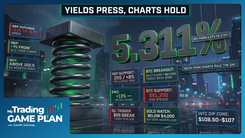
Bitcoin's price action is perhaps the most concerning for crypto bulls. While the stock market is in full rally mode—a "risk-on" environment that traditionally acts as a tailwind for crypto—Bitcoin's bounce from the $60,000 level has been notably weak by comparison.
The asset is currently carving out a larger bear flag pattern. While bulls hope this pattern fails, disciplined traders must respect the structure. When an asset shows relative weakness during a broader market rally, it often signals underlying distribution. If the bear flag breaks to the downside, the crypto markets could face severe headwinds.
The Psychology of Trading: Price is Truth
The most profound takeaway from today's market analysis is the importance of emotional discipline. In an era of social media echo chambers and sensationalist financial news, traders are constantly bombarded with extreme predictions—from assets going to zero, to assets rocketing to the moon.
Gareth perfectly encapsulated the professional trader's mindset:
"The chart has no emotion. Price is what it is. It is what it is. It is what it is. Price is truth in many ways."
When you strip away the narratives, the upgrades from obscure analyst firms, and the panic over inflation, you are left with price action. Is the asset at resistance? Is it at support? By answering these binary questions, traders can shut out the noise and make logical, probability-based decisions.
We do not trade in certainties; we trade in probabilities. A 75% probability setup will still fail 25% of the time. By accepting this mathematical reality, traders can manage their risk, avoid overallocating to a single "sure thing," and survive the inevitable drawdowns that the market delivers.
Conclusion: Navigating the Euphoria
As we head into the close of the week, the market is a powder keg of technical and fundamental catalysts. With major players like Sandisk, WDC, and Apple set to report earnings after the bell, the volatility is far from over.
Will Apple's earnings provide the final thrust needed to push the NASDAQ through the historic 25,000 barrier? Will oil's rejection at $111 provide a lasting tailwind for equities, or is it merely a temporary reprieve?
By focusing on clearly defined technical levels—like Alphabet at $380, Meta's gap fill at $575, and Intel's psychological barrier at $100—traders can navigate this euphoria with precision. The market will always provide opportunities for those who remain patient, respect the charts, and remember that price, above all else, is truth.
Trading involves substantial risk. All content is for educational purposes only and should not be considered financial advice or recommendations to buy or sell any asset. Read full terms of service.