
My Trading Game Plan Revealed - 05/05/2026: S&P 500 Topping Tail, AI Chip Frenzy and 10-Year Yield Watch

As they have been for weeks, the global markets are still navigating a dense web of geopolitical tensions, economic bifurcation, and historic tech stock euphoria. Following a recent exchange of fire between the US and Iran in the Strait of Hormuz, oil prices spiked before pulling back, providing a gentle tailwind for S&P futures. Yet, beneath this headline-driven price action lies a fascinating technical landscape dominated by the insatiable appetite for AI chip stocks—a frenzy that is drawing stark comparisons to the dot-com era.
In this morning's My Trading Game Plan show, Gareth Soloway, Chief Market Strategist at VerifiedInvesting.com, unpacked the critical technical levels, warning signs, and high-probability trade setups that are defining this unique market environment. For traders looking to separate logic from narrative, today's analysis provides a masterclass in reading the charts.
The S&P 500's Topping Tail: A Technical Warning Sign
The broader market has been on a momentous run, with the S&P 500 surging approximately 15% just since March 30th. However, as the index gently inclines back toward recent highs, a critical technical formation from Friday's session demands immediate attention: a topping tail.
For those newer to technical analysis, a topping tail is a classic bearish reversal signal. It forms when a candle has a long upper shadow (the tail) and closes in the lower 25% of its entire length. Psychologically, this pattern tells a story of intraday exhaustion. It illustrates a session where buyers aggressively pushed prices higher, only to be overwhelmed by sellers who seized control and drove the price back down by the close.
While no single technical signal is infallible, professional traders view these formations as vital breadcrumbs. They force us to ask whether the market's momentous upside move is finally running out of steam.
However, technical analysis is equally about knowing when a setup is invalidated. As Gareth explained, the bearish bias of this pattern can be canceled out:
"Any daily close above that tail high would negate the topping tail."
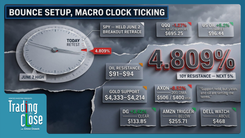
Currently, the high of that topping tail sits right around the 7,273 level on the S&P. Whether it happens today, tomorrow, or next week, a daily close above this specific threshold would erase the bearish implications of the tail. Furthermore, this topping tail occurred just above a major parallel channel. Historically, markets often pierce these upper boundaries—even closing above them on a daily or weekly basis—before ultimately reversing, a behavior we witnessed clearly during the 2022 bear market.
The Bifurcated Economy and Corporate "Stimulus"
While the S&P 500 digests its 15% run, the tech-heavy NASDAQ composite has posted an even more staggering 22% to 24% gain since March 30th, bringing it right to the upper band of its own larger parallel channel. This relentless upward momentum in the indices masks a deeply bifurcated economy—a market of distinct "haves and have-nots."
On Friday, the market will receive crucial jobs data, but the underlying health of the economy is currently being artificially supported by an unexpected source: Big Tech. The massive capital expenditure (CapEx) spending by giants like Microsoft, Meta, and Alphabet is functioning almost exactly like government stimulus. Hundreds of billions of dollars are flowing into the economy through AI infrastructure buildouts, keeping the broader economic ship afloat.
If these mega-cap companies ever decide to pull back on this spending, the underlying economic fragility will be exposed. We are already seeing this fragility in the earnings of the "have-nots." Companies like Shopify, PayPal, and Duolingo are all trading down on their earnings reports. The market is currently being carried on the back of the AI chip trade, and if that singular pillar falters, the downside risk for both the S&P and the NASDAQ is substantial.
The 10-Year Yield: The Market's Early Warning System
While retail investors remain fixated on the AI euphoria, professional strategists are keeping a watchful eye on the bond market. The 10-year Treasury yield closed yesterday around 4.44% and is currently down fractionally. However, the critical threshold to watch is 4.5%.
Many market participants have grown complacent regarding yields. When yields hit 4%, the market didn't care. At 4.25%, equities continued to rally. This has led to a dangerous assumption that yields no longer matter. But as Gareth poignantly noted:
"The bond market is basically the dog's nose sniffing out where there's trouble."
If the 10-year yield breaks out above 4.5%, it acts as a massive warning shot across the bow. Rising yields indicate that long-term expectations for inflation are accelerating. While the equity markets might ignore this in the short term due to AI hype, when the music finally stops, the cost of capital will matter immensely. For disciplined traders, these macro indicators must be factored into risk-reward models, even when the broader crowd is ignoring them.
Earnings Season Psychology: Waiting for Emotion
Earnings season is in full swing, providing a masterclass in how to trade volatility. The key to successfully trading earnings is understanding the relationship between price movement and human psychology.
Take Palantir, for example. The stock is down slightly on earnings but has essentially been chopping sideways in a tight range. For a day trader, this lack of significant movement translates to a lack of opportunity. Why? Because small moves don't trigger human emotion.
"Where there's emotion, there's opportunity," Gareth reminded viewers. When a stock makes a massive, violent move, retail traders panic sell or FOMO buy. This emotional overreaction pushes the asset away from its true equilibrium, creating a mispricing that technical traders can exploit.
We see this dynamic playing out in several other major names today:
Duolingo: The stock suffered a massive initial fall down to $93 before rallying sharply back to $106 all in the morning session. Because of this massive bounce, the risk-reward for an intraday long is no longer favorable at current levels. The disciplined approach is to wait for the stock to return to the $89 level before considering a day trade buy.
Shopify: Down significantly from its October highs of $180, Shopify is currently trading around $117.50 following its earnings report. While there is a gap fill at $115, this is considered a high-risk entry. Instead, the higher-probability setup lies lower down the chart. By connecting previous pivot lows, a strong buy zone emerges between $112.50 and $112.60, with a dollar-cost average (DCA) level identified at $109.30.
PayPal: The payments giant is getting slammed, dropping roughly 10% to trade around $45.50 in the pre-market. This drop completely invalidates the beautiful cup-and-handle bull flag the stock had previously formed. However, this panic creates a clear tradable level at $43.60. Looking left on the chart, this exact price point previously acted as heavy resistance before becoming firm support, making it an ideal technical bounce target.
The Semiconductor Frenzy: Echoes of the Dot-Com Era
The most fascinating aspect of the current market is the sheer verticality of the semiconductor and AI-related stocks. After the closing bell today, a slew of major players will report earnings, including AMD, Astera Labs (ALAB), Arista Networks (ANET), and Lumentum (LITE).
The price action in these names is historic. LITE, for instance, was a $150 stock just last October and has recently pierced the $1,000 mark. Seeing $50 billion to $500 billion companies make these types of vertical, parabolic moves is incredibly rare. For veteran traders, this price action is eerily reminiscent of the 1999/2000 dot-com bubble.
Take AMD as an example. The stock has been on a massive run. In a normal, rational market environment, a chart this extended would have a 75% probability of trading to the downside on earnings. However, because investors are currently willing to completely overlook ridiculous forward price-to-earnings multiples in the semiconductor space, the probabilities are skewed to a 50/50 coin toss.
Intel provides another fascinating technical study. The stock recently had a pierce of 100, driven by rumors that Apple might diversify away from Taiwan Semi. But the true technical marvel is a massive parallel channel that connects Intel's dot-com era highs all the way to its recent peaks. The stock pulled back perfectly off this multi-decade resistance level yesterday, proving that historical technical levels hold weight even decades later.
Conversely, we have SMCI, which has been severely beaten down amidst fraud allegations regarding the smuggling of restricted chips to China. Despite being in the hottest sector in the world, the overhang of illegal activity makes it a highly dangerous stock to buy, proving that fundamentals and news catalysts can still override sector momentum.
Bitcoin Hits the Target Zone and Commodity Divergences
Away from the equity markets, Bitcoin has achieved a massive technical milestone. The cryptocurrency has officially pierced $81,000, trading up to $81,600 and entering the exact target zone of $80,000 to $85,000 that Gareth mapped out back in February and March.
When Bitcoin was trading significantly lower, many market participants called for further downside. But as Gareth noted:
"The chart — until it tells me otherwise — is going to the upside."
Having reached this long-standing target zone, the disciplined move is to scale out. Gareth revealed he has unloaded roughly two-thirds of his shorter-term Bitcoin holdings, with plans to exit the remainder if the price reaches the $85,000 upper boundary. This is textbook trade management: identifying a target months in advance, waiting patiently for the asset to reach it, and systematically taking profits when the crowd is euphoric.
In the commodities sector, we are seeing fascinating divergences. Gold experienced a nasty sell-off yesterday and is currently chopping sideways, getting a small bounce today. The precious metal is trapped between major support at $3,900 and massive resistance at $5,000. Interestingly, gold is currently acting like a risk asset—going up when the NASDAQ goes up, and selling off when equities drop—yet it is not participating in the all-time highs seen in tech. Because the stock market is ridiculously overbought, this correlation gives gold a negative bias in the near term for swing traders, despite remaining a huge bull market in the long term.
Silver remains way off its $120 highs, hovering in a consolidation range. Meanwhile, Natural Gas had a significant breakout yesterday and is pausing today. For the bullish thesis to remain intact, natural gas must hold the previous breakout pivot highs at the $2.87 to $2.88 level.
Conclusion: The Discipline of Probabilities
As we navigate this bifurcated market, the lessons from today's analysis are clear. Whether it's waiting for Shopify to drop to $112.50, scaling out of Bitcoin at $81,600, or watching the 10-year yield approach 4.5%, successful trading requires an unwavering commitment to logic over hype.
The AI semiconductor trade is generating immense wealth, but it is also creating historic technical extensions that demand caution. By focusing on clear technical invalidation levels—like the 72.73 topping tail high on the S&P 500—traders can participate in the upside while maintaining strict risk management protocols.
In a market driven by emotion, rumors, and parabolic moves, your greatest edge is patience. Let the charts dictate your actions, wait for the high-probability setups to come to your levels, and never let the fear of missing out override your technical discipline.
Trading involves substantial risk. All content is for educational purposes only and should not be considered financial advice or recommendations to buy or sell any asset. Read full terms of service.