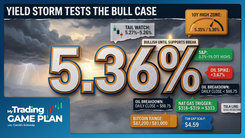

My Trading Game Plan Revealed - 05/22/2026: Relief Rally Tests Key Yields, Oil, and Tech Resistance

The financial markets are experiencing a notable relief rally this morning, driven by a crucial shift in macroeconomic headwinds. As geopolitical tensions show signs of temporary easing and bond yields pull back from critical resistance levels, equities are catching a much-needed tailwind. In today's edition of the My Trading Game Plan Revealed show, Verified Investing's Drew Dosek—stepping in for Chief Market Strategist Gareth Soloway—broke down the intricate technical setups across indices, commodities, and individual tech giants that are dictating this market environment.
For traders and investors, understanding the underlying mechanics of this bounce is paramount. Is this the resumption of a broader bull trend, or a temporary reprieve within a larger corrective phase? By stripping away the emotional narratives and focusing strictly on the charts, we can identify the high-probability zones that institutions are watching.
The Macro Foundation: Yields, Oil, and Geopolitics
To understand the current equity market bounce, one must first look at the bond and energy markets. Over the past several days, the primary source of pressure on risk assets has been the relentless climb of the 10-year Treasury yield, coupled with the threat of escalating conflicts in the Middle East. Overnight developments suggesting Iran may be willing to maintain its uranium enrichment below the United States' red line have injected a dose of optimism into the markets, causing U.S. oil to pull back 1.41%.
However, the most critical chart for equity bulls right now is the 10-year Treasury yield. After breaking above a long-term declining trendline, the yield is currently testing a massive area of contention.
"Whenever we have a push like what we've had in the past week, week and a half, that definitely puts stress on borrowing money. It puts stress on margins. And guys, it's going to put stress on future earnings reports," Dosek explained.
The technical setup on the 10-year yield is a masterclass in trendline analysis. By drawing a line from the October 2023 high to the January 2025 pivot, traders can see exactly where the battle lines are drawn. If the yield can reclaim and hold above 4.57%, the pressure on equities will likely resume. Conversely, a confirmed breakdown opens the door for a move down to the next major support level at 4.484%. This fractional difference in yield percentages translates to billions of dollars in institutional capital flows, making it the ultimate leading indicator for near-term market direction.
Similarly, U.S. oil is testing a vital support zone at $74 to $76. If geopolitical de-escalation continues and this support breaks, the next target lies significantly lower between $68 and $65. However, traders must remain vigilant; algorithmic trading programs are highly sensitive to geopolitical headlines. Should conflict resume, oil could violently spike to resistance at $83.50, followed by $87.00.
Broad Market Indices at a Technical Crossroads
The S&P 500 has responded positively to the retreating yields. After closing at 530.18 yesterday, the index pushed up to 532 in the morning session. However, this bounce is approaching a formidable technical ceiling. The SPY ETF faces a critical line in the sand—an inclining trendline dating back to February 2025 that connects to the October 2025 pivots. This trendline previously rejected price action on May 14, and today, it establishes heavy resistance at approximately $535.
The tech-heavy QQQ is painting a similar picture. After suffering a rejection inside its inclining parallel channel last week, it has drifted down to retest the bottom of that channel. Any upward push today will likely meet fierce resistance at $448.
What makes the current setup so fascinating is the psychological tug-of-war visible on the longer-term charts. Both the S&P 500 and the QQQ are currently forming what technical analysts refer to as a "weekly sleeper hold pattern." This is a complex topping formation that typically takes three to seven weeks to fully play out. While a strong close this week could put this bearish pattern on the warning track, it currently remains intact, implying that further downside could materialize next week.
Despite this looming bearish pattern, the weekly candles feature massive lower wicks.
"That tells me a lot of buyers are still willing to buy the dip. They're very anxious for any pullbacks illustrated right there on that weekly candle chart," Dosek noted.
This creates a dangerous environment for retail traders. The "buy the dip" muscle memory remains incredibly strong, but buying blindly into major overhead resistance while long-term topping patterns develop is a recipe for portfolio devastation.
Meanwhile, the small-cap Russell 2000 (IWM) is capitalizing on the drop in yields. After perfectly tagging the 50% median line of its parallel channel, the IWM has reclaimed its inclining trendline, flipping it into solid support at $203.94. If the risk-on sentiment holds, the next target is all-time high resistance at $209.43.
The Semiconductor Battlefield: Extreme Runs and Reversions
The semiconductor sector, tracked by the SMH ETF, remains the epicenter of market volatility. The historical context here is vital: whenever the SMH goes on a parabolic run of 230% or greater, it is almost universally followed by a severe reversion to the mean, typically resulting in a 30-40% or greater decline.
While the SMH hasn't quite tagged the 245% extension seen in the massive October 2022 through July 2024 run, it is precariously close to a major pivot point. The chart shows a clear double top formation, establishing heavy resistance at $240.58, followed closely by $241. Like the broader indices, the SMH weekly chart sports a massive wick, indicating that retail and institutional dip-buyers are fighting tooth and nail to prevent a rollover.
This sector-wide tension is perfectly encapsulated by the divergent price action between NVIDIA and smaller AI players.
NVIDIA, the undisputed behemoth of the AI data center space, is showing rare signs of technical vulnerability following its recent earnings report. Despite beating estimates, the stock sold off and closed underneath a critical inclining parallel channel that had supported the price since early May.
This is where technical discipline becomes mandatory. The line in the sand for NVIDIA today is yesterday's low of $142.24. If the stock closes below this level, the probability of a deeper correction skyrockets. The next immediate support sits at $141.73, but a break there opens a trapdoor down to the $128 level—representing a steep 10% drop. To negate this bearish breakdown, bulls must force a close back inside the parallel channel at $145.20.
Conversely, the market's appetite for AI remains ravenous when it comes to smaller, emerging players. APLD rocketed up 21% yesterday following news of a partnership with a new hyperscaler to increase AI data center capacity. Because APLD is an AI infrastructure company, the news of its $31 billion contracted hyperscaler lease milestone is a significant catalyst that can trigger massive algorithmic buying and short-covering. However, traders chasing this momentum must be aware of the technical boundaries: a pierce of the $20 level will likely trigger resistance, with the absolute top of the channel resting at $22.50. Should the stock retrace, support is established at $15.75.
Mega-Cap Tech Divergence: Google vs. Microsoft
The divergence in price action among the mega-cap tech giants provides a masterclass in why technical analysis must supersede fundamental news narratives.
Alphabet (Google) recently announced a major new AI-related partnership announcement. In a purely narrative-driven market, this news should have propelled the stock to new highs. Instead, the stock sold off, printing a textbook daily topping tail on the chart.
This phenomenon—where good news fails to lift a stock—is a classic hallmark of distribution. It suggests that large institutions used the retail liquidity generated by the positive headline to offload their positions. Google is now clinging to near-term support at $170.00. If this level fails, the chart points to a significant drop down to the major trendline support at $155.
Microsoft, on the other hand, is painting a much more constructive technical picture. After breaking out from a declining trendline, the stock executed a perfect technical retest of the bottom of its parallel channel, bounced, and is now engaged in bullish consolidation.
For Microsoft bulls, the trigger level is clearly defined. The stock needs to secure a daily close above $430 to break out of this consolidation phase. Once achieved, the initial target is $440 (the prior channel top), but the larger measured move points to a much higher target of $448, where it would re-attack the 50% median line of its larger parallel channel.
Commodities and Crypto: The Anatomy of Bearish Consolidation
While equities battle at resistance, the precious metals and cryptocurrency markets are exhibiting classic bearish consolidation patterns.
Gold has formed a near-term bear flag after its recent pullback. In technical analysis, when an asset drops sharply and then moves sideways rather than bouncing aggressively, it signals that sellers are simply reloading rather than retreating. The absolute line in the sand for gold bulls is $2,365.70. A breakdown from this flag pattern will likely trigger algorithmic selling down to the bottom of the inclining parallel channel at $2,280, with secondary support at $2,215.
Silver is tracing a similar pattern but is demonstrating slightly more relative strength by holding above its current support at $28.95. If the broader precious metals complex rolls over, silver's next support sits at $27.50. For long-term physical investors, a plunge into the 50% area of the larger parallel channel—between $24 and $22—represents a massive 50% discount from recent highs and a prime accumulation zone.
Bitcoin is mirroring the price action of the metals, consolidating sideways after a recent drop. It is currently catching support just above a previous consolidation range.
"This happens very often in charts, not only with cryptocurrency, but when price can come back down from a high, be looking at these areas, these nice little drop-down levels, and also the consolidation right on top. Generally, price likes to come right into that area, catch support, and potentially bounce," Dosek pointed out.
However, because the bounce has been anemic, the pattern remains a bearish consolidation. Until Bitcoin can generate an accelerated, high-volume move away from this pivot, the risk remains skewed to the downside, with the next major support level waiting at $65,000.
Finally, Natural Gas provides one of the most beautiful examples of long-term technical precision in the current market. The asset recently rallied sharply but was rejected exactly at the top of a long-term inclining parallel channel that dates back to February 2024. This channel flawlessly contained price action from lows of $1.60 all the way up to $5.30. Following the recent rejection, Natural Gas has pulled back to support at $2.90, with the top-end resistance remaining firm at $3.29.
The Discipline of the Chart
Today's market action perfectly encapsulates the core philosophy of Verified Investing: logic and charts beat hype and narratives every single time.
Whether it is Google selling off on seemingly stellar AI news, the S&P 500 fighting a multi-week topping pattern despite a relief rally, or the 10-year yield dictating the flow of trillions of dollars of global capital, the answers are always found in the price action.
The current environment demands extreme patience and discipline. With major indices pushing into heavy resistance and tech leaders like NVIDIA teetering on the edge of technical breakdowns, this is not the time for emotional, FOMO-driven trading. By mapping out these exact levels—from the $535 resistance on the SPY to the $430 breakout trigger on Microsoft—traders can remove emotion from the equation, manage their risk effectively, and wait for the market to come to their high-probability zones.
Trading involves substantial risk. All content is for educational purposes only and should not be considered financial advice or recommendations to buy or sell any asset. Read full terms of service.