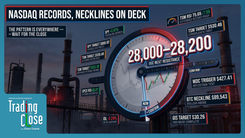

My Trading Game Plan Revealed - 05/26/2026: Algorithms Fuel Semiconductor Rally as Mega IPOs Propel Stocks

This market is not rallying on earnings or economic data. It is rallying on cross-asset triggers, headline risk, and institutional incentives. Crude oil is breaking lower, yields are testing a key pivot, and equities are responding exactly the way algorithmic flows would suggest.
In this morning's My Trading Game Plan show, Gareth Soloway, Chief Market Strategist at Verified Investing, broke down the chain reaction driving the move: oil weakness, bond-yield pressure, semiconductor momentum, and the looming incentive to keep sentiment elevated ahead of potential mega-IPOs. The result is a market that looks bullish on the surface, but is being held together by very specific levers.
The Algorithmic Engine: Oil, Yields, and Equities
The S&P 500 futures opened higher, looking to add about 50 points—a roughly 0.7% gain—following Friday's close at 7,473.47. While this pushes the index toward new higher highs, the real story is why this movement is occurring.
"The key to this market, you can say, oh, it's investor sentiment. Yes, it is. There's no doubt retail investors continue to pile in this market. But it's also a market that's based on institutional algorithms," Gareth explained.
These automated systems execute trades based on cross-asset correlations. Today's primary catalyst was a sharp drop in crude oil. On Friday, WTI crude oil broke a significant technical wedge pattern. By Monday, it had dropped roughly 7–8% intraday on Hormuz reopening hopes, trading down from Friday's close near $96.60 to around $89.
Lower oil cools inflation expectations. Cooler inflation pressure weighs on yields. Lower yields give equity algorithms permission to buy. That makes 4.5% on the 10-year yield the market’s immediate pressure point. Below it, equity bulls keep control. Above it, the rally becomes much more fragile.
Who Needs This Rally — and Why
The market is also trading against the backdrop of two potential mega-IPOs large enough to matter for broader sentiment. SpaceX is scheduled to begin trading June 12th, with Gareth citing a valuation of $1.75 trillion, while OpenAI is expected to follow later in 2026, with reports as of late May indicating it was preparing to file confidentially at a reported valuation of $852 billion to over $1 trillion.
When institutions underwrite IPOs of this magnitude, they require a euphoric broader market to ensure they can offload their shares to the public.
"Institutions need to keep investor sentiment extremely high, because they need the exit liquidity," Gareth warned. "When you're offering an IPO at $1.7 trillion, you can't just be like, oh, if the markets collapse and we go into a big bear market, no big deal… they literally have their reputations riding on this and tens of billions of dollars in profits."
The broader lesson is not that every IPO follows the same path. It is that retail traders need to understand who benefits when enthusiasm peaks around a major listing. Once the initial distribution window passes, price has to stand on its own.
Because of these looming mega-IPOs, Gareth suggests that a major market correction is unlikely in the immediate near term. Gareth argued that institutions have a strong incentive to keep sentiment elevated ahead of these offerings, including through aggressive upgrades and bullish market narratives.
Micron, Analyst Upgrades, and the Exit-Liquidity Question
The most glaring example of this institutional narrative-building can be seen in the semiconductor sector, specifically with Micron (MU). At the start of 2026, Micron was trading at $300. By Friday's close, it had reached $750. Today, the stock is opening sharply higher, trading around $813, representing a gain of roughly 171% from its early-2026 levels.
The catalyst for today's pre-market surge? UBS issued a new yearly price target of $1,625.
From a probability-based trading perspective, an upgrade that effectively doubles a stock's price after it has already run roughly 171% from early-2026 levels should trigger immediate skepticism. Gareth's point was not that Micron cannot trade higher. It was that traders should question the purpose of an upgrade that arrives after a stock has already gone vertical.
"To double, that screams institutions trying to push hysteria on retail investors to get exit liquidity… How do we unload 5 million shares of Micron without cracking the stock? Oh, I know. Let's give them a price target that's so much higher that even people buying at 1,000 or 800 will still think they're getting a good deal."
Professional traders look at the chart, not the headline. Elsewhere in the sector, Dell (DELL) has gone parabolic, closing Friday near $295 just below its 52-week high of $298. Gareth identified a critical logarithmic trend line of resistance around $330 that traders must watch closely. Meanwhile, Nvidia (NVDA) is seeing a small bounce after hitting a key trend line last week, though it has lost some of its post-earnings momentum.
A New Market Dynamic: Semiconductors as a Growth-Sector Safe Haven
Even at current oil levels near $89, with the potential to climb back toward $90–$100 if the Strait of Hormuz situation escalates, inflation remains a persistent threat. Traditional consumer-reliant businesses suffer as discretionary spending dries up. So, where is the safe money hiding? Semiconductors.
Gareth framed the shift with a simple question:: "If we're at $100 oil, is Google, Meta, Microsoft, Amazon, and the other players going to spend any less on CapEx for AI? Nope. If it's at $120 a barrel, will they spend any less? Nope."
The artificial intelligence arms race among mega-cap technology companies is entirely price-inelastic to crude oil. These tech behemoths view AI infrastructure as an existential necessity, regardless of macroeconomic pressures. In this cycle, semiconductors are trading like a growth-sector safe haven — because AI capex is viewed as less sensitive to oil-driven consumer pressure.
This sets up a straightforward rotation trade worth watching. If geopolitical tensions ease and oil prices collapse back down to $70 a barrel, we could actually see an exodus of capital from the semiconductor space as money rotates back into consumer cyclicals and small caps that benefit from lower energy costs.
Global Tech Dominance and Diverging Asset Classes
The semiconductor boom is not just a domestic phenomenon; it is reshaping global market capitalizations. In a stunning testament to the power of the chip industry, Taiwan's stock market capitalization now eclipses that of India. A small island nation has surpassed one of the world's most populous and rapidly developing countries, driven almost entirely by its dominance in semiconductor manufacturing.
This global tech euphoria is reflected in Asian indices as well. The Nikkei has reached new all-time highs, surging over 100% since its 2025 lows. Similarly, South Korea's Kospi has also seen a sharp rally since late March, reinforcing the global nature of the semiconductor-led risk bid.
Yet, while global equities soar, other asset classes are telling a very different story of divergence:
- Bitcoin: Despite the stock market sitting at all-time highs, Bitcoin is showing relative weakness. After catching a brief bid over the weekend, it was rejected and is currently trading below $77,000, failing to even reach five-day highs.
- Precious Metals: In a true risk-on environment, one might expect inflation hedges to catch a bid, but gold is trading flat and barely holding onto its support levels. Silver is actually forming a textbook bear flag pattern, suggesting further downside potential.
- Natural Gas: After taking profits on a successful trade last week, Gareth noted that natural gas is catching a small bid, but he remains on the sidelines waiting for a higher-probability setup.
The Psychology of Trading: Logic Over Narrative
Navigating a market characterized by 170%+ semiconductor runs, $1.75 trillion IPOs, and algorithmic reactions to geopolitical rumors requires a clear, disciplined mental framework. It is incredibly easy for retail traders to get swept up in the hysteria of a doubled price target or the FOMO of a market making new all-time highs.
This is where trader psychology becomes part of the setup. In a market built on narratives, upgrades, and automated triggers, discipline is not optional. Gareth's Verified Mindset course is built around exactly this kind of thinking.
"It is everything you need to train your brain to not get caught up in the nonsense, to see through the gray clouds, park them, see what's really going on," Gareth stated. "I still have my bad trades, but I can see exactly, and I know whether to stick with it. I don't get emotional about it."
When you understand that a price target upgrade to $1,625 on a stock trading at $813 is likely a mechanism to generate retail buying pressure, you stop reacting emotionally to the headline. When you understand that the 10-year yield testing 4.5% is the actual driver of the S&P 500's 50-point bounce, you stop guessing market direction and start trading the mathematical probabilities.
The Game Plan Moving Forward
As we progress through the trading week, the game plan requires strict adherence to technical levels and an awareness of the broader institutional chessboard.
Gareth’s watch list is clear: the 10-year yield at 4.5%, crude oil’s ability to stay below $92, and the S&P 500’s ability to defend its current range ahead of the SpaceX debut. If yields break lower and oil stays weak, algorithmic buyers have room to keep pressing equities higher. If oil reverses or yields reclaim control, the same machines that helped fuel the rally can quickly become the source of pressure.
The trade is not to chase Micron, Dell, or any semiconductor name because an analyst raised a target. The trade is to know the level before the headline hits. In this market, narrative creates the noise. Oil, yields, and price action tell traders what is real.
Trading involves substantial risk. All content is for educational purposes only and should not be considered financial advice or recommendations to buy or sell any asset. Read full terms of service.