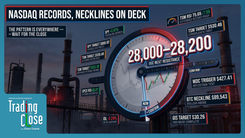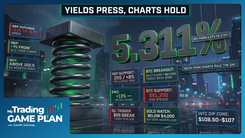

My Trading Game Plan Revealed - 05/29/2026: AI Boom, Oil Wedge Breakdown and VIX Complacency

The S&P 500 futures are pushing fractionally higher into new all-time highs this morning. The advance-decline line is poor. The VIX is sitting near 15. Oil just broke a wedge pattern after seven consecutive down days. And Q1 GDP grew at 2.0% annualized — but AI CapEx drove approximately 75% of that growth, meaning the underlying economy outside of AI infrastructure spending is growing at barely 0.5%.
That is the actual picture behind the all-time highs. One sector is holding everything together, and everything else is quietly breaking.
Oil: The Wedge That Was Already Written
About a week ago, a massive wedge pattern formed in crude oil. The geopolitical backdrop — US-Iran tensions, Strait of Hormuz uncertainty — had oil elevated and volatile. The chart was already telling a different story.
"Wedge patterns, folks, they work like compressors. So here's a wedge, and price stays between, and it gets crunched or pressurized more and more. And so the idea is that when it finally breaks, it has a lot of pressure — one way or the other, it's going to make a big move."
That pressure broke to the downside. Oil has now logged seven consecutive down days and is trading in the $87–89 range in pre-market — down sharply from the highs earlier this month. The technical setup is now pointing toward the $70 area as the next major target if the geopolitical situation resolves and the Strait reopens.
This is what technical analysis provides that news-watching cannot. By the time a Hormuz deal headline hits, the chart has already priced in the probability of that move. The wedge breakdown told traders where oil was going before the headline confirmed it.
If oil reaches $70, the inflation picture changes materially — energy prices come down, consumer pressure eases, and the case for the Fed to cut rates becomes cleaner. The whole macro sequence flows from this one breakdown.
The VIX Warning
The S&P 500 is making higher highs and higher lows. The immediate trend is intact. And yet the market internals are flashing a warning that is easy to miss when the index is printing new records.
The advance-decline line is remarkably poor for a market at all-time highs. Participation is narrow. And the VIX — sitting near 15 — is telling the same story.
"My general rule of thumb throughout my trading career is when the VIX gets below 15, that's when you have to start to be even more on alert. Anytime it gets between 10 and 15, at some point it spikes back to 30. When the VIX gets down to 15 or below, it means there's essentially no fear. It's a lot of complacency."
The 52-week range on the VIX is 13.38 to 35.30. The current reading near 15–16 is in the bottom 11th percentile of that range. Historically, these periods of extreme complacency are not stable — they are the conditions in which negative catalysts cause the most violent reactions. When everyone has stopped hedging and leverage is high, the exit is small and the move is fast.
The uptrend is intact until a lower low and lower high are established. But a VIX near 15 with poor advance-decline breadth at all-time highs is the market skating on thin ice. The conditions for a sharp correction are present. The catalyst has not arrived.
The AI Economy: Real, Stretched, and Alone
Q1 2026 GDP grew at 2.0% annualized. That sounds healthy. The breakdown is less reassuring.
AI CapEx — data centers, GPU clusters, power infrastructure, software buildout — accounted for approximately 75% of that 2.0% growth. Strip out AI infrastructure spending and the underlying economy is growing at barely 0.5%. The housing market is in its fifth consecutive quarter of contraction. Consumer spending is increasingly reliant on savings drawdowns and credit. The trade deficit widened sharply as imports surged.
"The economy is in such trouble and it's holding on by a hair because of CapEx spending by these AI players."
Dell Technologies is the clearest illustration of what this looks like at the stock level. Going into earnings, the stock had already run significantly. It looked technically overbought. It surged 33–40% on May 29 anyway — trading as high as $437–443 in pre-market before pulling back toward $420–423 — after reporting blowout Q1 results with AI server revenue skyrocketing and raising full-year guidance dramatically.
"Just because an AI stock looks overbought, it doesn't mean it has to come down."
Dell is up approximately 260% since early March. The stock entered completely uncharted territory on this move. When price has no historical resistance to reference, the only reliable markers are psychological round numbers — $400, $450, $500. Those are the levels where momentum traders and disciplined sellers interact in price discovery mode.
Amidst this AI euphoria, Microsoft stands out as the one mega-cap with a technically sound structure. The chart is forming an inverse head and shoulders pattern — which can also be read as a bull flag or cup and handle. Unlike most of the AI names, Microsoft's bullish posture is supported by the chart itself, not just by momentum and narrative.
Retailers Are Telling the Real Consumer Story
While trillions flow into AI infrastructure, the consumer is telling a different story through retail earnings.
Gap reported Q1 results after the close on May 28. Revenue came in at $3.5 billion — flat year over year and slightly below estimates — and the company lowered its full-year net sales growth outlook. The stock dropped approximately 14% in after-hours trading. The flagship Gap brand itself grew comparable sales 10%, but weakness at Old Navy and Banana Republic dragged the overall print. Gareth identified $20 as the technical level to watch for a potential day trade long — if price pierces that pivot, the setup becomes active.
American Eagle reported results on May 28 as well, beating EPS estimates and posting 9.7% revenue growth. But the guidance was cautious and the stock came under pressure pre-market. For traders watching the chart, there is a deep gap fill level at $13.60 — well below current trading — that represents the high-probability technical entry if the stock continues to weaken.
The pattern across discretionary retail is consistent: consumers are still spending, but the momentum is narrowing. High-income cohorts are holding up. Lower- and middle-income spending is under pressure from energy costs, credit tightening, and the cumulative weight of three years of elevated inflation. The AI companies building the data centers that are propping up GDP are simultaneously driving up electricity and water costs for the same consumers who are struggling to keep up. The infrastructure boom is not distributing its benefits evenly.
The Earnings Volatility Setups
Autodesk traded lower on earnings, failing to catch the software and AI bid that has lifted most of the sector. The chart reveals a day trade level around a historical pivot low — the kind of level where probabilities shift for a technical bounce rather than a continued breakdown.
Zscaler demonstrated this principle perfectly yesterday. After being hit hard on its own earnings, the stock snapped back approximately $10 — nearly 10% from low to high — as the cloud security sector caught a sympathy bid from Snowflake's blowout report. Identifying that the sector was technically oversold was the trade. The level was the entry.
AST SpaceMobile is showing elevated volatility today following recent aerospace sector news. The chart reveals a gap fill at $105.80 with a double pivot high sitting just below — a zone of technical confluence that day traders can use as a reference, provided risk management is tight given the stock's inherent volatility.
Bitcoin: The Line Holds — For Now
Bitcoin is approaching the 72,880–73,000 area — the same make-or-break level identified earlier this week. The asset faced rejection in the $80,000–$85,000 parallel channel zone and has been working lower since.
The question is unchanged: will it hold?
A confirmed close below this support zone activates the bear flag thesis. The technical damage from that breakdown would be severe, with the next major structural support well below current levels. This is the level the entire crypto market is watching — and given Bitcoin's track record of leading risk assets, it is the level broader equity traders should be watching too.
Being the Casino
The framework connecting all of these setups is the same.
"All we're doing is looking at those breadcrumbs, AKA probabilities, to give us the most likely outcome. That helps us make decisions that generally puts us to be the house or the casino versus the gambler."
Retail participants approach markets like slot machines — hoping a headline or earnings beat prints money on demand. Professional traders operate like the casino. They will lose some hands. They know that going in. What they have is a mathematical edge over a large enough sample of trades: the wedge breakdown in oil, the VIX complacency signal, the gap fill levels in retail stocks, the Bitcoin trend line.
The edge does not require certainty. It requires discipline. Not chasing Dell after a 260% run. Waiting for Gap to pierce $20. Accepting that the chart is the only source of objective truth available without insider information.
The AI boom is real. The valuations are stretched. The consumer underneath it is struggling. The VIX is near 15. And oil just broke a wedge pattern after seven consecutive down days.
The levels are defined. The trade is waiting for price to reach them.
What to Watch
- Oil $70 range — The wedge breakdown is confirmed. If a Hormuz deal materializes, the measured move target is the $70 area. Watch for price action below $85 as the next acceleration zone.
- VIX 15 — The complacency threshold. A VIX spike from these levels toward 25–30 has historically been sudden and violent. The trigger is unknown; the conditions are in place.
- Bitcoin 72,880–73,000 — The make-or-break level. Confirmed daily closes below this zone activate the bear flag thesis and have cross-asset implications for broader risk appetite.
- Dell $420 consolidation — After a 33–40% gap, watch whether Dell holds above the $420 area in the first full regular session. That is where the breakout becomes support or fails.
- Gap $20 pivot — Gareth's day trade trigger. The setup is active if price pierces that level.
- Microsoft inverse head and shoulders — The one technically sound mega-cap setup. Watch for a confirmed breakout from the pattern structure as the signal.
Trading involves substantial risk. All content is for educational purposes only and should not be considered financial advice or recommendations to buy or sell any asset. Read full terms of service.