
My Trading Game Plan Revealed - 06/03/2026: AI Mega-Cap Bubble, Nvidia Warning, S&P and Nasdaq Trend Lines

Oil is back above $95, geopolitical risk is rising, and market breadth remains weak. Under normal conditions, that combination would pressure equities. But this is not a normal tape. Right now, the AI trade is overpowering nearly every traditional macro signal—traditional correlations are being overwhelmed by a single dominant narrative—and Gareth Soloway warned this morning that this level of concentration creates both opportunity and serious risk.
In this morning’s My Trading Game Plan Revealed, Gareth Soloway, Chief Market Strategist at Verified Investing, broke down the staggering concentration of capital in artificial intelligence stocks, key technical levels on the S&P 500 and NASDAQ 100, and the underlying risks that could force a sharp repricing across the entire AI ecosystem. For traders trying to make sense of parabolic moves and shifting macroeconomic data, today’s analysis offered a clear technical roadmap.
The AI Concentration: A Historic Market Anomaly
To understand the current market dynamics, one must first understand where the money is flowing. Despite rising oil prices and global instability, the broader market remains hyper-focused on a single sector.
"The markets at this point don't care. I've been very clear on that in these game plans. The only thing that matters to this market is the AI trade," Gareth explained.
The sheer scale of this concentration is historically unprecedented. According to a proprietary concentration graphic Gareth reviewed during the show, the top 25 U.S.-listed AI stocks now account for $31.5 trillion in market capitalization. When measured against the total market cap of approximately $75 to $76 trillion, these 25 companies represent 41.6% of the entire market.
To put this into historical context, at the absolute height of the dot-com bubble in 2000—a period synonymous with speculative excess—the top tech names only accounted for about 37% of total market capitalization. We have officially surpassed the concentration levels of one of the most infamous financial bubbles in modern history.
This narrow breadth masks underlying weakness in the broader market. As Gareth pointed out, the advance-decline line shows more stocks falling than rising. If you were to remove these top 25 AI stocks from the S&P 500, the index would have a "goose egg" for the year—meaning zero positive returns.
However, recognizing a bubble and trading a bubble are two different psychological disciplines. "It doesn't mean that the bubble's ready to burst, by the way. We could continue up, and we could go to 50% of total market cap," Gareth cautioned. The takeaway for traders is not to blindly short the momentum, but to abandon the complacency of automatically buying every 1% pullback. Risk management is paramount when concentration reaches these extremes.
S&P 500 and NASDAQ 100: Critical Trend Lines
With the S&P 500 trading around the 7,600 level, looking to open down a mere 20 points, the index remains within striking distance of its highs. A 20-point drop on an index priced at 7,600 is mathematically insignificant, and the market could easily float positive intraday. However, the true technical battleground lies at a specific trend line.
Gareth highlighted a crucial support line originating from the market pullback triggered by the Iran war escalation, which previously sent oil spiking to $120 a barrel. Since that low, the S&P 500 has staged a beautiful rally, repeatedly returning to kiss this trend line. Over the last two consecutive days, price action has rested directly on this level. If this trend line breaks and holds, technical analysis suggests we could see multiple consecutive down days—a rarity in this current rally, which has only seen three consecutive down days once (and one of those was essentially flat).
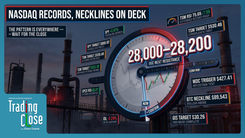
Meanwhile, the NASDAQ 100 (QQQ) is approaching a massive technical convergence on the logarithmic weekly chart. A trend line connecting the highs of 2022 is converging with a remarkable support line drawn from the bear market lows of late 2022 and early 2023. The QQQ is currently about 14 to 16 points below this convergence zone, representing a potential 2% to 3% move to the upside. When multi-year trend lines converge, they create formidable technical barriers that rarely break on the first attempt. Traders should monitor this 14 to 16-point upside target closely for potential exhaustion signals.
The 10-Year Yield and Economic Realities
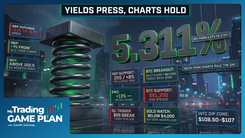
While AI dominates the headlines, the bond market is quietly flashing warning signs. The 10-year Treasury yield is pushing back up toward a critical technical and psychological threshold: 4.5%.
Earlier in the cycle, when the yield hit 4.5%, pulled back, kissed the level, and broke out, equity markets experienced hesitation. Conversely, when yields fell back below 4.5%, the stock market surged to new all-time highs. A daily close above 4.5% that sustains itself would likely reintroduce interest rate anxiety into equity valuations.
This yield movement occurs against a backdrop of mixed economic data. The ADP private sector employment report showed 108,000 and 18,000 jobs added, coming in very close to estimates. While inflation remains a "mess," the labor market is holding steady—neither growing rapidly nor shrinking. Because ADP is a private company, its data often provides a more accurate reflection of the labor market than the government's Nonfarm Payrolls report, which is due on Friday.
Parabolic Moves and Corporate Chess: MRVL, Google, and Microsoft
The individual stock action in the AI sector has transcended traditional valuation metrics, entering a phase of parabolic expansion that requires specialized technical tools to analyze.
Marvell Technology (MRVL) provided a textbook example of this mania. Following positive commentary from Nvidia CEO Jensen Huang—who suggested it could be the next $1 trillion name—MRVL exploded for a 35.5% gain, with pre-market action adding another 10% move on top. In just over two months from its March lows, MRVL has skyrocketed 270%, adding roughly $75 billion in market cap in essentially one trading day.
Gareth noted the necessity of using a logarithmic chart to analyze MRVL, as standard linear charts cannot properly display such vertical price action. He also pointed to recent political trading disclosures around AI-related names, arguing that the timing has added to the speculative atmosphere in the sector.
Another parabolic standout is Alab, an AI play with a $61 billion market cap that has run from $98 to $360 since March 30th. In previous eras, a $61 billion company was considered a massive large-cap stock. Today, it doesn't even crack the top 25 AI names, illustrating how the definition of "mega-cap" has been radically altered by trillions of dollars flowing into the market.
Alphabet’s Liquidity Timing and the Coming IPO Wave
One of the more pointed observations in today’s game plan involved Google (Alphabet) and the mechanics of market liquidity. Gareth discussed a major Alphabet financing headline—framing it as a sign of how capital-intensive the AI infrastructure race has become—and noted that the stock pulled into a potential day-trade gap fill level as a result.
The timing matters, Gareth argued. “Was it a coincidence that Google slash Alphabet offered $80 billion in shares to the public just before $3 trillion in IPOs are coming public? No,” he stated. Gareth framed the headline as a financing and liquidity event tied to AI infrastructure demand, with the broader point being that the AI race is becoming increasingly capital-intensive.
With massive entities like SpaceX, Anthropic, and OpenAI preparing to enter the public markets—bringing an estimated $3 trillion in new supply—liquidity could be drawn away from existing tech names. By moving now, Gareth argued, Alphabet smartly secured investor capital before these colossal IPOs hit the tape. When these new companies debut, they will likely join the top 25 AI stocks, potentially pushing the sector’s total market cap concentration toward 45% to 50%.
For day traders, Microsoft also presents an interesting setup. After correcting from its recent software relaxation trade rally, Microsoft is approaching a highly actionable zone. Gareth flagged a specific gap fill level as a prime area to watch for day trading opportunities.
Nvidia: The Canary in the Coal Mine?
Despite the broader market making new all-time highs, the undisputed king of the AI trade, Nvidia, showed a subtle but vital sign of relative weakness. Yesterday, the stock opened higher but failed to hold its gains.
More importantly, Gareth's technical eye spotted the potential early stages of a Head and Shoulders pattern forming on Nvidia's daily chart. While the right shoulder has not yet formed—meaning the pattern is unconfirmed—technicians must anticipate these setups. If Nvidia curls down over the next few days and completes the right shoulder, it would trigger a downside measured move target of 176, aligning perfectly with a parallel trend line. Given Nvidia's outsized weighting, a breakdown to 176 would send shockwaves through the entire S&P 500.
Crypto Capital Flight and Commodity Setups
The explosive moves in the stock market have had a direct, draining effect on the cryptocurrency space. Bitcoin recently suffered a massive two-day drop, bottoming out near the $65,000 support level that Gareth had precisely identified in previous sessions.
The psychology here is simple: why would retail and institutional speculators weather the volatility of crypto when traditional equities like MRVL and Alab are doubling and tripling in a matter of months? The stock market has effectively stolen crypto's momentum.
Technically, Bitcoin's current bounce from $65,000 is likely a "bounce-only best-case scenario." Unless Bitcoin can break back into its previous parallel channel, the former support line will now act as heavy resistance, likely leading to another leg down.
In the commodities sector, precious metals are flashing distinct technical signals. Silver continues to form a textbook bear flag pattern, suggesting a near-term measured move down to the $66 to $64 range. Gold, meanwhile, is experiencing a classic technical “sandwich,” trapped tightly between its 50-day and 200-day moving averages. As these two major moving averages converge, price compression increases, setting up the potential for a sharp move once price resolves.
The CapEx Assumption: What Could Break the AI Trade
Perhaps the most sobering part of today's analysis was Gareth's explanation of what could ultimately pop this historic bubble. The entire AI valuation model is built on the assumption of infinite, uninterrupted Capital Expenditure (CapEx) growth and perpetually expanding profit margins.
"If any of these AI companies ever come out and say, hey, this year, instead of spending $300 billion, we're going to spend $200 billion on CapEx, the markets would freak out," Gareth warned.
Gareth compared the setup to prior market episodes where concentration and crowded positioning made the tape vulnerable to a sharp repricing. In 1987, the market was highly concentrated, valuations were stretched, and a sudden shift in underlying mechanics (portfolio insurance) caused a violent repricing. The underlying mechanic today is CapEx. If the massive spending from tech giants slows down even slightly, the forward-looking earnings multiples of the entire AI ecosystem will collapse, bringing the broader indices down with them.
Conclusion: Trading the Probabilities, Not the Hype
The current market environment requires a delicate balance of technical discipline and psychological fortitude. We are witnessing a historic concentration of wealth in a single sector, driving stocks to parabolic heights while traditional safe havens and broad market breadth deteriorate.
As Gareth Soloway consistently argues, logic and charts must beat hype and narratives. Whether it’s waiting for Microsoft to reach its gap fill target, watching Nvidia for a confirmed Head and Shoulders breakdown to 176, or monitoring the 10-year yield’s battle at 4.5%, disciplined trading relies on letting the technicals dictate your actions.
The AI trade may continue to expand, potentially reaching 50% of the total market cap before the music stops. But by respecting key trend lines, understanding the macroeconomic backdrop, and maintaining strict risk management, traders can navigate this historic volatility and manage risk while remaining prepared for the next major shift.
Trading involves substantial risk. All content is for educational purposes only and should not be considered financial advice or recommendations to buy or sell any asset. Read full terms of service.