
My Trading Game Plan Revealed - 06/10/2026: Markets at a Crossroads: S&P and QQQ Breakdown Levels, Bitcoin 60K, Gold Selloff, SpaceX IPO Impact

The financial markets are navigating a stretch defined by sticky inflation, geopolitical escalation, and significant shifts in sector liquidity. As traders digest the latest macroeconomic data and prepare for one of the most consequential IPOs in recent memory, the technical charts are revealing critical levels that will determine the market's next directional move. In this morning's My Trading Game Plan Revealed, Gareth Soloway, Chief Market Strategist at Verified Investing, broke down the exact setups and thresholds that professional traders are watching right now.
The Macro Picture: CPI Relief and Geopolitical Stalemate
Today's market action was heavily influenced by the latest Consumer Price Index (CPI) data, which came in essentially in line with estimates. Headline inflation hit 4.2% year-over-year. In a vacuum, those numbers represent uncomfortably high inflation. However, the market's reaction — a pre-market push higher — illustrates a fundamental trading concept: markets trade on expectations, not absolute data.
"The CPI is horrendous, but the markets always have an expectation or a concern going into the numbers. And because it came in essentially in line with estimates, the markets are like, okay, we can deal with this," Gareth noted during the broadcast.
This relief-driven bounce is a classic market mechanism. When institutional investors brace for a worst-case scenario that fails to materialize, the subsequent short-covering can drive prices higher even if the underlying data remains problematic.
Adding to the macroeconomic backdrop is escalation in the Middle East. Yet West Texas Intermediate (WTI) crude oil saw only a fractional bounce, trading up roughly 83 cents to around $90 per barrel. From a technical and psychological standpoint, oil's inability to surge on direct geopolitical conflict suggests the market is already pricing in a diplomatic resolution. When an asset fails to rally on what should be bullish news, it is frequently a bearish signal for the underlying chart.
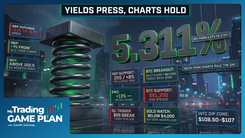
Meanwhile, the 10-year Treasury yield remains a key variable, hovering flat to slightly positive while holding above 4.5%. In bond markets, whole and half numbers carry significant psychological weight. A push toward the 5% level could intensify systematic and valuation-driven selling pressure in equities.
Technical Breakdown: The S&P 500, QQQ, and the "Stage 1" Warning
One of the most instructive technical lessons from today's analysis centered on the anatomy of a potential trend reversal in the S&P 500 and the Nasdaq 100 (QQQ). For months, the broader markets had maintained a textbook uptrend of higher highs and higher lows. Yesterday, that pattern showed its first crack.
The S&P 500 experienced a sharp flush, making a lower low intraday — but the nuance of how it made that low matters for probability. The index pierced the previous low intraday, then bounced and closed above it.
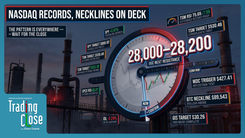
Gareth described this as a "Stage 1" bearish warning within his framework: meaningful, but not yet a confirmed breakdown. A daily close below a prior pivot low is the signal that trend-following algorithms use to shift from net-long to net-short. Because the S&P 500 and QQQ managed to defend their respective closing levels, the market remains in a state of suspended animation. For the QQQ, the line is clearly drawn at 695. With the index trading around 701.50, a daily close below 695 would materially increase the probability of a broader correction.
The SpaceX IPO adds another liquidity variable to this environment. Large offerings generally benefit from stable broader sentiment, and traders should consider whether capital being reserved for the debut is influencing positioning elsewhere. That does not prove institutions are collectively supporting the indices, but it adds useful context to the market's reluctance to break down decisively.
The SpaceX Vacuum and the Danger of AI Dilution
The impending SpaceX IPO is already affecting adjacent stocks. SpaceX shares are expected to be offered at $135, while a synthetic pre-IPO perpetual contract on Hyperliquid traded above $185 before retreating toward $155. That derivative reflects speculative expectations, not an official Nasdaq premarket price.
This concentration of capital is creating pressure in related names. AST SpaceMobile (ASTS), for example, has seen notable selling pressure. As Gareth observed, investors in ASTS appear to be taking profits to free up capital ahead of the SpaceX debut. For patient traders, this liquidity rotation creates an opportunity: ASTS has a compelling trendline and pivot confluence near the $70 level, making it a level to watch for a potential technical bounce once the SpaceX frenzy subsides.
The most significant corporate action of the day belongs to Super Micro Computer (SMCI). The stock dropped 7.6% yesterday and was falling another 12% today after the company announced a large financing plan that includes common stock, equity-linked depositary shares, and a later at-the-market offering. The financing introduces substantial potential dilution, particularly through the common-stock and equity-linked components, against a total market cap of approximately $43 billion.
This highlights a growing systemic pressure in the AI sector: the debt and dilution required to fund infrastructure build-out. Companies are taking on significant liabilities with the expectation that future AI cash flows will justify the expense. If those returns fail to materialize, the sector could face a meaningful reckoning.
Technically, SMCI is trading right at support near $35.50, having hit a premarket low of $35.47. Because the stock has already tested this level, its structural integrity is weakened. An aggressive day-trade entry sits lower at a gap-fill level of $33.45. If that level fails, the chart opens up toward $30.
Earnings Roulette and the Post-WWDC Apple Slump
Earnings season remains a minefield, and today's analysis reinforced the importance of capital preservation over speculative positioning around unknowable outcomes. Oracle (ORCL) is set to report after the bell. After bouncing from $135 to $250, the stock has retraced to trade around $200. There is an intraday gap-fill level at $191 that could serve as a day-trading bounce reference, but holding through the earnings release itself is a different calculation.
"I do not intend to hold this long or short into earnings, though. Let me be crystal clear on that. There's just too much unknowns," Gareth said. Earnings reactions are frequently disconnected from headline beats. A company can top estimates on both lines and still gap down 15% on a single line in forward guidance.
Chewy (CHWY) reported earnings and continues to trade near 52-week lows. For swing traders, the patience to wait for defined levels is the edge. There is a large unfilled gap near $16.85 that presents a potential bounce zone if selling pressure persists.
Apple (AAPL) is working through a classic "buy the rumor, sell the news" setup following a WWDC conference that failed to meet elevated expectations. The stock was near $317 two days ago before pulling back sharply to test support at $288. Currently trading around $290, the stock has shed more than 10% in a matter of days.
If Apple can hold this zone, a technical bounce toward $300 is viable. If the $288 support breaks, Gareth's framework points toward $270 as the next meaningful level.
Commodities at a Crossroads: Precious Metals Under Pressure
One of the more notable calls discussed in today's show was the technical breakdown in precious metals. Despite persistent bullish narratives around gold and silver heading into late 2025 and early 2026, the charts had been flashing warning signs for weeks.
"As much as I'm a long-term bull, gold was telling me, silver was telling me it was going down," Gareth said.
The trigger for gold's current slide was a decisive break below its 200-day moving average — one of the market's most widely watched long-term trend indicators. Once that level broke, selling accelerated. Gold is now approaching critical support at $4,100, roughly $38 to $39 from current intraday levels.
If $4,100 fails, Gareth's technical framework points toward the $3,600–$3,500 range as the next meaningful floor.
Silver is facing a similarly significant setup. The metal is testing a multi-month support level, and if that floor gives way, Gareth's measured target points toward $54 per ounce, with potential to flush below $50.
These setups align with a core principle of probability-based trading: price action takes precedence over narrative. For patient capital, a sustained flush could eventually create an asymmetric buying opportunity — but only once the charts confirm a base, not before.
In energy, natural gas continues to face resistance from its 200-day moving average, which is acting as a ceiling near $3.43. Until price action can close decisively above that level, natural gas offers limited technical edge for swing traders.
Bitcoin's Line in the Sand
The cryptocurrency market is in a holding pattern. Bitcoin is trading flat to slightly negative, but has formed a compelling "inside bar" pattern on the daily chart — a setup where the day's entire range falls within the prior session's high and low. Because Bitcoin has not yet closed below its recent reversal candle, the setup retains a cautiously bullish bias.
However, macro levels dictate the flow of leveraged capital in crypto.
"The only thing you care about on Bitcoin is the 60,000 level. You do not want to see close with confirmation below that. If that happens, we're headed to 50,000," Gareth warned.
The $60,000 level is the psychological and technical anchor of the current cycle. A confirmed breakdown below it could increase liquidation pressure across leveraged crypto markets and bring $50,000 into focus. Until that confirmation arrives, the bulls retain the benefit of the doubt.
The Discipline of the Chart
Today's market does not require traders to predict the next major move. It requires them to define the levels that would confirm it.
A QQQ close below 695, an SMCI break beneath $33.45, gold losing $4,100, or Bitcoin closing below $60,000 would each materially change the corresponding setup. Until those confirmations arrive, patience remains part of the strategy.
Define the level, understand the risk, and let the close determine whether the trade is real.
Trading involves substantial risk. All content is for educational purposes only and should not be considered financial advice or recommendations to buy or sell any asset. Read full terms of service.